

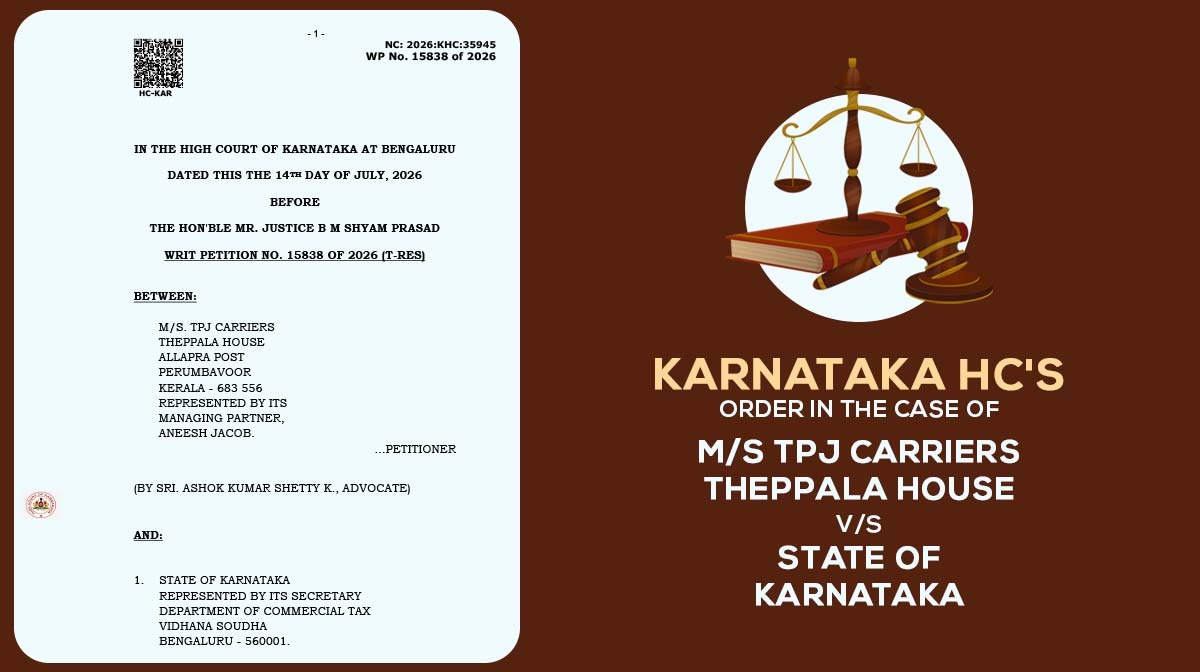
The Karnataka High Court has decided that if goods are seized, they can be sold under certain tax laws if the owner does not come forward to claim them. This sale can happen after the owner is given proper notice about the situation, which will be published publicly. If the owner chooses not to respond or seek a way to challenge the seizure, the goods can be sold.
The applicant, M/s. TPJ Carriers is the owner of a 14-wheeler tanker hired by M/s. SVP Petro Products for transporting bulk bitumen. The State GST Authorities intercepted the vehicle after which orders were passed u/s 129(3) of the Central Goods and Services Tax Act, 2017/State Goods and Services Tax Act, 2017, levying a penalty of Rs. 23,86,590.
The applicant is a transporter which claimed entitlement to release the vehicle upon payment of Rs 1,00,000, being the lesser amount contemplated under the first provision of section 129(6). Therefore, the applicant deposited Rs 1,00,000.
The applicant’s counsel, Ashok Kumar Shetty K., said that the penalty order was issued nearly two and a half months ago, but the authorities have not taken any action to sell the goods. Additional Government Advocate K. Hema Kumar said that the seized goods have not been brought to the sale because the appeal time may not have lapsed.
Section129(3) of the Central Goods and Services Tax Act specifies that the proper officer detaining or seizing goods or conveyances u/s 129 shall provide a notice citing the tax and penalty payable and, afterward, pass an order deciding the tax amount and penalty payable. The provision aims to ensure that any liability resulting from the detention or seizure of goods is formally determined before proceeding with their release or disposal.
Read Also: Delhi High Court: Section 129 CGST Act Cannot Penalize Minor GST E-Way Bill Errors
Justice B M Shyam Prasad said that “On careful consideration of all the circumstances, this Court is of the view that the authorities must act under the proviso to Section 129(6) of the Act for sale of the seized goods after taking out due notice and if the owner of the seized goods [the owner] does not avail the appellate remedy despite publication of such notice. The authorities, while taking out notice for sale, must also ensure that a copy is served in due course to the consignor.”
The Court stated that the statute requires authorities to act within fifteen days. In cases involving goods that are perishable, hazardous, or likely to lose value, they must be sold even sooner. In this case, the bench observed that the seized goods were clearly inflammable and hazardous, posing a risk of damage to the conveyance.
Similar: Common Show Cause Notice for Multiple Tax Periods Valid Under GST Law: Karnataka HC
The court disposed of the writ petition of the GST authorities and asked them to act in exercise of the powers under the proviso to Section 129(6) of the KSGST/CGST Act to bring the goods to sale, issuing public notice of sale, causing notice thereof to the owner at the earliest and in any event within five weeks from the date of judgment.
| Case Title | M/S TPJ Carriers Theppala House Vs State of Karnataka |
| Case No. | Writ Petition No. 15838 of 2026 (T-RES) |
| For Petitioner | Sri. Ashok Kumar Shetty K., Advocate |
| For Respondent | Sri.K. Hema Kumar., AGA |
| Karnataka High Court | Read Order |