

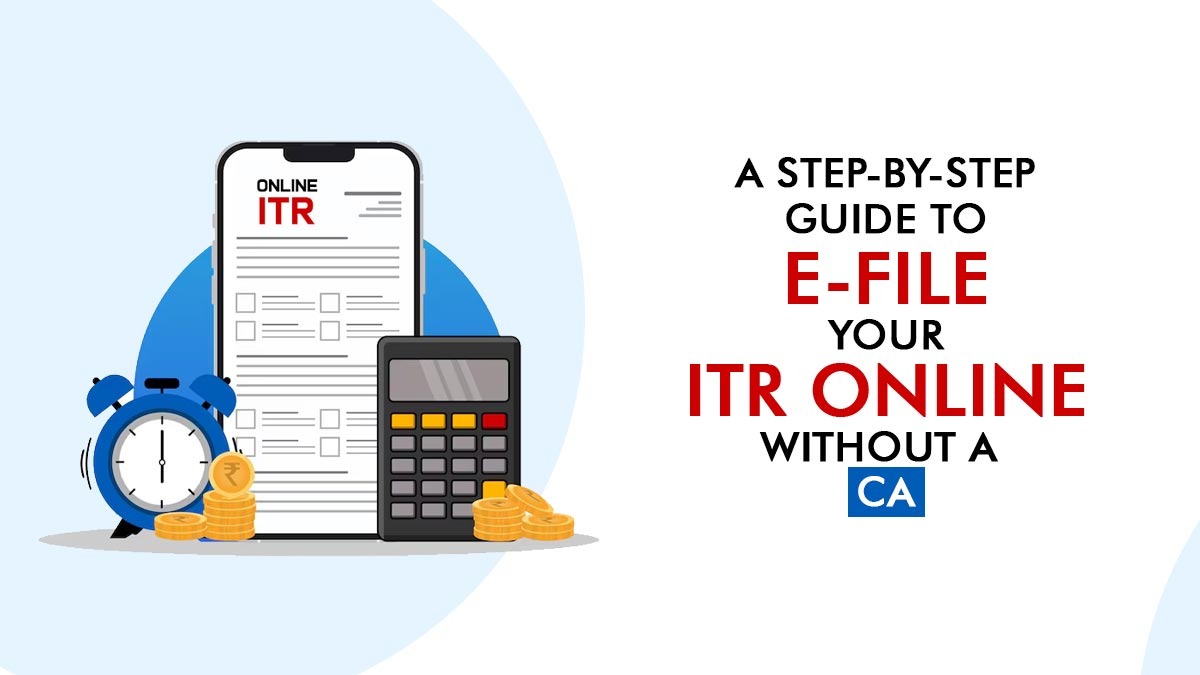
First-time ITR filing can be difficult. People think that hiring a chartered accountant (CA) is a perfect way to get it right. Self-filing has become a practical option for taxpayers with salary and interest income.
The online portal of the Income Tax Department has made self-filing accessible, while various income tax return filing software has made it streamlined. You can file an ITR on your own if you have no financial complications, are salaried, freelance, or run a small business, eliminating the need for a CA.
This blog focuses on the eligibility to file ITR without a CA, the filing procedure, and mistakes to avoid when filing.
How Can You File Your ITR Without a CA?
Yes, but within some conditions, such as when your earnings are from salary, bank interest, a single house property, or basic investments, filing your own ITR can be seamless. The online process has updated over time, and effective ITR software assists you in every step.
Now, most of the tools can compute your tax automatically, help you choose the correct ITR form, catches errors before your submission.
Nevertheless, if your financial affairs involve multiple businesses, foreign assets, audits, or any truly complex matters, it would still be beneficial to seek advice from a Chartered Accountant (CA).
If you understand your income, deductions, tax regime, and applicable ITR requirements, and your tax affairs are fairly straightforward, you can generally file your ITR yourself.
Why Indian Taxpayers are Choosing to File Their ITRs on Their Own
In cities like Ahmedabad, Mumbai, Bengaluru, Pune, Delhi, and Hyderabad, self-filing has become common. This shift is driven by-
- The online process is simpler
- Multiple E-verification
- Pre-filled income data
- Increasing digital convenience
- Budget-friendly software
Instead of visiting for tax consultation, people are now managing their filing online in an hour via phone or laptop.
How ITR Software Makes Tax Filing Easier for Taxpayers
Effective software facilitates the tough operations of tax filing and helps you avoid errors. Most platforms can provide you with-
- JSON File Prefill Import
- Form 26AS, AIS and TIS Import
- Accurate form selection
- Fast online income tax return filing
- Digital record-keeping
- Form 26AS and AIS matching
- Form 16 import
- Automatic tax computation
- Tax deduction suggestions
- Pre-submission error reviews
For those filing their returns for the first time, these small details prove to be truly helpful in getting everything right on the very first attempt.
Simple Steps to File ITR Online Without CA
Once you know the steps, filing doesn’t seem so daunting. Generally, the process works like this.
Step 1: Collect All Needed Documents
Start by accumulating your paperwork. You might require-
- PAN and Aadhaar card
- Form 16
- Salary slips and Bank statements
- Loan and TDS certificates
- Interest certificates
- Form 26AS and AIS
- Investment proofs
- Health insurance premium documents
- Capital gains statements, where useful
- Last year’s ITR/acknowledgement, if applicable
Step 2: Choose the Right ITR Form
Not all the taxpayer uses the same form
| Taxpayer | ITR Form |
|---|---|
| Individuals with salary, pension, one or two house properties, other income sources and specified capital gains subject to applicable conditions | ITR 1 |
| Individuals or HUFs without business or professional income, including those with capital gains and certain other income | ITR 2 |
| Individuals or HUFs earning business or professional income covered under ITR 3 | ITR 3 |
| Eligible individuals or HUFs selecting presumptive taxation under relevant provisions | ITR 4 |
Step 3: Enter Details of Your Income
Add all your income sources. It includes-
- Salary income
- Rental income
- Bank and FD interest
- Capital gains and Other taxable income
Many platforms allow you to import this directly from Form 16 or pre-filled government data, so you don’t have to type everything manually.
Step 4: Claim Applicable Tax Deductions
You must not overlook this, as this is where you start saving money. The deductions and exemptions availability relied on the applicable tax regime and the taxpayer’s eligibility. Before finalising your return, compare the old and new tax regimes. The common ones are-
- Section 80C and Section 80D
- NPS contributions and Home loan interest
- Section 80G contributions
By using the right deductions, you can actually reduce your payment amount.
Step 5: Review All Details Before Submission
You must verify before tapping on the Submit button. The following things need to be verified-
- PAN and Aadhaar number
- Personal and Bank account information
- Income information and amount of tax deductions
- Amount of refund and payable
An efficient ITR filing software can determine common data-entry, calculation, and validation errors prior to the submission of the return.
Step 6: Submit and Verify Your Income Tax Return Filing
If all the things are accurate, then tap Submit. Now you need to do an e-verification via-
- Aadhaar OTP
- Net Banking
- Bank ATM EVC
- Bank and Demat Account EVC
- Digital Signature Certificate (DSC)
E-verification is important, as it has some serious consequences.
When Do You Need a CA for ITR Filing?
Many people handle the filing themselves, but there are instances where a Chartered Accountant (CA) is well worth the fee. If you find yourself in any of the following situations, consider seeking a CA’s assistance:
- Income Tax notice
- Foreign income or assets
- Crypto transactions
- Several income sources
- Numerous companies
- Tax audit needs
- Complicated capital gains
- Complex or high-volume securities transactions
- Important tax planning conditions
Common ITR Filing Mistakes to Avoid
Software does most of the work, but mistakes do happen with people. The following things should be taken care of.
- Incorrect ITR form
- Wrong PAN or bank details
- Missing the ITR filing deadline
- Forget E-verification
- Missed bank interest income
- Tax deductions without proof
- Selecting the wrong tax regime
- Forgetting Form 26AS or AIS
- Failing to reconcile income with AIS or 26AS
Simple Tips for Hassle-Free ITR Filing
The following habits will make your filing season streamlined
- File before the due date
- Always save digital copies
- Match income with AIS
- Double-check every tax deduction
- Select updated software
- Save a copy of your income tax return
Closure: Now, ITR filing is not as difficult without a CA as it was in earlier times. Most Indian taxpayers can file ITR on their own if they have their documents in order, a decent understanding of income, and trustworthy ITR filing software.
Financial situations indeed vary for everyone. If your case involves business income, overseas assets, or other complex matters, it would still be beneficial to seek professional advice.