

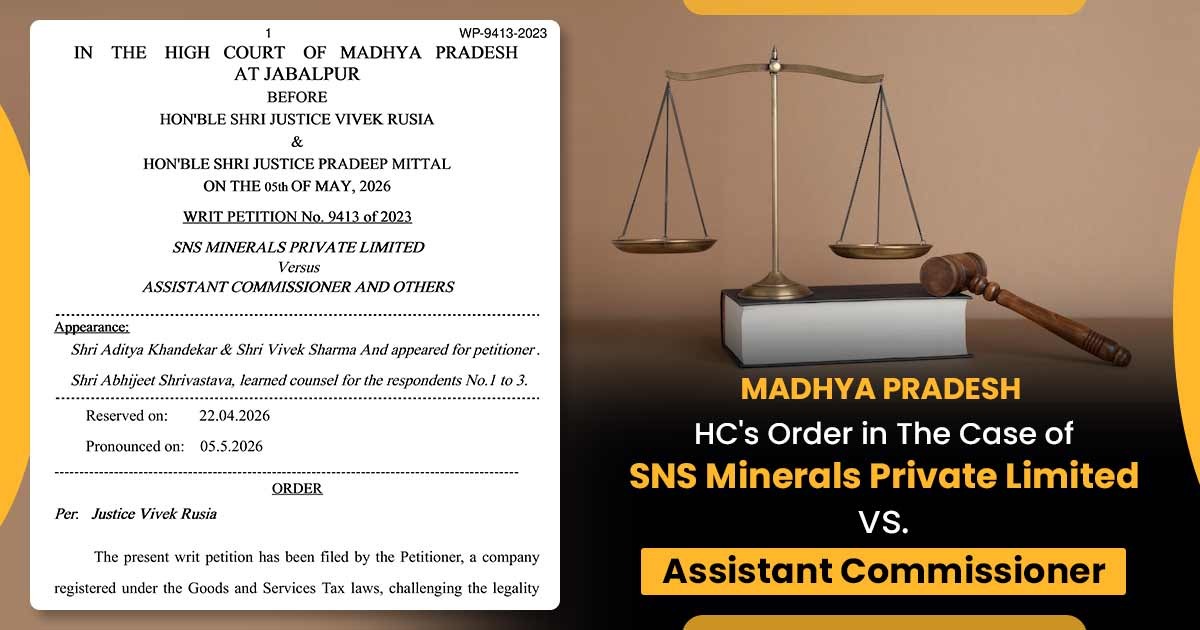
The Madhya Pradesh High Court dismissed the writ petition filed by SNS Minerals Private Limited, observing that once the Goods and Services Tax Appellate Tribunal (GSTAT) has been constituted and is operational, disputes arising under the GST law should ordinarily be resolved through the statutory appellate mechanism.
A Division Bench comprising Justice Vivek Rusia and Justice Pradeep Mittal granted the taxpayer liberty to pursue an appeal before the GST Appellate Tribunal against the appellate order that had set aside a GST refund of ₹84.26 lakh.
The applicant is involved in mining and the supply of limestone. He had filed an 18% GST on royalty under the reverse charge mechanism in the period from April 2018 to December 2018, while its outward supplies were charged to tax at 5%.
It asked for the refund under Section 54(3) of the CGST Act due to the accumulation of excess input tax. However, the refund claim was not considered; thereafter, the Appellate Authority permitted the appeal and directed the grant of a refund. As per the appellate order, the refund of Rs. 84.26 lakh was sanctioned and disbursed.
Hence, the department began review proceedings and contested the refund sanction order. The appellate authority permitted the appeal of the department and overturned the refund granted to the applicant.
The taxpayer was not satisfied with this development, and thus it approached the HC claiming that the earlier appellate order had reached finality and could not be indirectly reopened via subsequent proceedings.
The applicant before the HC claimed that the appellate authority had analysed its own earlier order, which was not allowable in law.
It stated that since the department had never contested the earlier appellate order before a higher forum, it had become final and binding. The parallel recovery proceedings began u/s 73 of the CGST Act had mistreated the procedure, the applicant added.
“Once the special statutory forum has been established by the government, the High Court should not entertain the petition and relegate the parties to avail the forum, especially constituted to address their grievances.”
Meanwhile, the revenue maintained that the refund sanction order was erroneous and prejudicial to the interests of the Revenue. It stated that the statutory scheme allowed review and contest of these orders and that the applicant had been furnished with a chance of hearing during the proceedings.
The Court, putting reliance on the decision of the Supreme Court in Whirlpool Corporation vs. Registrar of Trade Marks and Radha Krishan Industries vs. State of H.P., stated that writ jurisdiction must ordinarily not be practised where an effective statutory remedy exists, except in exceptional circumstances such as breach of natural justice, lack of jurisdiction, enforcement of fundamental rights, or challenge to the vires of a statute.
“When a right is created by a statute, which itself prescribes the remedy or procedure for enforcing the right or liability, resort must be had to that particular statutory remedy before invoking the discretionary remedy under Article 226 of the Constitution.”
Read Also: MP HC: Taxpayers Must First Pursue GST Appellate Tribunal Appeals Before Invoking Writ Jurisdiction
The High Court, after determining that there are no recognised exceptions to the rule of alternate remedy attracted in the current matter, refused to analyse the merits of the dispute.
Therefore, the writ petition was dismissed with a chance for the applicant to file an appeal before the GST appellate tribunal. The Court also determined that the interim protection already operating in favour of the applicant shall continue until the tribunal determines its stay application.
| Case Title | SNS Minerals Private Limited vs. Assistant Commissioner |
| Case No. | No. 9413 of 2023 |
| For The Petitioner | Shri Aditya Khandekar and Shri Vivek Sharma |
| For The Respondents | Shri Abhijeet Shrivastava |
| Madhya Pradesh High Court | Read Order |