

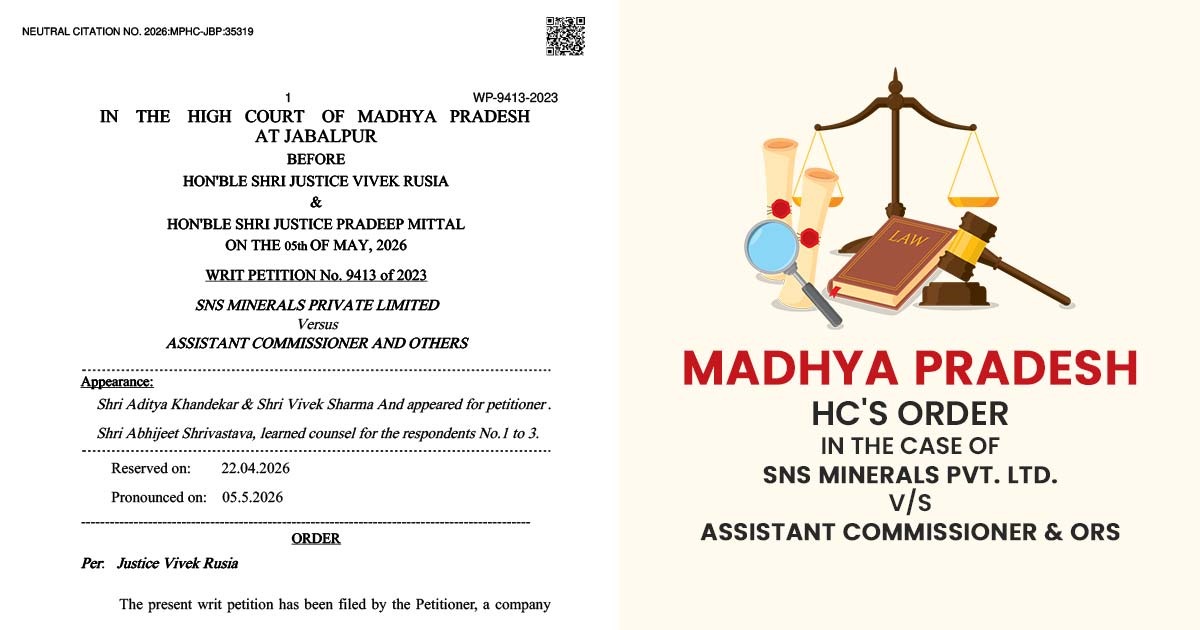
The Madhya Pradesh High Court has held that once the Goods and Services Tax Appellate Tribunal (GSTAT) is constituted and becomes operational, parties should ordinarily pursue the statutory appellate remedy before the Tribunal rather than invoke the High Court’s writ jurisdiction.
A division bench of Justice Vivek Rusia and Justice Pradeep Mittal dismissed a writ petition of SNS Minerals Pvt. Ltd. contesting an appellate order that had set aside a GST refund of Rs 84.26 lakh given to the company. However, the Court has granted liberty to the company to file an appeal before the GST Appellate Tribunal.
The court stated, “Once the special statutory forum has been established by the government, the High Court should not entertain the petition and relegate the parties to avail the forum, especially constituted to address their grievances.”
The issue has arisen from a refund claim of Rs 84.26 lakh filed by SNS Minerals, a company engaged in the business of mining and supplying limestone.
The adjudicating authority initially rejected the claimed refund.
The challenge to the company has arisen from a refund claim of nearly Rs 84.27 lakh. On the claim’s rejection, SNS Minerals succeeded before the appellate authority, which set aside the rejection order on May 20, 2021. After the same decision, the refund was sanctioned and paid to the company.
Read Also: GST Tribunal Appeals Hit by Portal Glitches Despite Deadline Extension
After that, the department contested the order sanctioning the refund. The appellate authority, on February 17, 2023, permitted the appeal of the department and set aside the refund that had earlier been granted.
Before the High Court, SNS Minerals argued that the appellate authority had effectively reexamined an issue it had previously decided in the company’s favour in May 2021. The company contended that this earlier order had attained finality, as it was never contested in a higher forum.
SNS Minerals argued that the refund sanction order was simply an outcome of that earlier appellate decision and should not be used as a means to reopen or overturn it.
The Court observed that the writ petition had been filed in 2023 at the time of the non-establishment of the GST appellate tribunal. The petition had been entertained on that ground.
The GST Appellate Tribunal had already been established and had started functioning in Madhya Pradesh, the Court noted.
The Bench ruled that all regulatory reasons of the applicant and the respondents in support of the impugned action could be regarded by the GST appellate tribunal.
Relying on the Supreme Court’s decisions in Whirlpool Corporation v. Registrar of Trade Marks and Radha Krishan Industries v. State of H.P., the Court repeated that a writ petition shall ordinarily not be entertained where an alternative remedy is present, except in recognised situations.
The Court determined that the applicant was not alleging a breach of the principles of natural justice, nor was he contesting the authority’s competence to issue the Show Cause Notice (SCN) or to decide the appeal. Additionally, the petitioner was not contesting the constitutional validity of any statute.
The Bench said that, “Therefore, in the circumstances, the remedy of writ petition cannot be permitted to be availed by passing the statutory remedy of appeal before the GST Appellate Tribunal. Once the GST Appellate Tribunal has been established, then the legal objection or grounds under the GST laws raised in this writ petition are liable to be appreciated by the learned Tribunal.”
Subsequently, the Court dismissed the writ petition with the chance to submit a plea before the GST Appellate Tribunal. It ruled that the interim relief available for the applicant shall continue till the application for stay is determined by the Tribunal.
| Case Title | SNS Minerals Pvt. Ltd. vs. Assistant Commissioner & Ors |
| Case No. | No. 9413 of 2023 |
| For the Petitioner | Shri Aditya Khandekar & Shri Vivek Sharma |
| For The Respondent | Shri Abhijeet Shrivastava |
| Madhya Pradesh High Court | Read Order |