

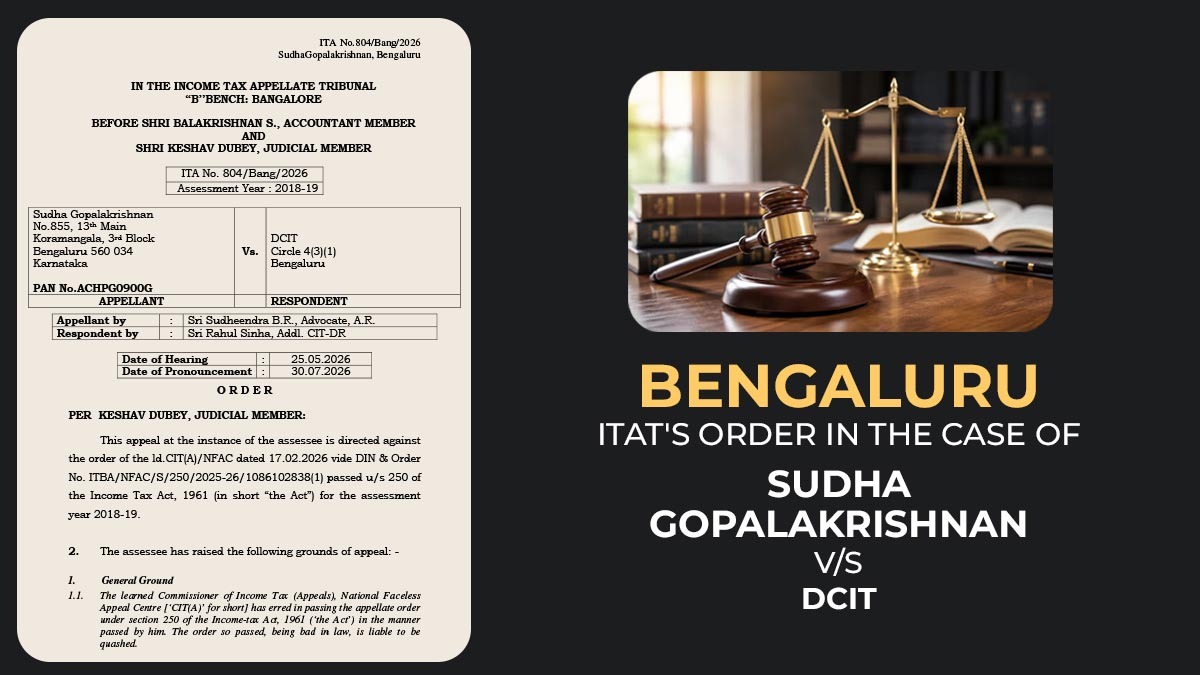
The Income Tax Appellate Tribunal (ITAT), Bengaluru Bench, has held that the Income Tax Department cannot create a fresh tax demand through a computation sheet or Section 156 notice of demand when the underlying assessment order accepts the returned income in full without any additions or disallowances.
The bench of Keshav Dubey (Judicial Member) and Balakrishnan S. (Accountant Member) asked the Assessing Officer (AO) to remove the tax demand of ₹24.90 lakh raised against the taxpayer, holding that such a demand was not lawfully sustainable.
The appeal arose from the assessment of an individual taxpayer for the AY 2018-19. Initially, the taxpayer had submitted her ITR on August 17, 2018, and therefore submitted a revised return on March 29, 2019, showing a total income of Rs 145.29 crore.
The revised return consists of income leviable at special rates, such as long-term capital gains, short-term capital gains, and dividend income taxable u/s 115BBDA. The tax obligation was calculated accordingly, and the taxes were duly remitted.
The revised tax return was processed u/s 143(1). The Centralised Processing Centre (CPC) accepted the reported income but raised a minor demand of ₹43,880 due to discrepancies in the calculation of interest under Sections 234B and 234C. The assessee paid this demand in June 2019.
Later, the case was selected for scrutiny under the e-assessment scheme, focusing on deductions claimed under Chapter VI-A. After reviewing the taxpayer’s submissions, the Assessing Officer completed the scrutiny assessment u/s 143(3), in conjunction with Sections 143(3A) and 143(3B), on January 1, 2021. The Officer accepted the income reported by the assessee without making any additions or modifications.
The assessment order accepted the reported income in full; however, the accompanying computation sheet and the notice of demand u/s 156 unexpectedly indicated a new tax demand of ₹24.90 lakh.
This additional demand included ₹14,806 for differences in tax, surcharge, and cess on special income, and ₹24.75 lakh, which primarily stemmed from increased interest under Sections 234A and 234B.
The assessee contended that neither the assessment order nor its reasoning provided any basis for the additional liability. The taxpayer argued that the computation sheet created fresh demands for tax and interest without any corresponding findings or additions in the assessment order.
The taxpayer contested the demand before the Commissioner of Income Tax (Appeals) through the National Faceless Appeal Centre (NFAC). The CIT(A) quashed the appeal without analysing the merits after recording that the taxpayer did not respond to multiple hearing notices.
Afterwards, the taxpayer approached the ITAT.
Before the tribunal, the taxpayer claimed that the additional tax computation shows an error evident on record. It was claimed that the assessment order considered the returned income entirely and thus did not explain any additional tax demand.
There is no explanation of the extra tax, surcharge and cess of ₹14,806 in the assessment order. Interest u/s 234A was incorrectly charged despite the original return having been filed within the specified deadline.
U/s 234B, additional interest does not have legal justification since it had already been correctly calculated in the earlier intimation issued u/s 143(1).
The Tribunal analysed the assessment records and observed that both the CPC while processing the return u/s 143(1), and the Assessing Officer during scrutiny had accepted the income reported by the taxpayer.
The Bench said that even after this, a demand of Rs 24.90 lakh has been raised mechanically by the Assessing Officer via the computation sheet and notice of demand, even though the assessment order itself does not have any additions, disallowances or findings giving rise to any further tax liability.
The Tribunal outlined that a computation sheet is only a consequential working document and cannot independently create a tax obligation. It cannot roll out fresh additions, disallowances or enhanced tax where the substantive assessment order does not include any such findings.
The Tribunal stated that the assessment order is the essential document that determines a taxpayer’s liability. Consequently, both the computation sheet and the demand notice must adhere strictly to the conclusions outlined in the assessment order.
In its interpretation of Section 156 of the Income Tax Act, the ITAT clarified that a notice of demand serves merely as a machinery provision to recover amounts that become payable as a result of the assessment order.
The Bench said that the statutory expression “in consequence of any order passed under this Act” signifies that the demand notice cannot create a tax obligation or roll out findings that are absent from the assessment order.
When an assessment order accepts the reported income without making any additions or adjustments, any subsequent demand raised only through a computation sheet does not have a legal basis and is, therefore, unsustainable.
The Tribunal made a significant observation regarding the imposition of statutory interest under Sections 234A, 234B, and 234C.
It stated that interest cannot be demanded through a computation sheet or notice of demand unless the assessment order certainly directs its imposition. General phrases like “charge interest as per rules” are insufficient to establish interest liability if the assessment order is otherwise silent on the matter.
Read Also: ITAT Bangalore Allows TDS Credit Despite Non-Claim in Original ITR
Since the Tribunal determined that the disputed demand had no support from the assessment order, it ruled that the computation sheet and notice of demand were inconsistent with the law.
As a result, the Tribunal instructed the Assessing Officer to delete the entire demand raised through the computation sheet and the notice issued u/s 156, thus allowing the taxpayer’s appeal.
| Case Title | Sudha Gopalakrishnan vs. DCIT |
| Case No. | ITA No. 804/Bang/2026 |
| Appellant By | Sri Sudheendra B.R. |
| Respondent By | Sri Rahul Sinha |
| Bengaluru ITAT | Read Order |