

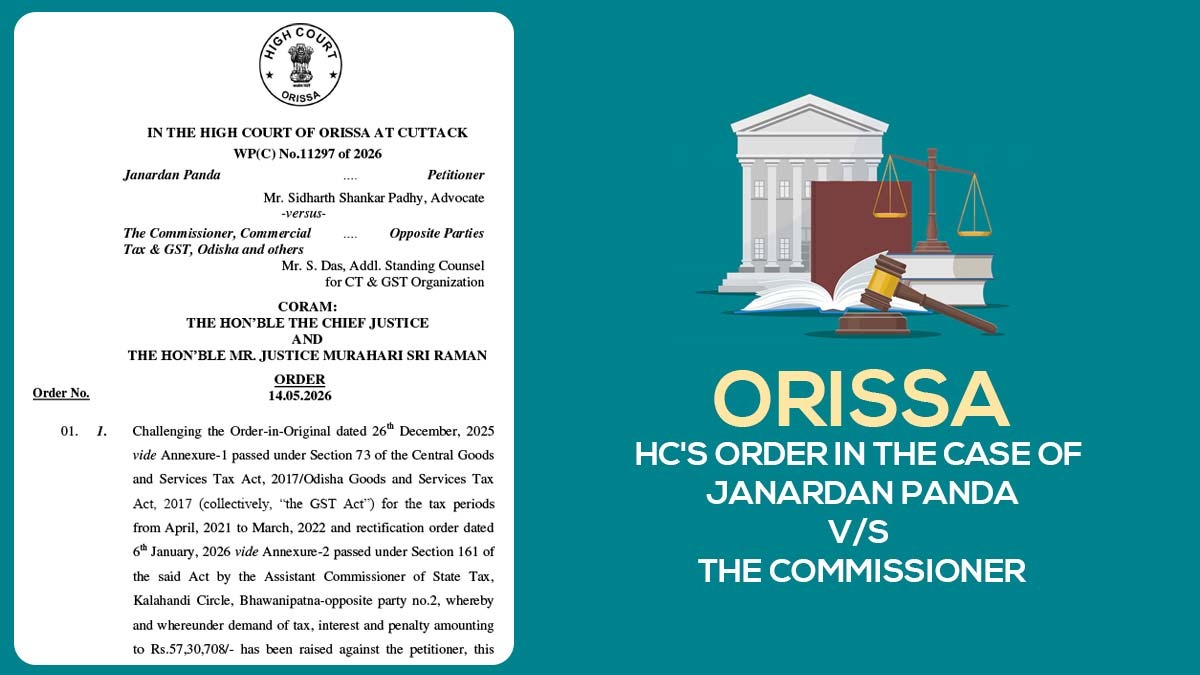
Orissa High Court delivered its judgment on May 14, 2026, in the case of Janardan Panda vs. The Commissioner, Commercial Tax & GST, Odisha and Others [WP(C) No. 11297/2026]. In this ruling, the Court set aside the adjudication and rectification orders passed under Sections 73 and 161 of the GST Act, having observed a clear violation of the principles of natural justice. The Court also noted that the taxpayer’s reply to the show cause notice was not properly considered by the authorities.
“Reply to show cause notice cannot be said to be empty formality or useless lumber.”
The petitioner challenged the Order-in-Original dated December 26, 2025, issued under Section 73 of the CGST/OGST Act for FY 2021-22, along with the subsequent rectification order dated January 6, 2026, passed under Section 161. Through these orders, the authorities demanded tax, interest, and penalties amounting to Rs. 57.30 lakh. The dispute mainly concerns GST liability under the reverse charge mechanism (RCM) on payments made for royalty, District Mineral Foundation (DMF), Environmental Management Fund (EMF), dead rent, and surface rent connected with mining activities.
The applicant before the High Court mentioned that a detailed response to the SCN in Form GST DRC-06 had been submitted on September 17, 2025. In the aforementioned response, the applicant chose a personal hearing and claimed that no taxable event had arisen during that period, as mining activities had not commenced.
But, even after the reply being on record, the adjudicating authority wrongly recorded in the order that the applicant neither responded to the notice nor appeared for a personal hearing.
Read Also: Orissa High Court Quashes Rejection of GST Appeal Filed with Minor Delay
The Department preserved the demand by claiming that tax on royalty under the reverse charge mechanism was legally recoverable and that disputed factual issues must be adjudicated before the appellate authority under the statutory remedy available under the GST Act.
The Bench said that the adjudicating authority had adopted a “manifestly erroneous approach” by proceeding as though no reply had been filed by the taxpayer, despite the reply being available on record.
Thereafter, the Court observed that although the authority subsequently invoked section 161 and passed a rectification order considering receipt of the reply, even the rectification proceedings were performed without allotting any chance of hearing to the applicant.
Helpful Post: How GST Software Fixes Common Mistakes in SCN Replies
The Bench held that the adjudicating authority must mechanically proceed with adjudication without independently acknowledging the objections raised in the reply to the Show cause notice (SCN).
The Court outlined that even in the absence of an appearance by the taxpayer, the adjudicating authority is required to apply its mind and give reasons while rejecting the explanation furnished in reply to the SCN.
Carrying that the impugned orders suffered from a clear breach of principles of natural justice and non-application of mind, the HC quashed both the adjudication order passed u/s 73 and the rectification order u/s 161. The case was remanded back to the adjudicating authority for fresh adjudication, after providing a reasonable chance of hearing to the applicant and allowing him to adduce proof in support of his case.
| Case Title | Janardan Panda vs. The Commissioner |
| Case No. | WP(C) No.11297 of 2026 |
| Counsel For Petitioner | Mr Sidharth Shankar Padhy |
| Counsel For Respondent | Mr. S. Das |
| Orissa High Court | Read Order |