

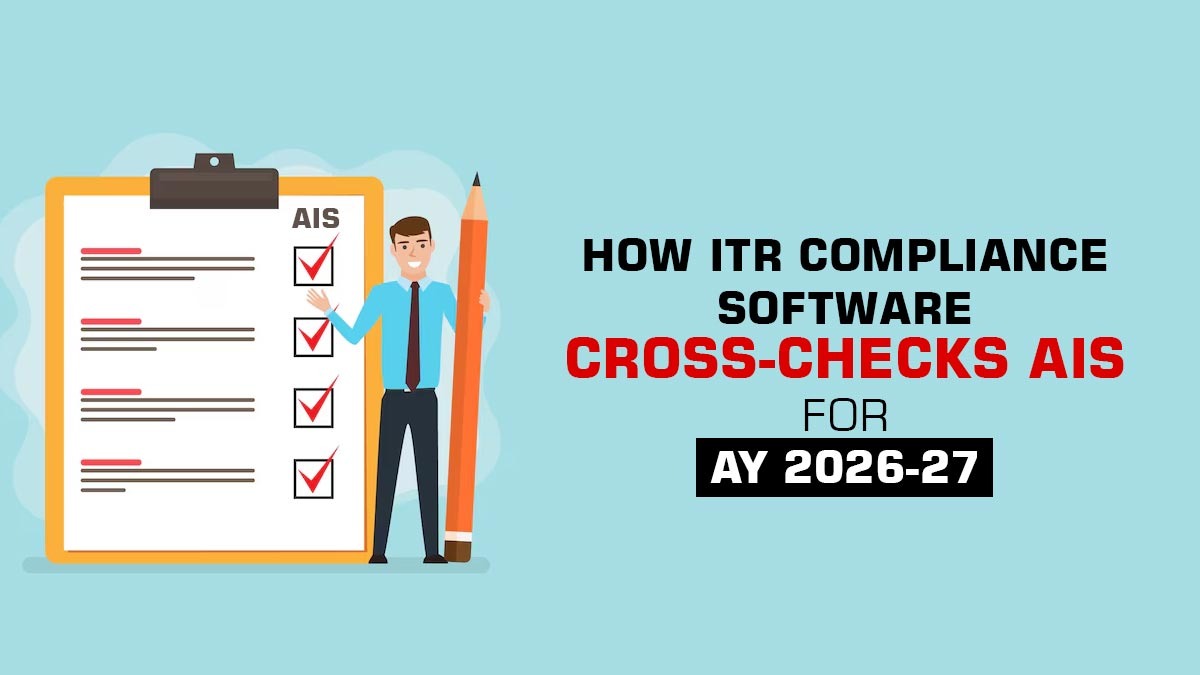
The process of preparing an Income Tax Return (ITR) has become more complex than simply reporting income and claiming deductions. For the Assessment Year (AY) 2026–27, taxpayers need to ensure that every financial detail provided in their return matches the information held by the Income Tax Department. In this regard, the Annual Information Statement (AIS) plays a crucial role.
The AIS delivers a comprehensive record of an individual’s financial activities, encompassing salary, interest income, dividends, Tax Deducted at Source (TDS), securities transactions, high-value purchases, and other reportable transactions compiled from banks, employers, and financial institutions.
The contemporary ITR filing software uses an automated system to verify the taxpayer’s return against the AIS before submission. The software determines discrepancies, validates income and tax credits, reconciles financial data, and specifies any missing or mismatched information that may result in notices, delayed refunds, or additional tax liabilities.
What is an Annual Information Statement (AIS)?
The AIS is a detailed statement that includes information about a taxpayer’s financial transactions during a financial year. It comprises data received from various reporting entities such as banks, employers, and other financial institutions.
AIS may have:
- Salary income
- Dividend income
- TDS and TCS
- Foreign remittances
- Property-related transactions
- High-value financial transactions
- Interest earned on savings and fixed deposits
Taxpayers should ensure that the details in their ITR match the AIS, as the Income Tax Department uses this information to verify the accuracy of tax returns.
Significance of Cross-Checking AIS
For tax return preparations, many taxpayers depend only on Form 16, bank statements, or personal records. If any transactions reported in the AIS are skipped or not revealed correctly in the ITR, then it may lead to discrepancies.
Cross-checking AIS assist to:
- Prevent income mismatches
- Enhance refund processing
- Improve overall compliance
- Determine missing financial transactions
- Ensure precise tax liability calculation
- Decrease the risks of receiving tax notices
For tax professionals managing multiple clients, manually comparing AIS data with return details can be very time-consuming. This is why ITR filing software is extremely beneficial.
AIS Verification By ITR E-Filing Software
You can see how ITR filing software verifies AIS for precise income reporting, verifies tax details, detects mismatches, and ensures error-free ITR filing.
Income Reconciliation
The software compares the income revealed in the tax return with numbers available in AIS. It checks salary, interest income, dividends, capital gains, and other taxable income to determine mismatches before submission.
Tax Computation Verification
After reconciling AIS information, the software recomputes taxable income, deductions, tax liability, surcharge, and cess. The support confirms that the final tax calculation is consistent with the present financial information.
Automatic AIS Data Import
It permits users to import AIS details from the income tax portal or via supported data files. The same removes manual data entry and lessens the risk of transcription errors.
TDS Verification
The automatic verification of TDS details is a crucial feature of TDS verification. The software compares the TDS claimed in the return with the entries shown in the AIS and pertinent tax statements, ensuring that taxpayers claim only the tax credits actually available.
High-Value Transaction Review
AIS includes the data concerning financial transactions declared by various institutions. The software determines such entries and alerts users if any reportable transaction has not been correctly revealed in the return.
Capital Gain Validation
Taxpayers engaged in capital gains transactions should support reconciling transaction details with AIS records. The same enhances the precision of capital gains reporting and lessens calculation errors.
Error Detection and Alerts
Advanced software conducts various validation checks before filing. If any discrepancies are found between the return and the AIS, users receive alerts that highlight the issues, allowing corrections to be made before submission.
Income Tax Return Filing Software Benefits
An effective ITR filing software provides various benefits for taxpayers and tax professionals.
- Precise reconciliation with AIS data
- Quicker preparation of tax returns
- Reduced manual verification effort
- Effective management of multiple clients
- Improved tax calculation accuracy
- Securely managing taxpayer information
- Lower risk of notices due to data mismatches
- Compliance with the latest Income Tax Department requirements
Such features improve productivity while assuring reliable tax filing.
Effective Practices Before IT Return Filing for AY 2026-27
Before the submission of the return, it is suggested to-
- Match TDS and tax payment details
- Verify capital gains and investment transactions
- Download and review your latest AIS
- Verify all income sources reported in the statement
- Confirm deductions and exemptions with supporting documents
- Resolve any discrepancies before filing the return
Such precautions prevent future intricacies and enhance the possibility of seamless return processing.
Closure: For the Assessment Year 2026-27, the Annual Information Statement (AIS) has become an important part of the income tax filing procedure. The income tax department uses the AIS to validate the data furnished in tax returns. This makes it essential to reconcile this information before submission. The ITR filing software automates the verification procedure by importing AIS data, which verifies the income and tax credits, identifies discrepancies, and validates tax calculations.
This functionality saves time, improves the accuracy of filings and reduces the chances of compliance issues. Whether you are an individual taxpayer, a Chartered Accountant, or a tax consultant managing multiple client accounts, using ITR e-filing software with AIS cross-check capabilities can speed up the filing process, enhance accuracy, and reduce stress.