

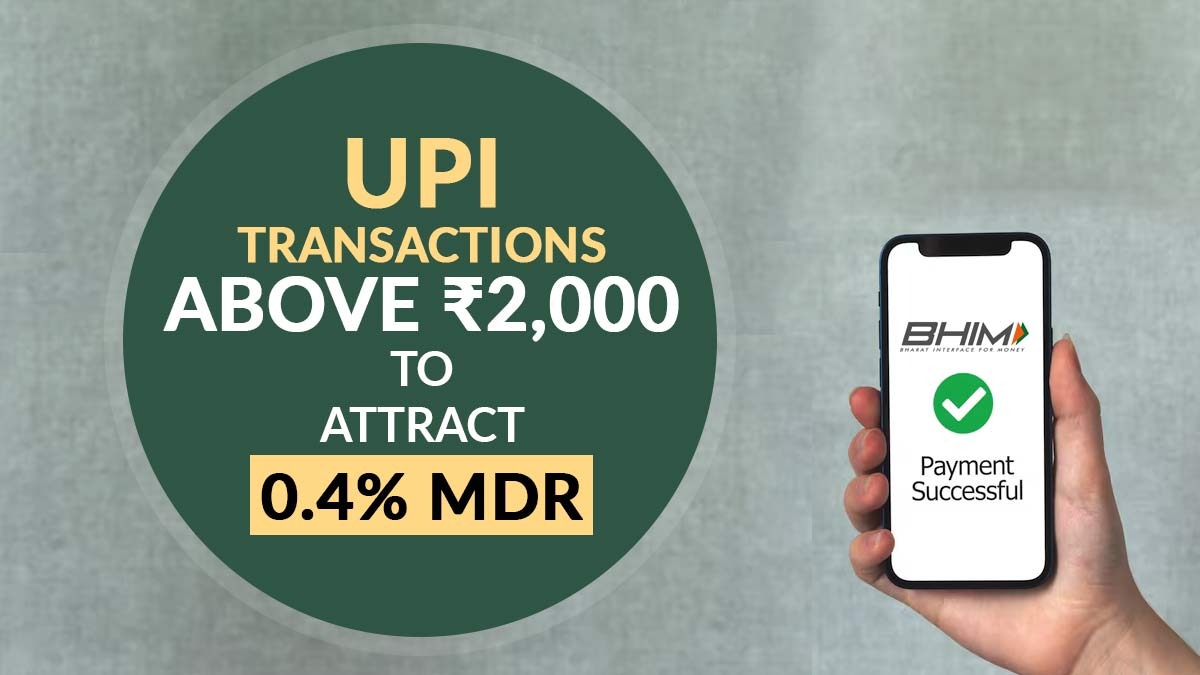
On September 15, the UPI Steering Committee conducted a meeting and settled the UPI MDR at 0.4%, or 40 bps, for transactions above Rs 2,000. W.e.f. October 15, 2026, MDR charges will be applicable.
The maximum MDR that can be charged per transaction is capped at Rs 300. At 0.4%, a transaction of Rs 75,000 would attract the full Rs 300 MDR. For transactions exceeding Rs 75,000, the MDR will remain capped at Rs 300, irrespective of the transaction value.
MDR is the commission that merchants pay to banks for processing digital payments. The 0.4% fee will translate into Rs 8 per Rs 2,000 spent or Rs 40 for every Rs 10,000 paid using UPI. Under the new UPI Merchant Discount Rate (MDR) structure, NPCI has described small merchants as those obtaining up to Rs 1 lakh a month via UPI QR codes.
However, the NPCI has granted certain necessary exemptions for services such as telecom, railways, fuel, and insurance to ensure customers are not affected. For these services, the MDR has been fixed at ₹5 per transaction. The MDR for capital market transactions, which typically involve very high transaction values, has been fixed at 0.02%.
A notification from the Central government has mentioned that banks cannot levy any charges on Unified Payments Interface (UPI) transactions of up to Rs 2,000 or payments made via RuPay-powered debit cards.
The National Payments Corporation of India (NPCI) operates UPI and the domestic card network RuPay. At an MDR of approximately 40 bps, this ecosystem can generate annual revenue of up to ₹16,000 crore.
MDR income is shared among ecosystem partners such as account-issuing banks, beneficiary banks, consumer-side payment service providers (PSPs), merchant acquiring payment aggregators and NPCI. The NPCI receives a fixed switching fee of about 0.02 bps per transaction.
Also Read: SBI Set to Offer UPI-Based Lending to Small Businesses Without GST Registration
UPI apps like PhonePe, Google Pay, and Paytm partner with banks to connect to the UPI network; these partners are known as PSP banks. Since PSP banks play a significant role in ensuring the success of UPI, it is possible that they will receive a larger share of the MDR, unlike in the card ecosystem.
In the UPI ecosystem, Yes Bank, Axis Bank, ICICI Bank, HDFC Bank, and SBI are the largest PSP banks.