

Case Facts
The taxpayer in this case was involved in quarrying and sale of crushed stones and was subjected to proceedings for FY 2018-19 based on the fact that the ITC claimed in GSTR-3B was more than the ITC shown in GSTR-2A.
The proper officer considered the difference of ₹2,33,502 (CGST ₹1,16,751 and SGST ₹1,16,751) as excess ITC and confirmed tax, interest and penalty aggregating to ₹4,60,582 u/s 73.
The taxpayer said that the alleged mismatch arose because the ITC relevant to FY 2017-18 was claimed in FY 2018-19 within the allowable period u/s 16(4), and such credit was shown in the GSTR-2A of FY 2017-18.
The demand was verified without providing a personal hearing; however, the show-cause notice has the hearing information as “NA”. The First Appellate Authority confirmed the demand without analysing the reconciliation. Thus, the taxpayer approached the GSTAT.
Issue-
The issue is whether ITC can be disallowed solely based on a mismatch between GSTR-3B and GSTR-2A for the fiscal year 2018-19, without verifying the taxpayer’s claim that the discrepancies pertained to invoices from fiscal year 2017-18 that were availed within the permissible period specified u/s 16(4).
Additionally, there is the question of whether the failure to provide a personal hearing as required by Section 75(4) compromised the adjudication process. Another point of concern is whether the lack of issuance of FORM GST ASMT-10 u/s 61 rendered the proceedings invalid.
Held That:
Through remand, the GSTAT permitted the appeal. It said that GSTR-2A for the related period could not be deemed as conclusive proof for disallowing ITC, and the taxpayer’s explanation for FY 2017-18 credit required invoice-wise verification.
The Tribunal noted that the First Appellate Authority assumed non-reflection in the FY 2018-19 GSTR-2A indicated suppliers’ non-payment of tax, without conducting the necessary verification.
Read Also: Karnataka HC Grants Relief on Common GST Notices, GSTR-2A/GSTR-3B ITC
The Tribunal said that personal hearing u/s 75(4) is mandatory where an adverse decision is contemplated, and the absence of any hearing compromised the adjudication.
The court ruled that the failure to issue FORM GST ASMT-10 did not invalidate the proceedings, as the scrutiny under Section 61 and the proceedings under Section 73 are independent processes.
As a result, the previous orders were overturned, and the case was sent back for a fresh adjudication. This includes an invoice-wise verification referring to the GSTR-2A for the fiscal year 2017-18, suppliers’ GSTR-1, ITC registers, books of accounts, and GSTR-9/GSTR-9C.
The Proper Officer was also instructed to apply CBIC Circular No. 183/15/2022-GST. Additionally, the Proper Officer must provide a proper personal hearing and issue a new, reasoned order within twelve weeks. The interest and penalties resulting from this case will depend on the new determination of tax liability.
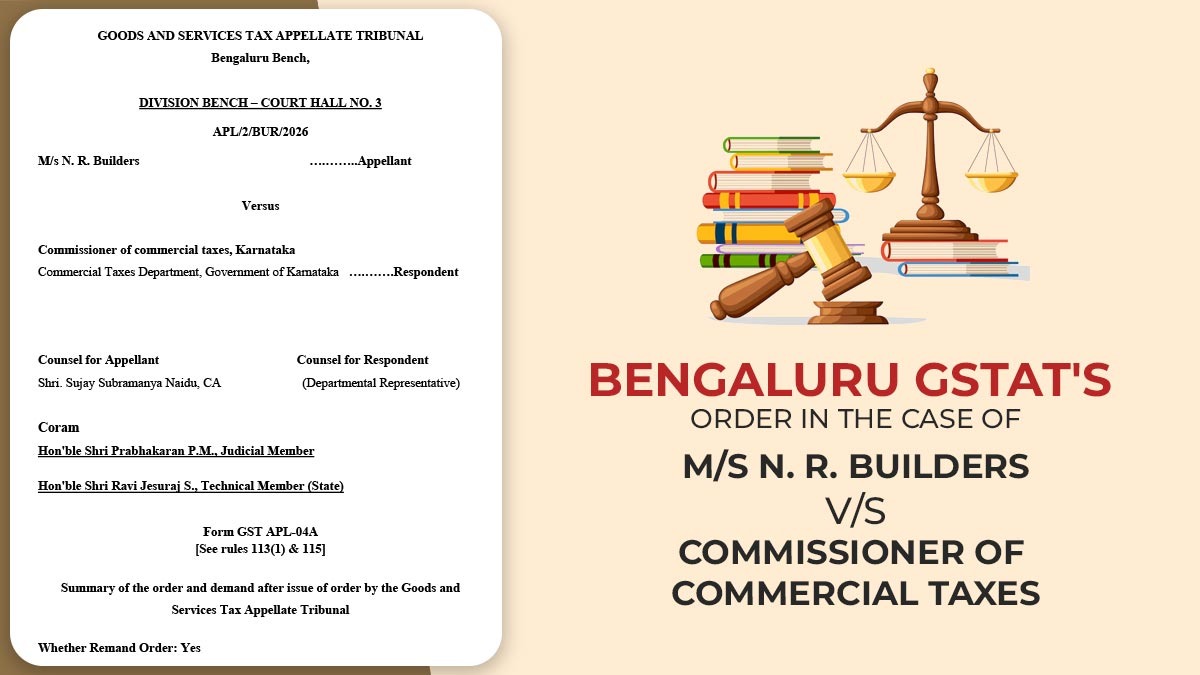
| Case Title | M/s N. R. Builders vs. Commissioner of Commercial Taxes |
| Case No. | APL/2/BUR/2026 |
| Counsel for Appellant | Shri. Sujay Subramanya Naidu |
| Bengaluru GSTAT | Read Order |