

The Karnataka High Court has provided temporary relief in a legal case that questions whether it’s fair to issue general tax notices for several time periods at once. The case also discusses whether businesses can claim tax credits for construction work that is used to earn rental income.
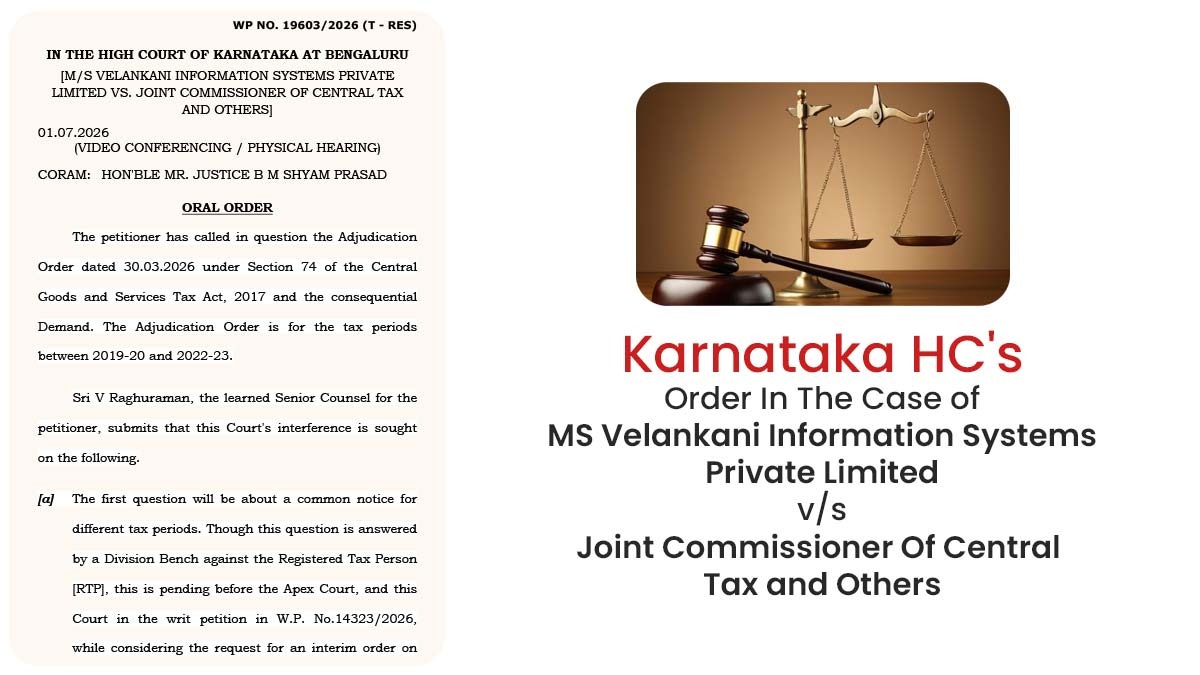
Justice B. M. Shyam Prasad has suspended the immediate implementation of an adjudication order issued under Section 74 of the Central Goods and Services Tax (CGST) Act, 2017, subject to certain specified conditions. The case is scheduled for further hearing on August 18, 2026.
The challenge is related to an adjudication order dated March 30, 2026, which includes tax periods from 2019-20 to 2022-23. The applicant has questioned the adjudication order and the consequential tax demand on three principal grounds.
The first problem is related to the legality of issuing a single SCN for multiple assessment years. However, a Division Bench of the Karnataka High Court had earlier kept these notices; the applicant said that the issue is currently pending before the Supreme Court. It was mentioned that if the Supreme Court rules in favour of taxpayers, proceedings begun via such common notices could become jurisdictionally invalid.
The second issue pertains to the refusal of Input Tax Credit (ITC) due to discrepancies between Forms GSTR-2A and GSTR-3B. The petitioner argued that the transactions in question were legitimate and that taxes had been paid to the suppliers. Citing the Karnataka High Court’s decision in Instakart Services Private Limited v. Union of India, the petitioner contended that bona fide recipients should not be denied ITC solely because of defaults or non-compliance by their suppliers.
The third issue is related to the availability of ITC on machinery and equipment used for constructing commercial buildings that are leased out. The petitioner claims that this expenditure qualifies for ITC as it is directly connected to taxable rental income. They referred to a previous interim order from the High Court in a similar case, where relief was granted on the condition that 10% of the disputed ITC be maintained in the Electronic Credit Ledger.
Post acknowledging the submissions, the Court granted interim protection on the condition that the applicant keeps a minimum of 10% of the disputed ITC concerning rental income in its Electronic Credit Ledger until further orders. The respondents have been given a chance to complete their pleadings and seek vacation of the interim order.
The case is anticipated to have broader implications for GST litigation, specifically regarding three recurring issues: the legality of common notices that cover multiple tax periods, the refusal of Input Tax Credit (ITC) because of mismatches between GSTR-2A and GSTR-3B caused by supplier defaults, and the eligibility of ITC for construction-related inputs used in commercially leased properties.
| Case Title | M/S Velankani Information Systems Private Limited Vs. Joint Commissioner Of Central Tax And Others |
| Case No. | WP NO. 19603/2026 |
| For Petitioner | V Raghuraman, Senior Counsel |
| Karnataka High Court | Read Order |