

The Madurai Bench of the Madras High Court has held that uploading an adjudication order on the GST common portal constitutes valid service u/s 169 of the GST Act.
The Court dismissed a writ petition contesting a tax demand and recovery proceedings on the fact that no physical copy of the assessment order had been given.
The bench of Justice C. Saravanan granted the taxpayer a chance to pursue the statutory appellate remedy by directing the appellate authority to consider the appeal without raising the limitation issue, in light of the deposit of 25% of the disputed tax.
Read Also: Madras HC Permits to File a Fresh Appeal as GST SCN Was Uploaded Only on Portal
The applicant contested an assessment order and the consequential recovery notice. The applicant claimed that, although it had not taken part in the assessment proceedings, the final order had never been physically communicated, rendering the proceedings illegal and in violation of the principles of natural justice as well as Section 169 of the Tamil Nadu GST Act.
The applicant put reliance on earlier judgments of the Madras High Court, particularly Sahulhameed v. Commercial Tax Officer and other subsequent decisions, wherein the court noted that authorities must provide notices and orders personally, through registered post, or through the registered email address before resorting to publication on the GST portal. The applicant said that the failure to physically provide the assessment order vitiated the adjudication procedure.
The Court analysed the regulatory structure governing service of notices under the GST law. The Court referred to Section 169 of the GST Act, which specifies multiple allowable modes for providing decisions, orders, summons, notices and other communications.
The judgment observed that section 169(1) provides that service can be accomplished by various alternative methods which comprise direct delivery, registered or speed post, email, and by making the communication available on the GST common portal.
Opposite to the claim of the applicant that physical service was mandatory, the Court said that the statute itself considers portal upload as one of the legally valid modes of service.
The Court considered its previous decision in Sahulhameed, where assessment orders had been quashed with directions to furnish fresh chances to taxpayers after appropriate service of Show Cause Notice (SCN).
Justice Saravanan differentiated the current matter, outlining that the statutory language of Section 169 consists of making communications available on the common portal as a valid mode of service.
The High Court highlighted this principle by contrasting Rule 52 of the Tamil Nadu General Sales Tax Rules, 1959 with Section 169 of the GST Act.
While earlier frameworks relied heavily on physical service, the modern GST regime explicitly recognises electronic modes-including portal uploads-as valid service. This comparative statutory framework served as a central pillar of the Court’s ruling.
Relying on the Apex Court’s ruling in M/s. ASP Traders v. State of Uttar Pradesh (2025), Justice Saravanan underscored the automated framework of the GST system.
The Court reiterated that the proper officer is statutorily mandated to issue the formal adjudication order in Form GST MOV-09 and upload its corresponding summary in Form GST DRC-07 directly on the GST portal.
As per the High Court, this strengthens the regulatory importance of electronic communication through the common portal under the GST framework.
After confirming that the assessment order was duly uploaded to the GST portal, the High Court held that the petitioner’s challenge to the order and subsequent recovery proceedings lacked merit. Finding no grounds to interfere, the Court dismissed the writ petition.
Considering the petitioner’s arguable grounds on the merits, the Court exercised its discretion to allow the petitioner to pursue the statutory appellate remedy.
Also Read: Madras HC: Uploading GST Notices on Tax Portal Without Effective Service Is an Empty Formality
The petitioner agreed before the Court to deposit 25% of the disputed tax. The Court recorded this agreement and directed that if the deposit is made and an appeal is filed within 30 days of receiving the order, the Appellate Authority will determine the appeal on its merits, without dismissing it based on limitation.
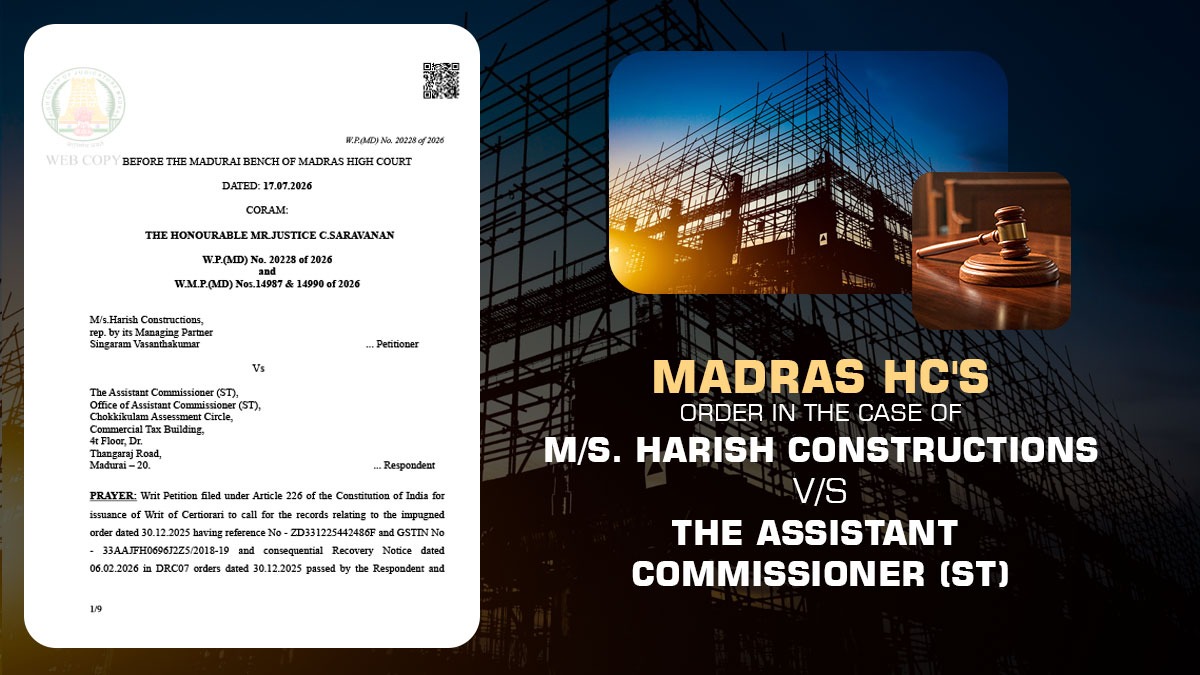
| Case Title | M/s. Harish Constructions vs. The Assistant Commissioner (ST) |
| Case No. | W.P.(MD) No. 20228 of 2026 and W.M.P.(MD) Nos.14987 & 14990 of 2026 |
| For the Petitioner | Mr. S.Venkatasubramaniyan |
| For Respondent | Mr.S.Venkatesh |
| Madras High Court | Read Order |