

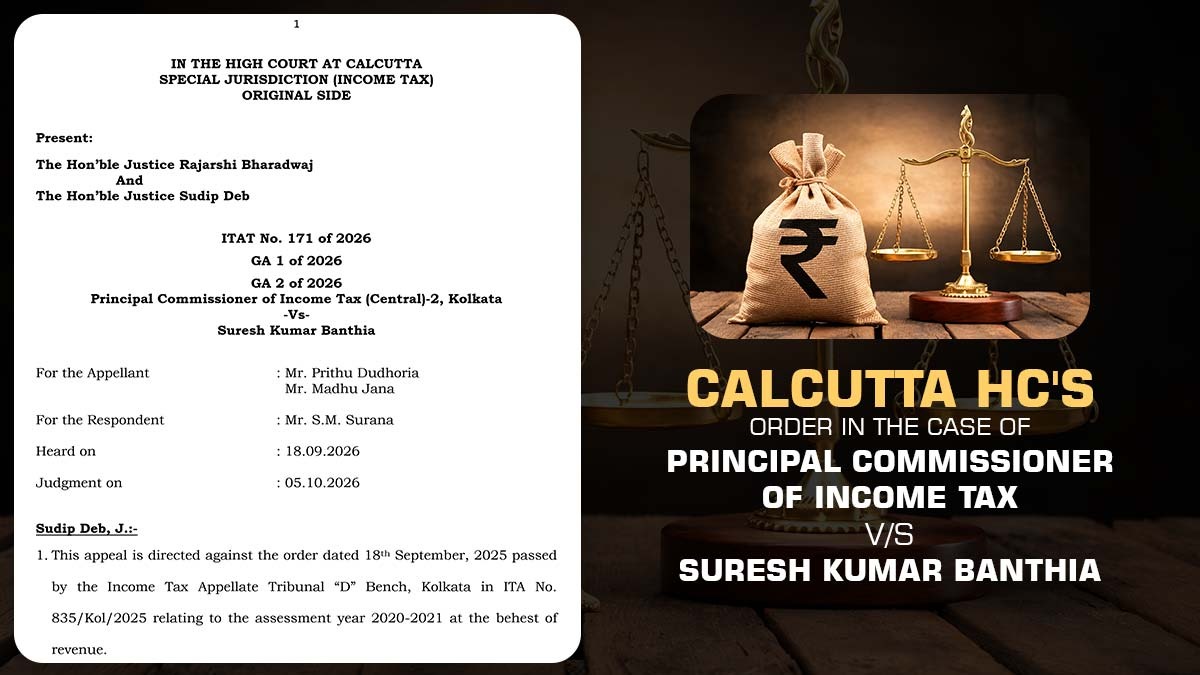
The Calcutta High Court dismissed the appeal of the revenue against the Income Tax Appellate Tribunal (ITAT) September 2025 order deleting a Rs. 11.35 crore addition made against businessman Suresh Kumar Banthia for AY 2020-21.
The Division Bench comprising Justice Rajarshi Bharadwaj and Justice Sudeep Deb observed that although strict rules of evidence do not apply to income-tax proceedings, tax authorities and tribunals are nevertheless guided by the principles of the law of evidence and the general principles of natural justice. The Bench stated:
“The strict rules of the Indian Evidence Act (now Bharatiya Sakshya Adhiniyam) do not apply to income tax proceedings but the Tax Authorities are guided by its underlying general principles and natural justice. It is important to mention here though the Income Tax Authority and Tribunals are not bound by the rigours but the proceedings initiated under Income Tax Act can still invoke common law principles and foundation of rules of evidence.”
The Assessing Officer had initially added ₹3.01 crore for alleged unexplained cash loans and ₹4.46 crore for interest. Subsequently, the Commissioner of Income Tax (Appeals) increased the total addition to ₹11.35 crore based on the ‘peak credit’ reflected in certain seized documents.
The Revenue argued that the ITAT overlooked incriminating evidence and erroneously accepted Banthia’s retraction of the statement recorded during the survey.
HC observed that the search of two financial l brokers, Kasera and Sanwaria, had been undertaken in November 2018, before the start of the related fiscal year for AY 2020-21.
The Income Tax Appellate Tribunal (ITAT) discovered that the material seized in the search did not specify any link with Banthia’s income for the assessment year in question.
It said that Banthia withdrew his survey statement within 5 days, alleging it was recorded under coercion and that no corroborative proof existed.
The ITAT did not find that the assessing officer had not produced any material to corroborate the entries in the seized and impounded documents.
Furthermore, the Bench noted that although the names of individuals allegedly involved in the cash loan transactions appeared in the documents, their statements were not recorded, nor were summons issued to them, even though the authorities possessed their contact details.
Important: Delhi ITAT Deletes ₹23 Lakh Addition U/S 69A, Accepts Tree & Mango Sale Proceeds as Source
Referring to the Supreme Court’s rulings in Dhakeswari Cotton Mills Ltd. v. Commissioner of Income Tax and Omar Salay Mohamed Sait v. Commissioner of Income Tax, it is reiterated that tax authorities cannot make an assessment founded only on guesswork, suspicion or conjecture.
The judges found that the ITAT, the final fact-finding authority, had accurately computed the documentary proof and reached its conclusions only after considering the information on record.
They did not discover any infirmity or error in the Tribunal’s order and held that the questions raised by the Revenue Department were purely questions of fact. They observed:
“Non-applicability of the Evidence Act in its technical sense does not prevent the Income Tax Authority from invoking the general principles embodied in the Evidence Act. We find from the impugned order that the Appellate Tribunal has correctly assessed the admissibility of the documentary evidence.”
Read Also: Calcutta HC Upholds ITAT Order Removing ₹4 Cr Addition in Reassessment Case
Accordingly, finding no substantial question of law, the High Court dismissed the Revenue’s appeal and stay application.
| Case Title | Principal Commissioner of Income Tax vs. Suresh Kumar Banthia |
| Case No. | ITAT No. 171 of 2026 |
| For the Appellant | Mr Prithu Dudhoria and Mr Madhu Jana |
| For the Respondent | Mr. S.M. Surana |
| Calcutta High Court | Read Order |