

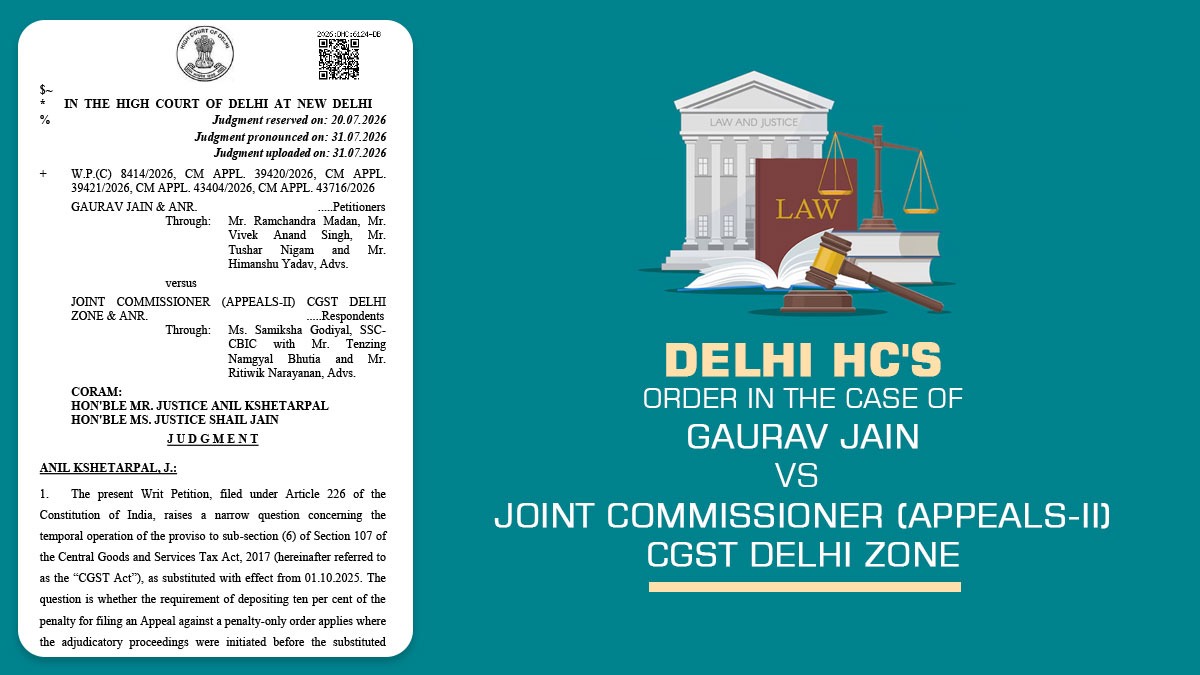
The Delhi High Court has held that the amended provision requiring a 10% pre-deposit of the penalty for submitting against penalty-only orders under the CGST Act cannot be applied to adjudicatory proceedings initiated before the amendment came into force on 1st October 2025.
A Division Bench comprising Justices Anil Kshetrapal and Shail Jain held that the petitioner’s right to appeal vested on the date the show cause notice (SCN) was issued, i.e., 25 June 2025. Accordingly, the subsequent amendment introducing the 10% pre-deposit requirement could not be applied to the petitioner.
“The substituted proviso does not, therefore, govern the appeals arising from the SCN dated 25.06.2025,” the Court stated.
An SCN had been issued by the applicants on June 25, 2025, proposing penalties u/s 122(1A) of the CGST Act. Therefore, the adjudicating authority passed an order on December 16, 2025, levying penalties of Rs 346.55 crore on each applicant, without raising any tax demand against them personally.
Before October 1, 2025, Section 107(6) of the CGST Act did not require any percentage-based pre-deposit for appeals against wholly disputed penalty-only orders u/s 122(1A).
However, after the substitution of the proviso w.e.f October 1, 2025, appellants contesting these orders became obligated to deposit 10% of the penalty before submitting a plea. In the case of applicants, this translated into a pre-deposit of nearly Rs 34.66 crore each.
Petitioners claimed that as the adjudicatory proceedings had started with the issuance of the SCN before the revision came into effect, their appellate rights were controlled by the provision, which has not changed.
While the Revenue said that the revised proviso applied because the appeal could merely be submitted after the order was passed in December, by which time the amendment had earlier come into force.
Also Read: Delhi HC GST Order Valid Even If Every Reply to SCN Is Not Discussed in Detail
HC repeated that the right of appeal is a substantive right which vests upon the start of the lis and comprises the conditions regulating its exercise.
In Hoosein Kasam Dada (India) Ltd. v. State of Madhya Pradesh and Ors, reliance was placed on the decisions of the Apex Court, which said that when a revised condition restricts the right of appeal, it could not regulate an appeal arising from proceedings which had started before the amendment.
The High Court stated that, “Appeal is substantive…it cannot be taken away, impaired or subjected to a more onerous condition unless the legislature has manifested such an intention expressly or by necessary intendment. Although an Appeal can ordinarily be filed only after an adverse decision is rendered, the right to pursue the proceedings through the appellate hierarchy attaches to the lis at its commencement; the adverse order merely makes that right capable of exercise.”
The Court mentioned that in this case, the lis started with the issuance of the Show Cause Notice (SCN) on June 25, 2025, when the department claimed a definite claim of personal penal obligation against the applicants.
It mentioned that, “The replies and hearing were subsequent steps in an adjudicatory process already initiated… There is thus an unbroken continuity between the SCN, the adjudication and the appellate remedy arising from the resulting order. The lis commenced no later than 25.06.2025.”
The Court did not discover any sign in the Finance Act, 2025, that Parliament intended the amended proviso to operate retrospectively. The Court said that the new 10% pre-deposit requirement shall not apply to adjudicatory proceedings initiated before October 1, 2025.
Read Also: Madras HC Cancels GST Order for Non-Reply to SCN; Allows Fresh Adjudication with 10% Pre-Deposit
Thus, the Court said that the petitioners were not needed to deposit 10% of the penalties as a condition for submitting their statutory appeals.
| Case Title | Gaurav Jain Vs Joint Commissioner (Appeals-II) CGST Delhi Zone |
| Case No. | W.P.(C) 8414/2026 |
| For the Petitioner By | Mr Ramchandra Madan, Mr Vivek Anand Singh, Mr Tushar Nigam and Mr Himanshu Yadav |
| For Respondent | Ms Samiksha Godiyal, Mr Tenzing Namgyal Bhutia and Mr Ritiwik Narayanan |
| Delhi High Court | Read Order |