

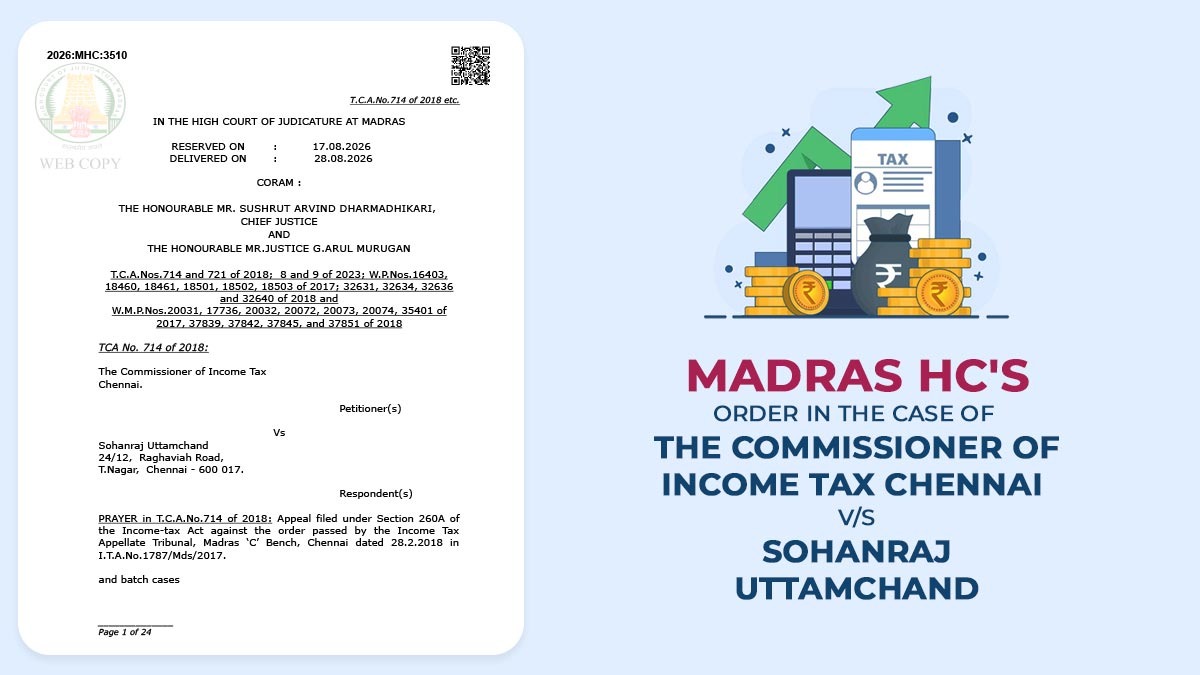
The Madras High Court, in a recent ruling, allowed income tax exemption u/s 10(38) of the Income Tax Act, 1961, observing that a mere sudden surge in the share price does not make a Long-Term Capital Gain (LTCG) claim bogus.
The Court said that the transactions were made via appropriate channels and the assessing officer did not report any direct connection between the manipulation of the share price and the respondent-taxpayer.
According to the facts of the case, the respondent-taxpayer, Sohanraj Uttamchand, reported an income of ₹11.8 crore for AY 2013-14.
The Assessing Officer (AO) noted that the taxpayer sold 7,72,000 shares of PFL Infotech Limited for a sale consideration of ₹34.6 crore and 7,50,000 shares of Risa International Limited for ₹38.05 crore. The taxpayer claimed an exemption on the Long-Term Capital Gains (LTCG) under Section 10(38) of the Income Tax Act, 1961.
Regarding the sale of shares in PFL Infotech, the share price increased from Rs. 22 to Rs. 760, while the share price of Risa International rose from Rs. 10 to Rs. 600. This sharp increase drew the assessing officer’s suspicion regarding the transactions.
It was alleged that the share prices of PFL Infotech Limited had been manipulated as part of a suspected “pump and dump” scheme. Following survey operations, the Assessing Officer (AO) treated the sale proceeds as unexplained credit u/s 68 read with Section 28 of the Income Tax Act.
When the case was contested, the appellate tribunal favoured the taxpayer and set aside the additions under Section 68 read with Section 28.
The appellate tribunal observed the situations which led the officers to come to the conclusions that LTCG was fake; however, the tribunal mentioned these suspicions cannot displace the documentary proof of the taxpayer on shares traded via a recognised stock exchange, payment of STT, identity of the company whose shares were traded, etc.
The revenue department placed multiple claims before the HC, including that the taxpayer has no experience in trading, and observed that a statement by a Director of Shallot Vincom Private Limited alleged that certain companies were utilised to furnish accommodation entries to beneficiaries of penny-stock manipulation.
The respondents, who are the taxpayers, argued that the department failed to provide any evidence directly linking them to the allegations. They contended that these accusations were based solely on suspicions.
Read Also: Section 111A, 112A & 112 Under Income Tax Act Provisions
Since the shares were sold through stock exchanges, they argued that it cannot be assumed that there was manipulation without independent findings, which were lacking in this case.
Chief Justice Sushrut Arvind Dharmadhikari and Justice G. Arul Murugan addressed the issue raised by the revenue regarding the application of the Supreme Court’s decisions in CIT v. Durga Prasad More and Sumathi Dayal v. CIT. They noted that the test of human probabilities should be considered and applied, certainly in the absence of any concrete proof.
“The “test of human probabilities” enunciated in those decisions is undoubtedly a valid and useful tool of appreciation of evidence, but it does not dispense with the requirement that the Revenue must, at the very least, bring on record some positive material connecting the assessee with the alleged design, particularly where the primary documentary evidence of the transaction is not under challenge.”
The Court upheld the Tribunal’s view that capital gains cannot be deemed bogus solely based on a sharp rise in share prices, particularly when the shares were traded on a recognised stock exchange, and payments were made through banking channels. The Court found no infirmity in the order of the Income Tax Appellate Tribunal.
The failure to establish the manipulation of the share price of the taxpayer by the revenue, the Court said that the appellate tribunal was correct in deleting the additions made u/s 68 read with Section 28. It dismissed the revenue’s appeal and permitted the income tax exemption u/s 10(38) claimed by the respondent-taxpayer.
| Case Title | The Commissioner of Income Tax, Chennai vs. Sohanraj Uttamchand |
| Case No. | TCA No. 714 of 2018 |
| For Appellant(s) | Mr.T.Ravi Kumar |
| For Respondent(s) | Mr Srinath Sridevan and Mr Bhagawath Krishnan |
| Madras High Court | Read Order |