

Reaffirming the doctrine of corporate separateness and the need for strict adherence to procedural safeguards under GST law, the Karnataka High Court set aside a coercive recovery action initiated against a third-party company that was not the defaulting assessee.
The Court held that the GST Department cannot recover the tax dues of one company from another merely on the ground that both entities share a common director.
Justice S.R. Krishna Kumar, relying on the Court’s earlier decision in SJR Prime Corporation Pvt. Ltd. vs. Superintendent of Central Tax, held that garnishee proceedings under Section 79 of the CGST Act cannot be initiated directly against banks without first issuing notice to the alleged garnishee. The Court emphasised that compliance with procedural safeguards is mandatory, and any recovery action taken in violation of these requirements is liable to be quashed.
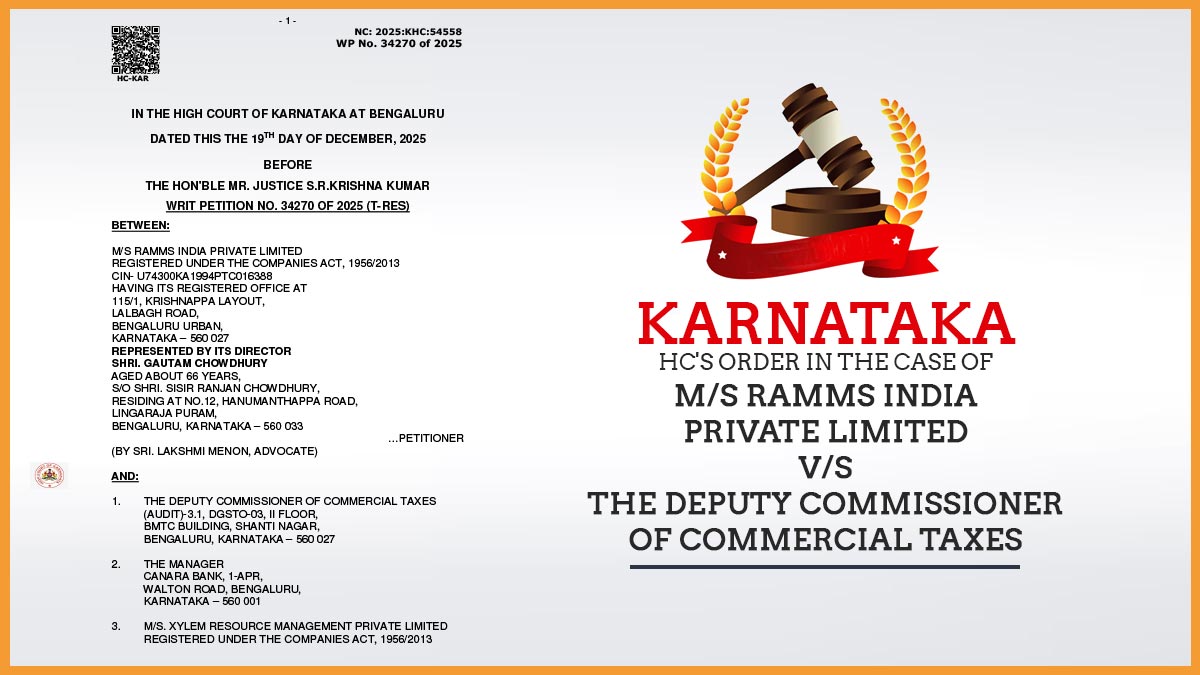
A private limited company incorporated in 1994 submitted the writ petition contesting a Form GST DRC-13 dated 14 October 2025 issued by the Deputy Commissioner of Commercial Taxes (Audit). The department, via an impugned garnishee notice, recovered Rs 73 lakh from the bank account of the applicant kept maintained with Canara Bank for the FY 2022-23.
The recovery is related to the GST dues adjudicated against another private limited company incorporated in 2007. Although the two companies were separate legal entities, one individual served as a director for both. Only to the second company, the SCN u/s 73 of the Karnataka GST Act and the subsequent adjudication order dated 29 November 2023 were issued and not against the applicant.
The applicant said that it was neither the taxpayer in default nor a garnishee of the defaulting company. No money is due on the default entity by it. On the grounds of a common directorship, the department attached its bank account without lifting the corporate veil through any lawful process. This recovery was not allowable in law and breached the settled norms controlling garnishee proceedings under GST.
Post-examining the record, the court said that the recovery action was legally not sustainable. The court mentioned that the applicant company, along with the defaulting company, was an independent juristic person, each owns a separate legal identity.
The court declared that simply because one individual served as a director for both companies, the tax liabilities of one entity could not be imposed on the other. The applicant was not a garnishee, and there was no determination that it held or was obligated to pay money to the defaulting company. The department’s effort to recover dues by indirectly lifting the corporate veil without justification was contrary to the law.
Read Also: Karnataka HC Raps GST Authorities, Directs ₹10 Crore Refund for Coercive Recovery
HC quashed the impugned GST DRC-13 notice on 14 October 2025, asked the applicant to appear before the tax authority dated 5 January 2026, and provided freedom to the applicant to submit documents and pleadings to pursue a refund of the recovered amount.
The court asked the tax department to determine the refund claim within 4 weeks without insisting on a separate application and ordered that if the refund is sanctioned, then the amount, including applicable interest, needs to be filed within 2 weeks thereafter.
| Case Title | M/S Ramms India Private Limited Vs The Deputy Commissioner of Commercial Taxes |
| Case No. | WRIT PETITION NO. 34270 OF 2025 (T-RES) |
| For Petitioner | Sri. Lakshmi Menon |
| For Respondent | SMT. Jyoti M. Maradi, HCGP for R1 Sri. Vignesh Shetty, advocate for R2 |
| Karnataka High Court | Read Order |