

The applicant was registered under the GST laws in multiple states. Following a Scheme of Amalgamation approved by the National Company Law Tribunal on November 14, 2019, another company merged with the applicant. As a result, all assets and liabilities of the transferor entity were transferred to the applicant. Additionally, the unused Input Tax Credit (ITC) recorded in the transferor company’s books, which pertains to the CGST credit that transitioned from the previous central excise regime via TRAN-1, was also intended to be transferred to the applicant.
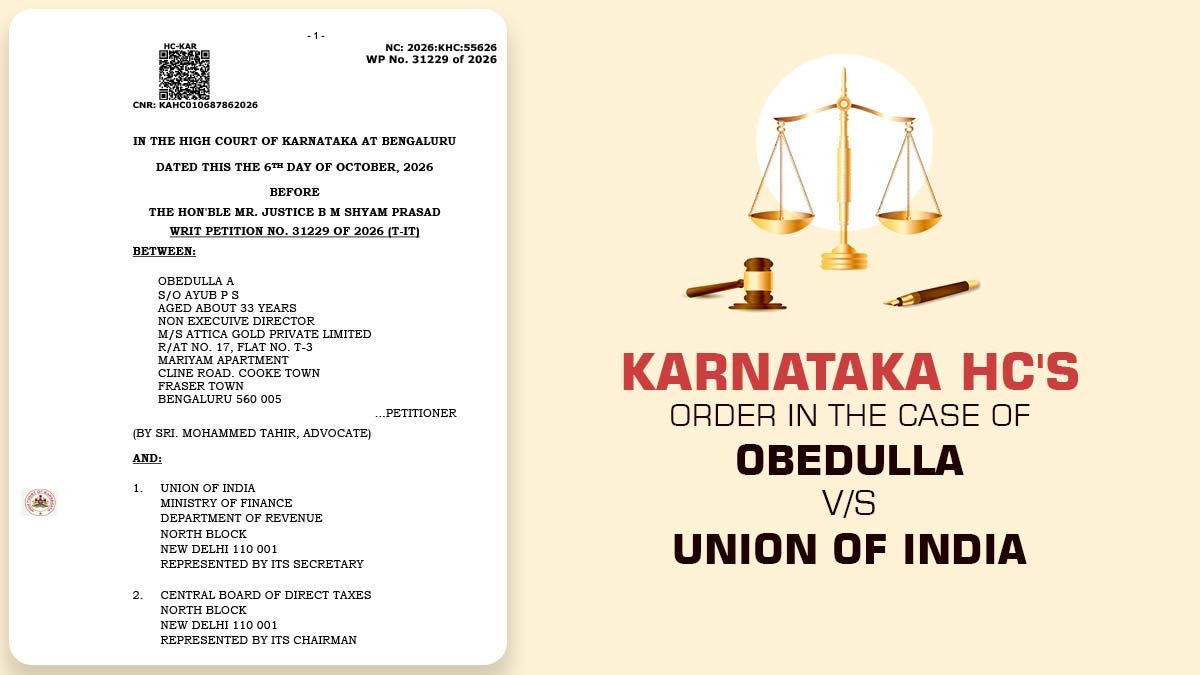
The applicant attempted to transfer their Input Tax Credit (ITC) under the GST rules by submitting Form GST ITC-02 on the GST website. However, their request was denied with an error message stating that the sender and the ITC recipient must be in the same state or union territory. As a result, the applicant brought an action in the High Court, contending that this restriction on the GST website has no legal basis and unduly impedes the transfer of ITC that should have been permitted by a legitimate business merger.
On the decision of the High Court of Bombay in Umicore Autocat India (P) Ltd Vs. Union of India reliance was placed, which had allowed the inter-state transfer of ITC in a similar amalgamation situation. The revenue countered that GST registrations are pertinent to the State and that inter-State transfer of ITC is not considered under the existing structure. Also, the revenue stated that a CBIC circular on the apportionment of ITC in business reorganisations was issued, and that the Bombay High Court ruling has been challenged before the Supreme Court of India.
Whether, upon an amalgamation approved by the NCLT, unused ITC can be transferred from the transferor company to the transferee company located in a different State, and whether the GST portal or authorities can reject the same transfer by levying a “same State” condition not found in Section 18(3) of the CGST Act read with Rule 41 of the CGST Rules.
The HC permitted the writ petition and held that Section 18(3) of the CGST Act, read with Rule 41 of the CGST Rules, permits the transfer of ITC in cases of amalgamation and does not impose any requirement that the transferor and transferee be located in the same State. The endorsement included in Form ITC-02 on the GST portal, which charged a “same State/U.T.” condition, lacked a statutory basis and effectively introduced a substantive restriction through a procedural mechanism.
The Court stated that the statutory forms could not be amended to incorporate provisions not contained in the parent legislation. Any departmental view denying a regulatory claim must be separately recorded in a proper order rather than embedded in a specified form. The portal limitation does not preclude the exercise of regulatory rights.
The reasoning furnished by the Bombay High Court in the case of Umicore Autocat India (P) Ltd. has been held by the court and stated that easier flow of ITC is a foundational objective of the GST framework, and inter-State considerations do not explain the refusal of eligible CGST credit transfer pursuant to a lawful amalgamation. The Court did not determine any effective reason to depart from the Bombay view.
Read Also: How GST Software Resolves GSTR-3B & 2A/2B ITC Mismatches
The Court, while acknowledging that the applicant had restricted its claim to CGST credit and that the ITC had earlier been accounted for manually in its books in accordance with the NCLT Scheme, directed the department to permit the manual filing and processing of Form ITC-02 until an appropriate system mechanism is developed.
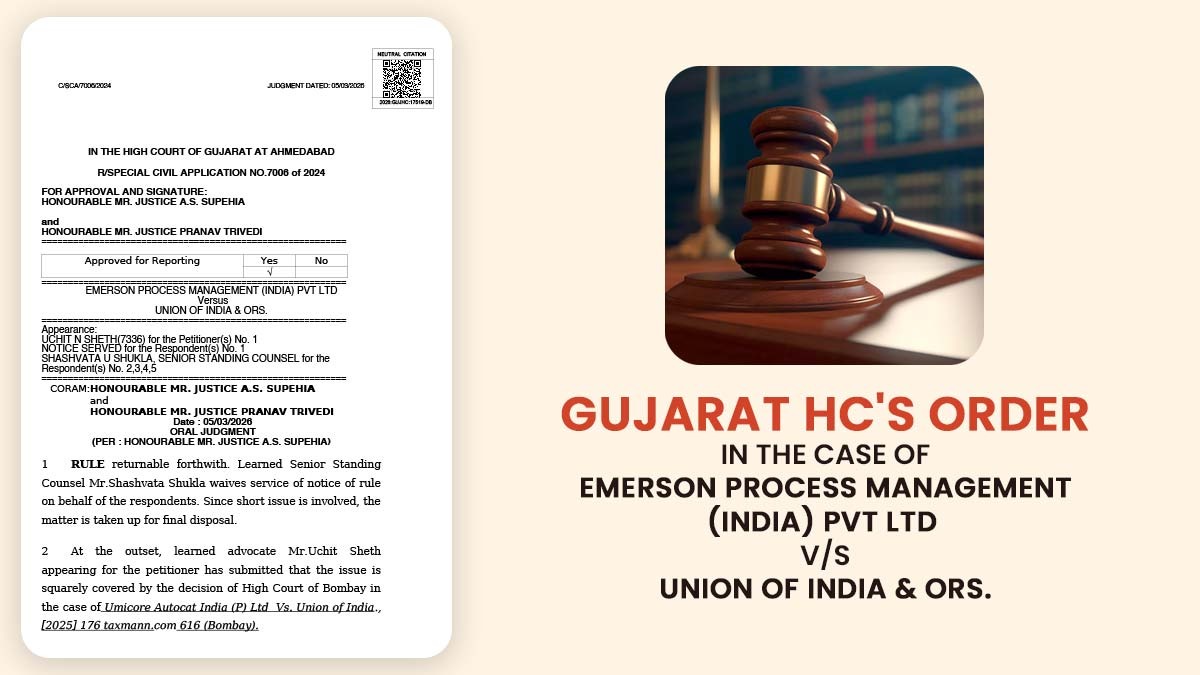
| Case Title | Emerson Process Management (India) Pvt Ltd Versus Union of India & Ors. |
| Application No. | 7006 of 2024 |
| For Petitioner | Uchit N Sheth |
| For Respondent | Shashvata U Shukla, Senior Standing Counsel |
| Gujarat High Court | Read Order |