

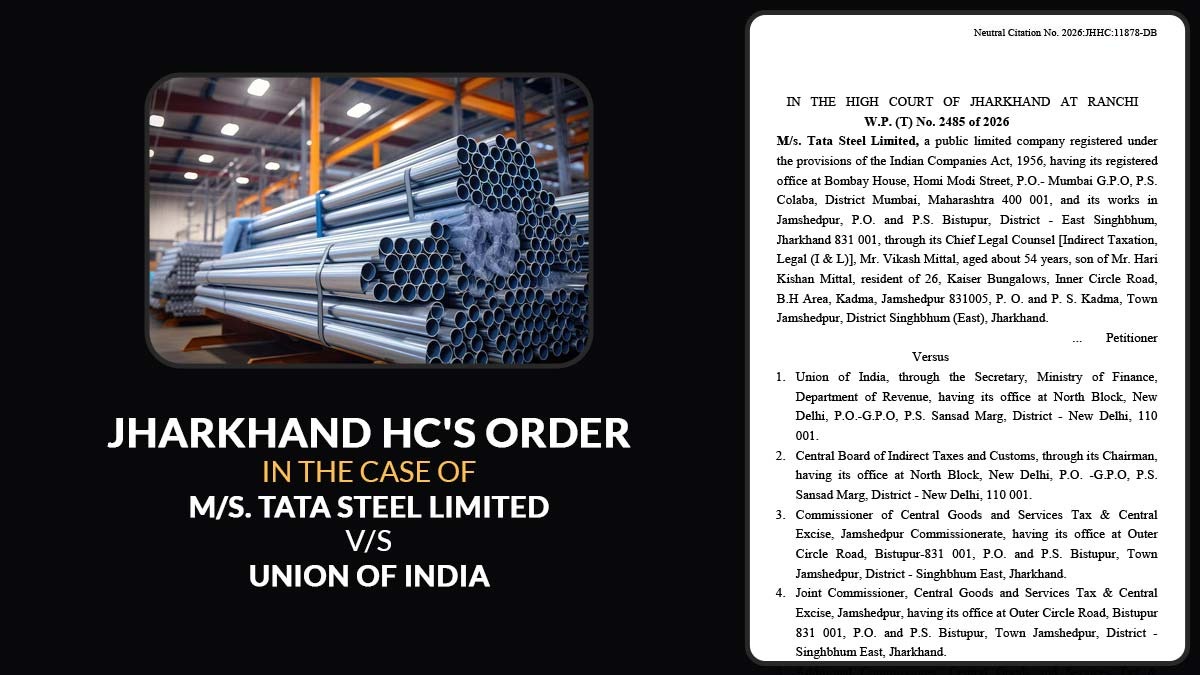
The Jharkhand High Court has not acknowledged a writ petition submitted by Tata Steel Limited contesting a GST adjudication order that includes alleged incorrect availment of ITC, arguing that the company had not made out a case to bypass the statutory appellate remedy.
The Court held, “We are satisfied that the petitioner has not made out any case for bypassing the alternate statutory remedy of appeal.”
A Bench of Chief Justice M. S. Sonak and Justice Rajesh Shankar outlined that the High Court cannot be converted into an appellate forum in tax matters.
“This Court, in such matters, does not exercise any appellate jurisdiction but only exercises its powers of judicial review.”
The Court said that analysing the correctness of findings in the adjudication order involves re-evaluation of proof and disputed facts, which falls outside the extent of writ jurisdiction.
“Any consideration of such a factor would involve adjudication of the disputed issues and evaluation of the material on record.”
The case emerged from a challenge to an order-in-original dated December 26, 2025, passed under section 74 of the CGST Act, which applies to matters involving allegations like fraud, wilful misstatement, or suppression of facts to evade tax. Tata Steel stated that such necessary ingredients were absent and that the proceedings were thus without jurisdiction.
The company also argued that the show cause notice was founded on an audit report, and that the matter had previously been placed in the call book but was later removed to prevent the proceedings from becoming time-barred.
It claimed that this process breached the principles of natural justice and fair play, and asserted that its jurisdictional objections were not adequately considered in the adjudication order.
The revenue countering the petition stated that no exceptional situations exist to explain the bypassing of the appellate remedy. It said that Tata Steel had been furnished with a chance to answer to the SCN, that its submissions were duly regarded, and that any grievances on merits could be addressed before the appellate authority.
Important: How GST Software Fixes Common Mistakes in SCN Replies
The High Court agreed with the Revenue, stating that the dispute involved factual issues that needed examination. These included whether there was a wrongful claim for input tax credit and whether fraud or suppression occurred. The Court noted that such matters could not be settled in writ proceedings and were better suited for the appellate forum, which has broader powers to review both facts and law.
The Court dismissed the argument that the proceedings were completely without jurisdiction, stating that the SCN could not be deemed to have been issued without meeting the necessary conditions at the outset. It clarified that whether those conditions were ultimately satisfied is a matter for a merits-based adjudication, which should be evaluated on appeal.
On the appeal of breach of natural justice, the court did not discover any substance, noting that an SCN had been issued and a chance to reply had been given.
“Again, whether such answers are correct or not is something that cannot be easily tested by the petitioner by availing of the alternate statutory remedy. However, this is not a case of a patent failure of natural justice as was sought to be projected.”
The court noted that the jurisdictional objections raised by Tata Steel were closely connected to disputed factual issues. As a result, these objections could not be considered cases of a complete lack of jurisdiction that would justify intervention at the writ stage.
The court determined that neither of the recognised exceptions for bypassing alternative remedies applied in this situation. Consequently, it declined to hear the writ petition and dismissed it.
Also Read: Punjab & Haryana HC Calls GST Notice Vague for Alleging Excess ITC Without Evidence
However, it provides liberty to Tata Steel to submit a statutory appeal within 4 weeks, asking that if the appeal is submitted within that duration, the appellate authority will regard it on its merits without rejecting it based on limitation.
The court mentioned that all claims of the parties are stayed open to be determined via the appellate authority and that its observations were limited to the issue of maintainability of the writ petition.
| Case Title | M/s. Tata Steel Limited v. Union of India |
| Case No. | W.P. (T) No. 2485 of 2026 |
| For Petitioner | Mr Kavin Gulati, Mr Salona Mittal |
| For Respondent | Mr Amit Kumar, Mr Anurag Vijay |
| Jharkhand High Court | Read Order |