

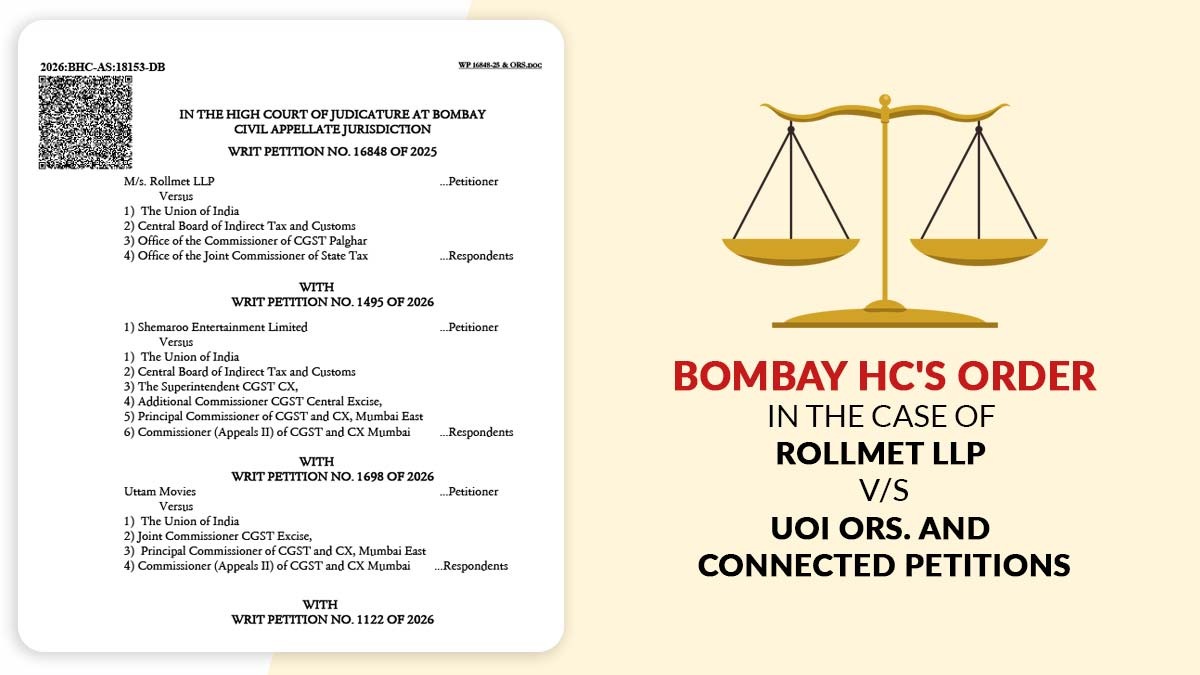
A larger bench of the Bombay High Court will determine whether the Goods and Services Tax (GST) department is permitted to issue a single notice covering multiple financial years under Sections 73 and 74 for tax-related issues. This decision involves a case known as Rollmet LLP against the government, along with other related cases.
A group of judges, including Justices GS Kulkarni and Aarti Sathe, decided to pass a case on to a larger panel of three judges on April 17. This decision came while they were reviewing a collection of petitions filed by Rollmet LLP and other taxpayers from various industries, including real estate, banking, logistics, manufacturing, etc.
The petitions were filed contesting consolidated SCNs which covers several financial years.
The claim was that the CGST scheme is year‑wise, and that a single SCN bunching different years breaches the limitation framework in Sections 73(10) and 74(10) and is thus without jurisdiction. Section 73(10) mandates a final order in non-fraud cases within 3 years of the annual return due date or the incorrect refund date. Section 74(10) extends this outer limit to 5 years for fraud, wilful misstatement, or suppression cases.
The applicants put reliance on the ruling by the bench in Goa in Milroc Good Earth Developers vs. Union of India, followed by the Nagpur bench rulings of Paras Stone Industries and Rite Water Solutions, which held that there is “no provision” in the CGST Act to club tax periods and therefore, consolidated SCNs are not valid. Also, they mentioned that similar views of the Madras, Kerala, and Karnataka High Courts, which outlined that each fiscal year is a distinct unit for assessment and limitation.
Important: How GST Software Handles Notices & Hearings Easily U/S 73
The GST Department pointed to contrary decisions of the Delhi High Court in Mathur Polymers and Ambika Traders, and of the Allahabad High Court in SA Aromatics, upholding consolidated SCNs that include multiple financial years. These are relevant for cases that have fake Input Tax Credit (ITC) where the transactions occurred over several years.
The bench interpreted Sections 73 and 74 as a self-contained “code” regulating demand and recovery. The Court, upon a plain reading, does not discover any indication that sub-section (10) of either Section 73 or 74 was intended to limit or prohibit a consolidated SCN which includes multiple periods.
The Court noted that considering the limitation provisions as a bar on clubbing different periods shall lead to rewriting the statute. The judges marked the difference of views across High Courts and mentioned doubt whether the Milroc judgment shows the legislative scheme. Therefore, it referred the matter before a larger bench.
| Case Title | Rollmet LLP V/S UOI Ors. and Connected Petitions |
| Case No.: | WRIT PETITION NO. 16848 OF 2025 |
| Counsel For Petitioner | Mr Abhishek A. Rastogi, Ms Pooja M. Rastogi, Ms Minal Songire, Ms.Aarya |
| Counsel For Respondent | Mr Karan Adik AW, Mr Suman Kumar Das |
| Bombay High Court | Read Order |