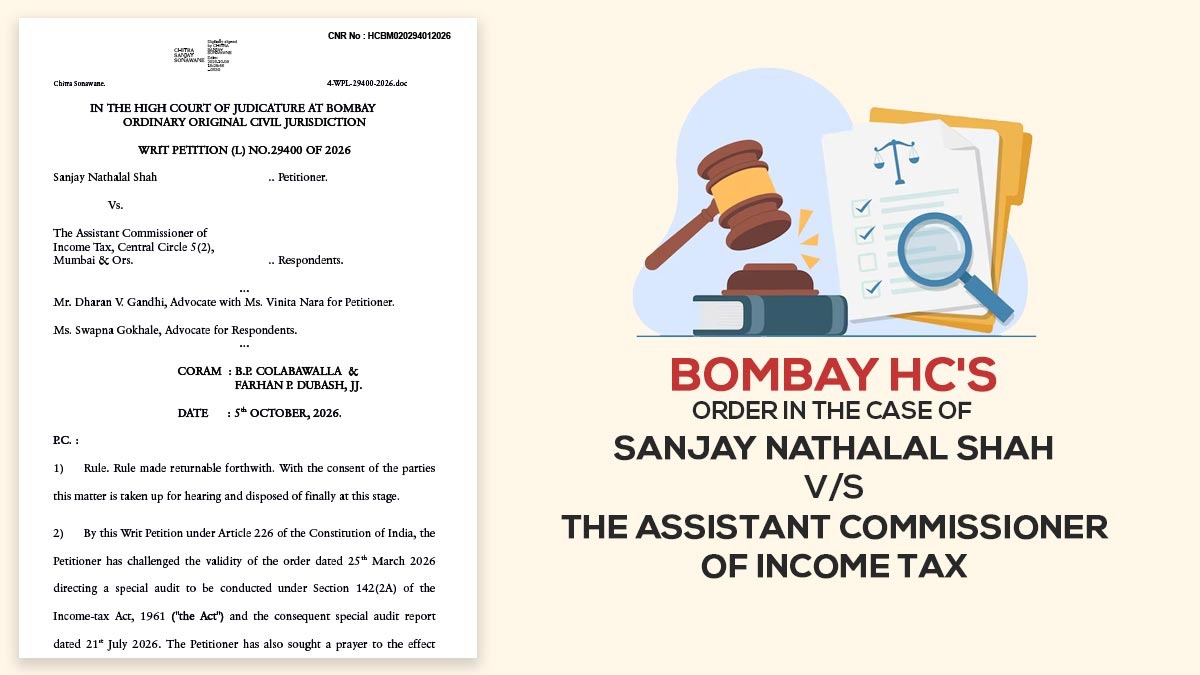


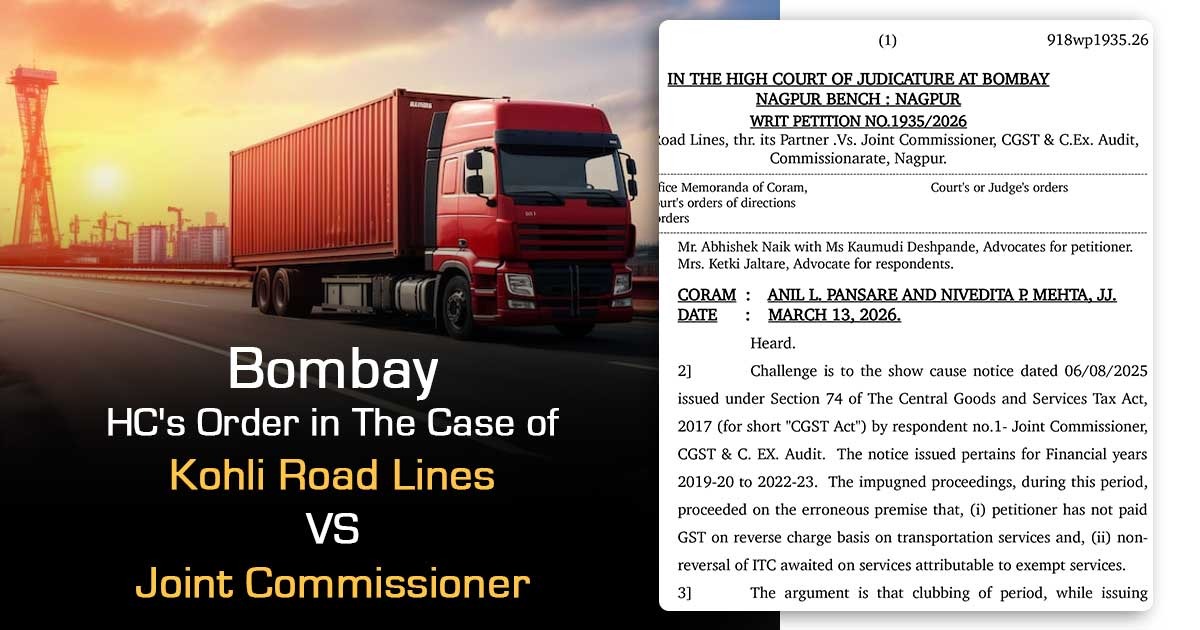
The Bombay High Court’s Nagpur Bench has cancelled a GST notice that required someone to explain their actions regarding taxes. The court decided that tax officials cannot combine several years of financial information into one notice when they are assessing taxes and trying to collect owed money. This ruling is based on the Central Goods and Services Tax (CGST) Act under section 74.
The Bench of Justice Anil L. Pansare and Justice Nivedita P. Mehta has stated that consolidation would collapse various regulatory timelines and procedural safeguards, which the law does not allow.
The main issue is whether tax authorities could issue a single SCN that includes various financial years. The applicant mentioned that the same clubbing of tax durations is contrary to the statutory scheme of the CGST Act, which treats each financial year as a distinct tax period.
This claim has been accepted by the court, putting reliance on its earlier rulings, along with Milroc Good Earth Developers and Rite Water Solutions (India) Ltd., which categorically held that consolidation of multiple financial years in a single notice is not allowable u/s 74.
The Bench made an analysis of the CGST structure and shows various aspects. The GST regime is structured for defined tax periods, which are associated with the returns submitted for each fiscal year. Sections 73 and 74 cite limitation periods for issuing orders of three years and five years, respectively, from the deadline of the annual return for each fiscal year. Such limitation durations function independently for each year, which makes consolidation legally untenable. Combining multiple years into a single notice shall disrupt regulatory timelines and harm the ability of the taxpayer to answer every year.
Delhi High Court’s Perspective Distinguished
The Revenue put reliance on a contrary ruling from the Delhi High Court in the case of Mathur Polymers, where the court allowed consolidated notices in cases involving alleged fraudulent Input Tax Credit (ITC) claims spanning multiple years. They also claimed that the Supreme Court had chosen not to interfere with that judgment.
However, the Bombay High Court clarified that the dismissal of a Special Leave Petition at the initial stage does not equate to an affirmation of the case’s merits and does not invoke the doctrine of merger. Therefore, the ruling from the Delhi High Court was not binding in this instance. The Bench further noted that its own subsequent decisions had taken a different stance, which would persist within its jurisdiction.
Relief Granted with Permission to Reissue Notice
The court, permitting the petition, quashed the impugned SCN. But it granted tax authorities the liberty to issue fresh notices as per the law, ensuring compliance with the regulatory provisions of separate assessment for each fiscal year.
The Court stated that if the earlier rulings of the Bombay High Courts are overturned by the Supreme Court in the future, the authorities shall be allowed to revive the proceedings.
| Case Title | Kohli Road Lines, thr. its Partner .Vs. Joint Commissioner |
| Case No. | Writ Petition No.1935/2026 |
| For Petitioner | Kohli Road Lines, thr. Its Partner .Vs. Joint Commissioner |
| For Respondent | Mrs. Ketki Jaltare, Advocate |
| Bombay High Court | Read Order |