

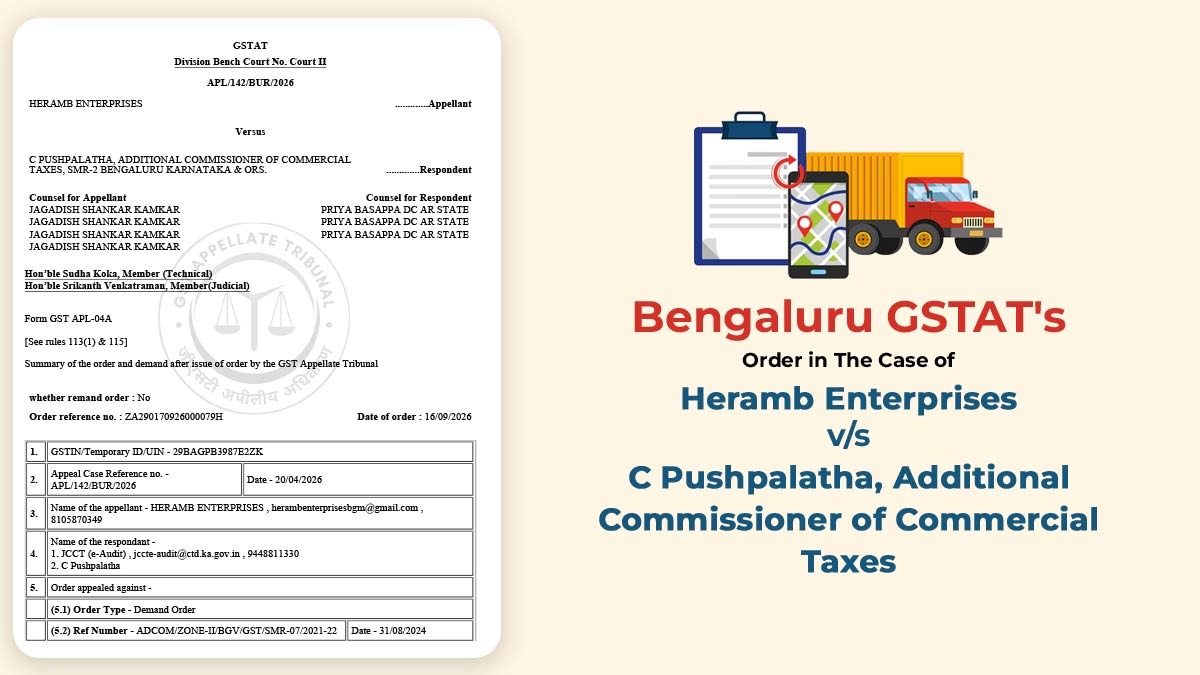
The Bengaluru Bench of the Goods and Services Tax Appellate Tribunal (GSTAT) has upheld a penalty imposed on a taxpayer for supply chain non-compliance.
The tribunal dismissed the appeal after GST authorities established that the consignment was being unloaded at an unauthorised location inconsistent with the address specified in the accompanying tax invoice and e-way bill.
The Tribunal said that the following generation of an e-way bill and invoice after interception could not cure the breach u/s 129 of the CGST Act, as the needed documents for the actual destination were not present when the vehicle was intercepted.
A division bench, Judicial Member Srikanth Venkataraman and Technical Member Sudha Koka, upheld the order of the Revisional Authority, which had reinstated the penalty imposed by the proper officer.
The case relates to a vehicle interception at Udayambag, Belagavi, on October 6, 2020, while the vehicle was carrying plywood.
The goods were being unloaded at REC Flow Technology LLP; however, the tax invoice and e-way bill present with the vehicle included transportation from Intercon Wood Industries, Perumbavoor, Kerala, to the appellant’s premises at Vadgao, Belagavi.
The proper officer determined that the movement of goods to REC Flow Technology LLP was unsupported by valid statutory documents and subsequently levied a penalty u/s 129 of the CGST Act. The appellant later generated the requisite tax invoice and e-way bill on the same date.
Granting relief to the appellant, the First Appellate Authority observed that the goods had reached the destination within the validity period of the e-way bill and there was no intention to evade tax. It reduced the penalty to ₹500 each under the CGST and KGST Acts.
The Revisional Authority subsequently reversed the order and restored the original penalty. It observed that the e-way bill relied upon by the appellant was generated only after the vehicle was intercepted and appeared to have been created subsequently to justify the contravention.
The appellant before the Tribunal said that the supplier, transporter and recipient were registered dealers, the transaction was genuine and recorded in the books, and the e-way bill could not be generated earlier because of a technical glitch. It mentioned that the revisional proceedings were barred by limitation.
The limitation objection has been denied by the bench. Referring to the Supreme Court’s decision regarding the ‘cognisance for extension of limitation’ and the subsequent ruling in the G.R. Infra Projects Ltd. vs. State of Madhya Pradesh case, the Court held that the relaxation in time limits granted due to COVID also applies to departmental proceedings.
Important: GSTAT: Definition, Members, Delay Reason and Domino Effect
Considering the merits of the case, the Tribunal observed that under Section 68, it is mandatory for the person in charge of the vehicle to carry the e-way bill and other prescribed documents, whereas Section 129 applies when the transportation of goods is carried out in violation of the Act or the rules.
The Tribunal discovered that the appellant knew about the method but did not generate the e-way bill and tax invoice for delivery to REC Flow Technology LLP before the movement. It observed that no proof was there to claim the technical glitch.
“The appellant had raised an e-way bill and tax invoice only after coming to know about the detention of goods. It is not possible to accept the contention of the appellant that the e-way bill could not be generated due to a technical glitch. No evidence was furnished by the appellant to support this plea. It is clear the appellant had the intention to evade the payment of taxes due to the Government”, the bench stated.
The Tribunal held that the generation of documents following the interception was an afterthought, and the absence of necessary documents at the time of interception constituted a deliberate act aimed at evading tax payment.
“We are of the view that the absence of tax invoices and e-way bill at the time of interception has to be treated as a wilful act to evade payment of taxes. When the mandate of law is that the goods being transported must be accompanied by relevant statutory documents and if the goods are being transported without the relevant statutory documents, the consequences would follow”, the Court mentioned.
Read Also: Allahabad HC: Penalty Invalid for GST E-Way Bill Expiry Caused by Vehicle Breakdown
The Court also distinguished the cases cited by the appellant regarding expired e-way bills and procedural breaches, stating that those rulings did not apply to the circumstances of the present case.
Therefore, the Tribunal confirmed the order of the Revisional authority and dismissed the appeal.
| Case Title | Heramb Enterprises vs. C. Pushpalatha, Additional Commissioner of Commercial Taxes |
| Case No. | APL/142/BUR/2026 |
| Counsel for Appellant | Jagadish Shankar Kamkar |
| Counsel For Respondent | Priya Basappa |
| Bengaluru GSTAT | Read Order |