

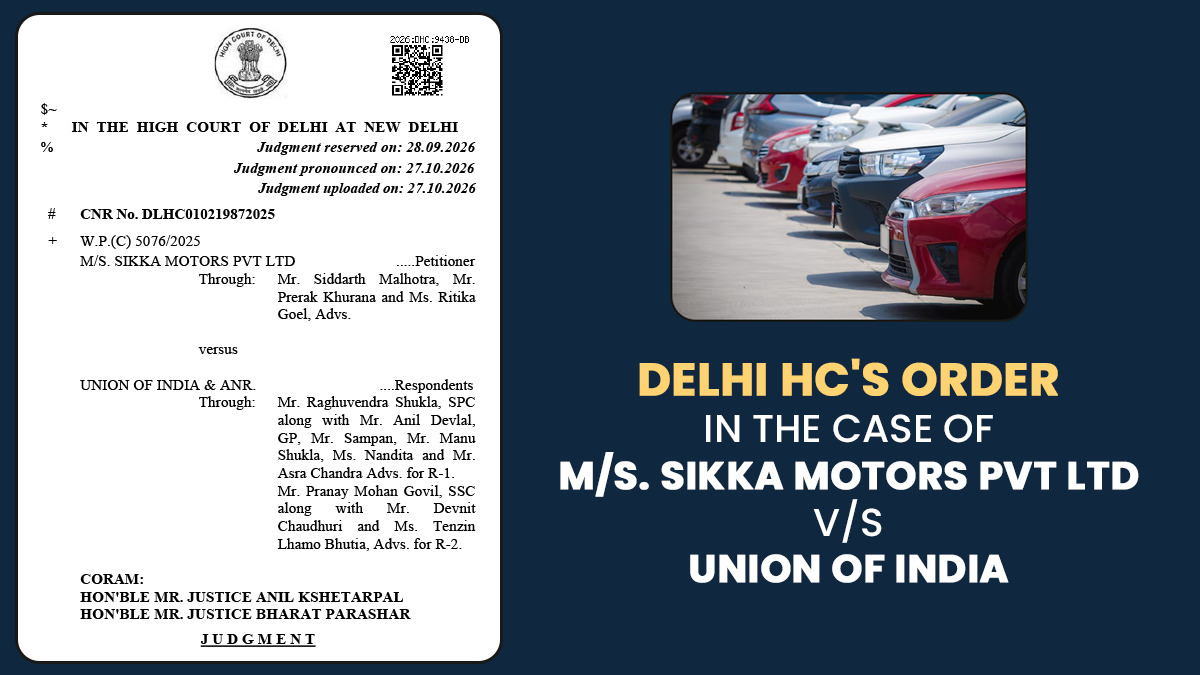
The applicant, M/s. Sikka Motors Pvt. Ltd., is in the business of a Hyundai car dealership and was registered under the GST Act in 2017. During the scrutiny of its GST returns for the financial year 2019-20, the department claimed that the applicant had wrongfully claimed Input Tax Credit (ITC) amounting to Rs. 10,57,392 from suppliers whose registrations had been retrospectively cancelled, as well as Rs. 5,57,720 from suppliers who had not filed their GSTR-3B returns.
Additionally, the department raised concerns regarding an outstanding late fee of Rs. 1,03,100 for the delayed filing of Form GSTR-1 and the non-payment of interest totalling Rs. 3,39,603 due to delayed GST payments. The discrepancies were communicated to the applicant via Form ASMT-10 dated 29/02/2024. The department then provided opportunities for personal hearings on 12/07/2024, 22/07/2024, and 31/07/2024.
Following these hearings, the department issued a Show Cause Notice, which was later followed by an Order-in-Original. Dissatisfied with the proceedings, the applicant approached the Delhi High Court, arguing that the SCN was issued after the stipulated statutory limitation period.
After examining the documents submitted and the relevant legal provisions, the High Court observed that Section 73(10) of the CGST Act prescribes a maximum time limit for passing an adjudication order, while Section 73(2) mandates that a ‘Show Cause Notice’ must be issued at least three months before the expiry of this time limit.
The Court observed that in the Notification No. 56/2023-Central Tax dated 28/12/2023, the limitation period for passing an order u/s 73(10) for FY 2019-20 had been extended up to 31/08/2024. As a result, the Show Cause Notice needed to be issued by 31/05/2024.
However, it was only made available to the petitioner on the GST portal on 08/08/2024, which was well past the deadline. The Court dismissed the department’s argument that the notice had been generated on time in its internal AIO system but could not be uploaded to the GST portal due to a technical issue.
The Court observed that Section 169(1) furnishes various other modes of serving notices, along with registered post, speed post, and email. Although the department was aware of the technical glitch, it did not try to serve the notice using any alternative legal methods. The department cannot excuse its failure by citing a technical issue with its own system, as administrative mistakes should not harm taxpayers or extend the limitation period set by Parliament.
The petitioner’s alleged failure to respond to Form GST ASMT-10 or participate in personal hearings was irrelevant to the limitation issue. This non-response did not exempt the statutory limitation requirement, nor did it relieve the department of its duty to issue the notice within the stipulated timeframe.
Consequently, the Court deemed the SCN to be time-barred and ruled that the Order-in-Original dated August 23, 2024, could not be upheld in law. As a result, the High Court quashed both the Show Cause Notice and the related Order-in-Original and allowed the writ petition.
| Case Title | M/s. Sikka Motors Pvt Ltd Vs Union of India |
| Case No. | W.P.(C) 5076/2025 |
| For the Petitioner | Mr Siddarth Malhotra, Mr Prerak Khurana, Ms Ritika Goel |
| For the Respondent | Mr Raghuvendra Shukla, Mr Anil Devlal, Mr Sampan, Mr Manu Shukla, Ms Nandita, Mr Asra Chandra, Mr Pranay Mohan Govil, Mr Devnit Chaudhuri, Tenzin Lhamo Bhutia |
| Delhi High Court | Read Order |