


As the December 31, 2026 deadline approaches, the filing of GSTR-9 for the financial year 2025-26 is becoming a significant topic of discussion among chartered accountants, tax professionals, and businesses. What might seem like a straightforward annual compliance task is evolving into an intricate reconciliation process, particularly concerning Input Tax Credit (ITC), amendments, and reporting requirements.
Conversations among GST professionals on social media have emphasised the increasing challenges of accurately completing annual returns. From understanding the appropriate treatment of reclaimed ITC to identifying discrepancies in reporting across different tables, experts are advising businesses not to wait until the final weeks to tackle this important task.
Why Has Complexity in GSTR-9 Emerged This Year
A significant point in this discussion is the ICAI’s updated Technical Guide on the GST Annual Return (as of November 2026). Released on November 23, this guide incorporates legislative amendments, procedural changes, and developments related to the GST portal up to October 2026.
The updated particulars outline table-wise reporting of ITC, along with the credit reversed and subsequently reclaimed under Rules 37 and 37A.
For professionals managing multiple GST registrations, the challenge lies not merely in calculating the closing ITC balance; rather, it involves determining when the credit was originally claimed, when it was reversed, the reasons for such reversal, and the financial year in which it was subsequently re-claimed.
Special Attention Needed for ITC Reclaims Under Rules 37 and 37A
The GST ITC (Input Tax Credit) reclaimed under Rules 37 and 37A requires attention. The updated guidance specifies that when ITC is reversed in an earlier financial year and later reclaimed under Rule 37 or Rule 37A, the reclaimed amount is considered ITC for the financial year in which it is reclaimed.
As a result, this credit should be reported in Table 6H of GSTR-9 for the year in which the reclamation occurs.
For example, if a business reverses ITC of ₹50,000 in FY 2024-25 and reclaims it in FY 2025-26 under Rule 37A, the reclaimed amount is mandated to be reported in Table 6H of the FY 2025-26 annual return.
This distinction is important because reporting the same amount in the incorrect table can lead to reconciliation discrepancies and may result in duplicate ITC reporting.
Updated ITC Reporting Fields Need Effective Reconciliation
Another key revision for the 2025-26 financial year is the inclusion of separate fields to distinguish between the previous year’s ITC and the current year’s ITC.
The new reporting structure consists of:
- Table 7A1: ITC reversal under Rule 37A.
- Table 7A2: ITC reversal under Rule 38.
- Table 6A1: ITC of previous financial years but claimed during FY 2025-26, excluding Rule 37 and Rule 37A reclaims.
- Table 6A2: Net ITC concerning FY 2025-26, calculated after deducting the amount in Table 6A1 from Table 6A.
Due to these changes, it has become important to reconcile the Form GSTR-3B data with the ITC ledger, GSTR-2B, and supporting documents before finalising the annual return.
Importers Should Analyse the New Table 8H1
Businesses that import goods have an additional reporting requirement they need to consider. Table 8H1 includes the IGST paid on imports during the financial year 2025-26 that is claimed as Input Tax Credit (ITC) in a subsequent financial year.
Importers are required to check their Bills of Entry, ICEGATE records, GSTR-2B, and GSTR-3B to ensure that the import-related credits are accurately reflected.
This change aims to improve the reconciliation of import IGST and to avoid discrepancies between the available credit and the credit actually claimed.
GSTR-9 and GSTR-9C: Who Should File?
Not every registered taxpayer needs to file GSTR-9. The applicable turnover limit specifies the filing requirements.
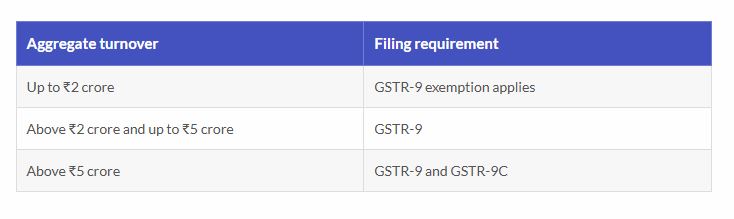
The thresholds can be evaluated via aggregate turnover on an all-India basis under the same PAN. The applicable annual returns and reconciliation statements are due by December 31, 2026.
Late Filing Causes Compliance Obligation
Skipping the deadline for the annual return may lead to late fees u/s 47 of the CGST Act. The late fee for GSTR-9 is computed on a per-day basis, subject to statutory limits and turnover-based slabs.
Additionally, businesses required to file GSTR-9C should pay attention to its submission timeline. Delaying the reconciliation statement, even after filing GSTR-9, can result in separate late-fee implications, as clarified by CBIC Circular No. 246/03/2025-GST.
What Accountants Are Required to Complete Before 31st Dec
With the upcoming deadline, GST professionals are now focusing more on completing the reconciliation process rather than waiting until the final days to prepare annual returns.
Some specific checks are-
- Check the ITC with GSTR-2B: Verify the eligible credit, reversals, reclaims, and missed entries.
- Check import-related ITC: Match Bills of Entry with ICEGATE data and the credit claimed in returns.
- Validate HSN-wise disclosures: Ensure the summary in Table 17 agrees with the underlying sales records.
- Reconcile GSTR-1 with GSTR-3B: Determine the differences in outward supplies, tax liability, and revisions.
- Review Rule 37 and Rule 37A transactions: Keep a year-wise records of reversals and following reclaims.
- Complete GSTR-9C reconciliation: Businesses exceeding the ₹5 crore threshold must ensure that turnover and tax differences are accurately explained.
Another date that warrants attention is November 30, 2026. U/s 16(4), this is the last date for claiming eligible Input Tax Credit (ITC) corresponding to the financial year 2025-26, or the date of filing the annual return, whichever is earlier. Therefore, rather than viewing December 31 as the sole compliance deadline, businesses should review any pending credit claims before this cut-off date.
Tax Professionals Make Use of Updated Guides, Diagrams and Webinars
The increasing complexity of annual GST reporting has led to a growing demand for practical reference material. Accountants and tax practitioners are sharing section-by-section explanations, ITC reporting diagrams, reconciliation manuals, and webinar updates to help their peers navigate these changes.
The broader discussion is now shifting its focus: rather than just concentrating on how to file GSTR-9, the emphasis is increasingly on ensuring that every figure reported in GSTR-9 is accurately reconciled and can be substantiated through supporting records.
Closure: For the financial year 2025-26, GSTR-9 warrants a high degree of attention to detail, notably because additional fields for ITC reporting have been introduced, and a clear distinction has been made between credits pertaining to the current year and adjustments related to the previous year.
For accountants managing multiple clients, getting an early start can prove highly beneficial. Reviewing reconciliations, documenting ITC reversals and reclaims, and staying updated on the latest ICAI guidelines can all help minimise avoidable errors.
As December 31 is near, the challenge is filing the annual return within the stipulated time as well as ensuring that the numbers declared are correct, consistent, and defensible if questioned in a future GST scrutiny or audit.