

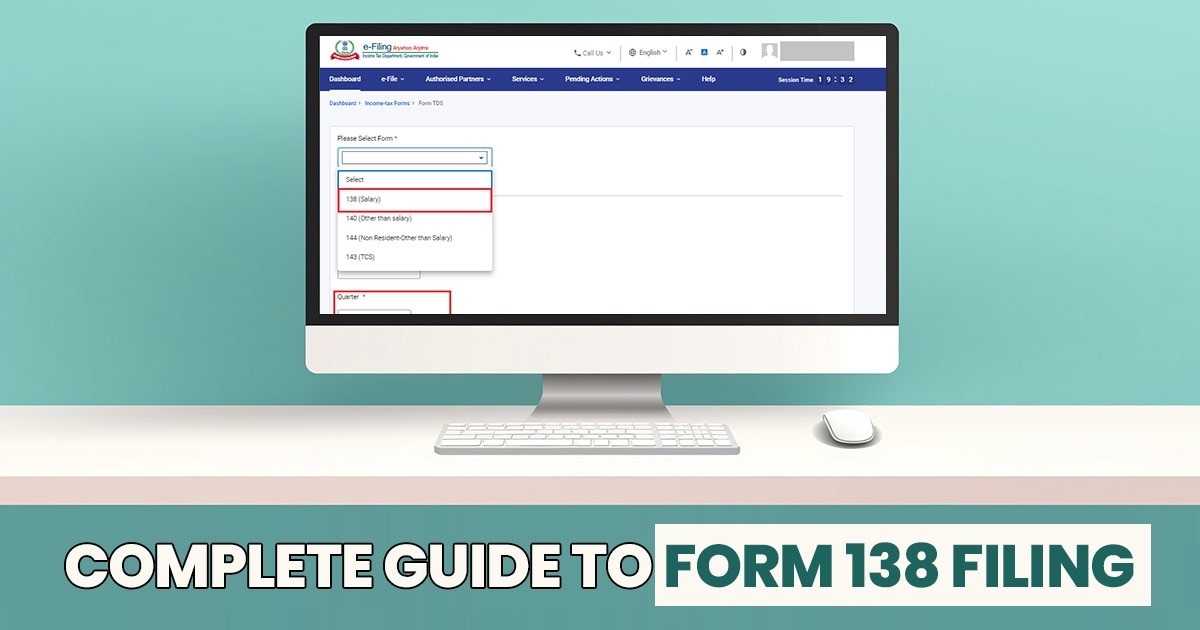
The Income Tax Act, 2025 introduces a revised framework for several tax compliance forms. Under this change, Form 138 has been implemented to replace the erstwhile Form 24Q for the reporting of Tax Deducted at Source (TDS) on salary payments.
Although the form number has changed, its purpose remains the same. Form 138 filing is used to provide quarterly details of TDS deducted from employees’ salaries. It also includes TDS deducted by specified banks on payments made to eligible senior citizens in accordance with the applicable provisions of the Act. Accurately filing the form within the required timelines is crucial for ensuring proper TDS credit for deductees and for helping employers fulfil their statutory compliance obligations.
Understanding Form 138
Form No. 138 is specified as a quarterly TDS statement stipulated under the Income Tax Act, 2025. It is used to report tax deducted from salary income u/s 392. It comprises reporting requirements for TDS deducted by particular banks on payments made to eligible senior citizens u/s 393(1).
Starting from the year 2026–27, Form 138 will substitute the existing Form 24Q. This change is administrative and does not revise the fundamental reporting requirements.
Objective of Form 138
The purpose of filing Form 138 is to-
- Report TDS deducted from employees’ salaries during each quarter.
- Report tax deducted by specified banks on eligible senior citizen payments.
- Ensure accurate reflection of TDS credits in taxpayers’ records.
- Reconcile the tax deducted with the tax deposited to the Government.
- Promote transparent and standardised TDS reporting under the new tax framework.
Who Must File Form 138?
The below-mentioned deductors should submit Form No. 138 –
- Employers deducting TDS from salary u/s 392.
- Central and State Government departments are accountable for salary payments.
- Companies, LLPs, partnership firms, trusts, societies, and other employers are responsible for deducting tax from salaries.
- Specified banks deduct TDS on payments to eligible senior citizens u/s 393(1).
Applicability Criteria for Form 138
Form 138 filing is applicable when:
- TDS has been deducted from salary payments.
- Tax deducted in the quarter has been deposited with the Government.
- A specified bank deducts tax from payments made to eligible senior citizens.
Whenever tax has been deducted during a given quarter, it is mandatory to file a quarterly statement, regardless of the number of employees involved.
Details Needed to File Form 138
Before preparing the return, the deductor must keep the below-mentioned information in hand:
- TAN and PAN of the deductor.
- Name and address of the employer or bank.
- Relevant financial year and quarter.
- Challan details relating to the tax deposited.
- PAN of each deductee.
- Salary paid during the quarter.
- Amount of tax deducted and deposited.
- Dates of deduction and payment.
- Details of any applicable interest or late filing fee.
Ensuring the accuracy of such information helps avoid verification errors and processing delays.
Form 138 Due Dates (TY 2026–27)
| Quarter | Period | Due Date |
|---|---|---|
| Q1 | April – June | 31 July 2026 |
| Q2 | July – September | 31 October 2026 |
| Q3 | October – December | 31 January 2027 |
| Q4 | January – March | 31 May 2027 |
It is suggested to complete the filing of Form 138 before the deadline, so that there is enough time to resolve any validation or technical issues.
Recommended: TDS and TCS Return Filing Due Date for TY 2026-27
Form 138 Filing Process
The process of filing Form No. 138 includes the below-mentioned steps:
Step 1: Compile salary and TDS details for the relevant quarter.
Step 2: Verify employee PANs, challan particulars, and tax deduction details.
Step 3: Prepare Form 138 using the utility prescribed by the Income-tax Department.
Step 4: Validate the statement through the prescribed file validation utility.
Step 5: Upload the validated statement on the authorised e-filing portal.
Step 6: Download and retain the acknowledgement generated after successful submission for future reference.
Annexures in Form No. 138
Depending on the reporting requirements, Form 138 includes various annexures.
- Annexure I includes deductee-wise TDS information and is submitted every quarter.
- Annexure II is submitted with the fourth-quarter return and includes annual salary details, exemptions, and tax computations.
- Annexure III is applicable where specified banks declare TDS deducted on eligible senior citizen payments.
Late or Wrong Filing Outcomes
Unable to submit Form 138 precisely or within the stipulated time can result in-
- Change of late filing fees
- Interest for late deduction or deposit of TDS
- Penalties for non-compliance or wrong reporting
- Late granting of TDS credit to employees
- Notices or further scrutiny from the Income Tax Department
Filing on time and accurate declaration supports preventing unwanted compliance problems.
Effective Practices for Deductors
To ensure seamless compliance-
- Validate employee PAN information before filing
- Match challan details with tax payment records
- Reconcile payroll information every quarter
- Instead of waiting until the last day, complete the filing before the due date.
- Keep the acknowledgement and supporting documents for future verification.
- Evaluate the return thoroughly before filing
Form 24Q vs. Form 138: Key Changes
| Particulars | Form 24Q | Form 138 |
|---|---|---|
| Applicable Law | Income-tax Act, 1961 | Income-tax Act, 2025 |
| Type of Return | Quarterly TDS statement for salary payments | Quarterly TDS statement for salary payments |
| Form Number | Form 24Q | Form 138 |
| Reporting Purpose | Salary TDS reporting | Salary TDS reporting |
This change primarily reflects an adjustment in form numbering under the new law, while the purpose of reporting remains largely the same as before.
Also Read: All About TDS Return Forms 138, 140, 143, and 144 with Due Dates
Closure
Form 138 filing is the specified quarterly statement for reporting salary-related Tax Deducted at Source (TDS) under the Income Tax Act of 2025. While it substitutes Form 24Q, employers and specified banks are expected to follow a similar reporting process in accordance with the updated legal framework.
It is essential to provide accurate information, ensure timely filing, and properly reconcile payroll and challan data to facilitate smooth compliance and timely credit of TDS to the deductees. Gen TDS Software simplifies Form 138 preparation and e-filing for CA’s, CS’s, and tax professionals. It enables deductors to prepare TDS statements, manage challans, and complete TDS filing requirements more efficiently.
Check the User Manual for Form 138:
https://www.incometax.gov.in/iec/foportal/newformpage/forms/form138-um
Download Form No. 138