


Tax Deducted at Source or TDS refers to an advance tax that is deducted from the income or earnings of an individual or an organisation before actually crediting the income into the account of an individual or entity, as per the Taxation Code of India.
As the name suggests, Tax deducted at source, it is the tax that is deducted or subtracted from the income at the source from where the income was generated. The tax so collected at source is directly contributed to the government’s revenue on behalf of the taxpayer or income generator.
So, the TDS on the earnings of individuals and businesses become one of the sources of government revenue, and this is the reason why the provisions of TDS play an important role for the government.
Tax Deducted at Source applies to both kinds of income – Regular income as well as Occasional or Irregular income. So, we can say that TDS is deducted from various incomes such as Salary, Commission, professional fees, and Interest. However, TDS is not confined to just these incomes.
The responsibility of deducting the TDS lies on the shoulders of the TDS deductor, that is, the employer or the payee. The payee or the employer owes an obligation to deduct the tax before paying the salary or income to the receiver or employer. Here is a brief list of individuals who are TDS Deductors (who are liable to deduct TDS) under the Taxation Rules.
Latest Update
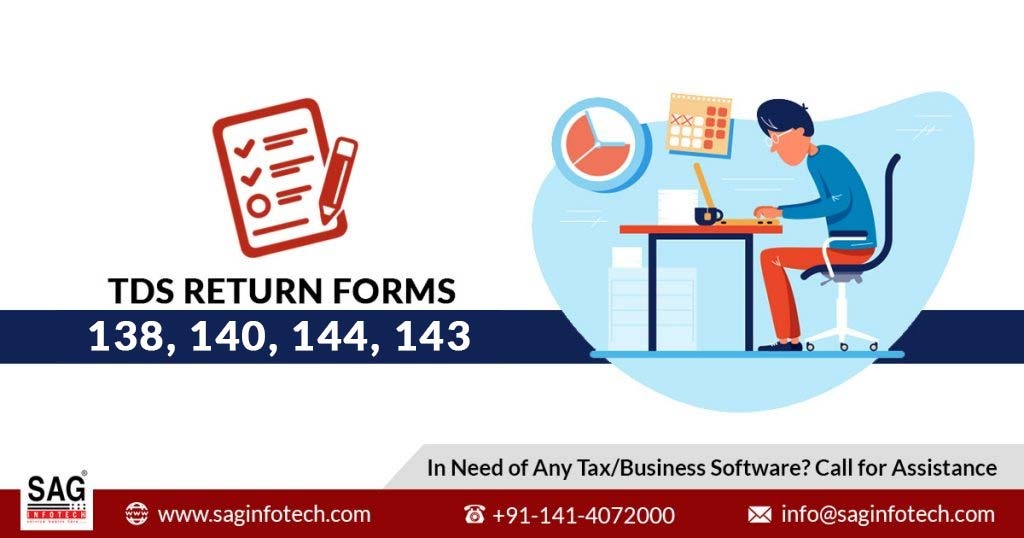
- From 1st April 2026, the TDS Return filing Form No. are revised by the Income Tax Act, 2025; therefore, TDS Return Form No. 24Q, 26Q, 27Q, 27EQ are now replaced by the new form serial no. 138, 140, 144, 143, respectively.
Get a Free Demo of TDS Return Filing Software
List of TDS Deductors
- Individuals
- Body of Individuals
- Association of Individuals
- Partnership Firms
- Hindu Undivided Family
- Limited Companies
- Local Authorities
Benefits of Paying TDS
It is to be noted that TDS can be deducted only from the earnings, which implies that this TDS liability arises only in the case of earnings or income. TDS is deducted ahead of making payment and is taken from the payments which are made in cash, cheque or credit.
The amount so collected under TDS is deposited in the government revenue through different government agencies. The provision of TDS holds benefits for the government as well as the individual on whose behalf TDS has been paid. Now, let’s have a look at the benefits of paying TDS to the government.
- Tax evasion is prevented as tax is deducted at the source.
- Tax is collected promptly.
- A big squad of individuals falls under the tax net.
- TDS collection is a constant source of revenue for the government.
Rate of TDS deduction
TDS is deducted at various rates based on the nature and the amount of income earned. Different TDS rates apply to different kinds of income. The tax has to be paid on the extra amount earned above a certain maximum threshold, which is tax-exempt. TDS rate varies from 1 per cent to 30 per cent on different types of payments, including salaries, commissions, professional fees, interest earned, rent, etc.
Read Also: TDS Online Payment Procedure, Due dates, and Forms: Ultimate Guide
Method of TDS deduction
TDS is deducted by the deductor from the payment made to the receiver at a certain fixed rate applicable to that particular type and source of income. Deductor is liable to deduct the TDS and further deposit it to the government. For instance, when the employer pays a salary to the employee, the employer plays the role of deductor, and the employee becomes the TDS deducted.
Few Noteworthy Points about TDS Returns
- TDS Return refers to a quarterly statement that is submitted by the deductor to the Income Tax Department.
- A TDS Return can be defined as a summary of all the TDS-associated transactions that are carried out during a quarter.
- The TDS statement showcases a summary of all the entries of TDS collected and paid by the deductor to the Income Tax Authority.
- The TDS Return statement contains details such as the deductor’s & deductee’s PAN number, detailed particulars of the TDS contributed to the government’s revenue and the information of the TDS Challan.
Deadlines for TDS Returns Filings
| Quarter | Quarter Period | Due Date of Filing TDS Returns |
|---|---|---|
| 1st Quarter | 1st April to 30th June | 31st July |
| 2nd Quarter | 1st July to 30th September | 31st October |
| 3rd Quarter | 1st October to 31st December | 31st Jan |
| 4th Quarter | 1st January to 31st March | 31st May |
Penalty on Late Filing of TDS Returns
According to the new rules, which became effective from April 1, 2017, a maximum penalty of Rs. 10,000 is leviable on an individual for the late filing of the TDS Return.
- TDS Not Deducting: As of the date when TDS was supposed to be deducted, until TDS was deducted, you were supposed to deduct 1% per month
- Failure to Deposit TDS with the Government: From the date that TDS is deducted to when government payments are made, the rate is 1.5% per month.
- Fees for Late Filing Under Section 427 @ Rs 200 Per Day: Form 141 may be subject to a fine under Section 427 if it is not submitted on time. If Form 141 is not submitted by the end of the day, a fine of Rs. 200 will apply per day. The buyer would pay late deductions, late payments, and interest.
Different Types of TDS Return Forms
The deductor is responsible for deducting the TDS from the income of the deductee and filing the TDS Return form for it. Different types of TDS Return Forms are available for different deductions, depending on the nature of income and the kind of deductee on behalf of whom TDS is paid.
| Name of TDS Old Return Forms | Name of New TDS Return Forms (From 01.04.2026) | Details of the TDS Return Forms |
|---|---|---|
| Form 24Q | 138 | Statement for TDS from salaries |
| Form 26Q | 140 | Statement for TDS from all payments other than salaries. |
| Form 27Q | 144 | Statement for TDS from additional income like interest, dividends, or any other amount payable to NRI (foreigners). |
| Form 27EQ | 143 | Statement for TCS (tax collected at source) |
Let us take a deeper dive into the details of the various kinds of TDS Return Forms.
Form 138 – Statement for TDS from Salaries
This form is used to prepare eTDS returns for the TDS deducted on salary u/s 192 of the Income Tax Act, 1961. This form has to be submitted by the deductor every quarter. It includes details such as salaries paid and the TDS deducted from the employees by the employer.
Form 138 has two annexures, which are Annexure I and Annexure II. Annexure I includes the details of the deductor, deductees, and challans, and Annexure II includes the details of the deductees’ salaries.
The submission time of both annexures is different. The deductor has to submit the Annexure-I for all four quarters of the fiscal year, whereas Annexure-II does not need to be submitted for the first three quarters of the fiscal year and has to be filed & submitted for the fourth quarter of the fiscal year with details of the salaries of all the employees of the complete fiscal year.
Form 140 – Statement for TDS From All Payments Other Than Salaries
Form 140 is used for the TDS on all the payments received other than the salary. It has to be submitted by the deductor every quarter and is applicable for TDS u/s 200(3), 193, and 194 of the Income Tax Act of 1961. It is used for TDS on income such as dividend securities, interest on securities, directors’ remuneration, professional fees, etc.
Note:
- The government deductors need to specify “PANNOTREQD” on the form.
- Non-government deductors have to mandatorily furnish PAN.
TDS Form 144 Statement from Extra Income to NRI (Foreigners)
Form 144 is relevant for payments made except for the salary to non-resident Indians and foreigners. It is used for the declaration of TDS for the NRIs and Foreigners. Form 144 is submitted by the deductor every quarter and is relevant for TDS u/s 200(3) of the Income Tax Act of 1961. It is used for TDS on additional income such as interest, bonus or any other sum owed to NRI or foreigners.
Note:
- The government deductors need to specify “PANNOTREQD” on the form.
- Non-government deductors have to mandatorily furnish PAN.
Form 143 – Statement for TCS (Tax Collected at Source)
Form 143 refers to the quarterly statement of TCS that reflects the details of the TDS u/s 206C of the Income Tax Act of 1961. It can also be called as the statement that furnishes the Tax Collected at Source (TCS).
TCS is the tax collected by the seller. When a purchaser purchases some products or commodities, the seller takes the tax from the buyer via the TCS route. This TCS is received when the purchaser makes payment either in cash, cheque, credit, demand draft or through any other payment mode.
Form 143 is submitted by the corporate deductors & collectors every quarter, and it is mandatory to furnish TAN in this form. However, government deductors and collectors can not file this Form.
Note:
- The government deductors need to specify “PANNOTREQD” on the form.
- Non-government deductors have to mandatorily furnish PAN.
Steps to Download TDS Return Forms
TDS Return Forms are classified into four categories. A taxpayer has to opt for a particular category for which he/she want to file TDS Returns. Here is a step-by-step process to download the TDS return forms:
Step 1: Go to the official website of NSDL → https://nsdl.co.in/
Step 2: Click → the “Downloads” tab > choose E-TDS/E-TCS from the drop-down list
Step 3: Click → “Quarterly Returns” > choose → “Regular”
Step 4: Welcome to the new page.
Step 5: Now select the TDS Return Form according to the needs stated under the “Form” section.
General Queries on TDS Return 138, 140, 144, 143 Forms
Q.1 – Which are the various income tax related forms?
Form 138, 140 and 144 are return forms related to TDS which are to be presented by the deductor to Income Tax Department.
Q.2 – What is TDS?
TDS stands for Tax Deducted at Source which means tax is deducted at the time of payment of salary or any other income. Payer or deductor deducts the TDS and submits the amount (TDS amount) as tax to the government. Recipient or deductee receives the TDS subtracted amount as income or salary.
Q.3 – What is Form 138 and how to submit it?
Form 138 is an online TDS return form used for the amount deducted on salary under section 192 of the Income Tax Act. It is a quarterly compliance form.
One can submit Form 138 online as well as offline. However, for some categories online compliance is the must:
- Deductor is a government organization.
- Director or manager of a company.
- If the deductor has account audited for the previous year under section 44AB of Income Tax Act
- If more than 20 employees are recorded in a report for a particular financial year.
Please Note: Online TDS returns are considered only through the Return Preparation Utility (RPU). For this, you need the assistance of third-party vendors or use TDS-RPU which is a government authorized tool available on NSDL for filing TDS.
Q.4 – How Form 138 is different from Form 140?
Form 138 is the form valid when the recipient of payment (deductee) is an employee in the company. Whereas 140 is valid for other domestic incomes excluding salary. One must care about filling the precise form.
Q.5 – How can I get Form 138 for filing TDS returns?
- Step I – Visit NSDL official website link for which is https://www.tin-nsdl.com/
- Step II – Go to “Downloads” then select E-TDS or E-TCS from the dropdown.
- Step III – Click on the “Quarterly Returns” tab and choose “Regular”.
- Step IV – You will land on a new page from where you can select Form 138 for download
Please Note: There are four TDS forms available for download on NSDL. The taxpayer has to choose among them his required TDS form depending on the situation.
Q.6 – Do I need to file Form 140 separately for contractors, professionals, interest, etc.?
No only a single form is required along with separate annexures filed for payments made to each type of resident (annexure should be affixed separately with each challan payment).
Q.7 – What is Form 141 used for? Does Gen TDS software give the facility of downloading Form 141?
Form 141 is Return Cum Challan Statement and is used in case of transferring the immovable property which is more than Rs. 50 Lakhs.
Q.8 – What are the key pointers to accurately file TDS using Form 140?
- Take care of what information you are entering in the form and carry all the relevant documents as proof of the verify your entered data.
- Make sure to verify all your PAN details.
- Reconfirm everything as a slight mistake may lead to the cancellation of your form.
- Keep yourself updated with the news related to return filing. CBDT often extends the last date of filing the TDS and other returns which can prove to be positive news for you as you dont have to hustle with your return filing. Dont easily trust on any website search for a reliable source of information.
- Authorities keep on amending the format of the Forms, make sure you know which is the latest form so that you are not on the wrong track.
Q.9 – What is the penalty for late filing of Form 144?
Mentioned in section 427, the penalty for the late filing of Form 144 is minimum Rs. 200/per day of delay and maximum it can go up to the amount equal to the total TDS deducted. Mentioned in section 461, the Non-filing of form 144 will invite the minimum penalty of Rs. 10,00o and maximum of Rs. 1,00,000.
Mentioned in section 461, no penalty is imposed under the following circumstances:
- TDS is already paid by the deductor but returns are not filed.
- All the dues are clear including the interest and late filing but returns are not furnished.
- Returns are filed before the expiry of 1 year from the starting due date of filing the returns.
Q.10 – What are the steps to generate revised TCS returns (143)?
- Step.1. Select the appropriate Financial Year and Quater. A popup will come on the screen. Select the return type, form, date and quarter of generating the file.
- Step.2. Click on CCSI option Auto ➣ Manual ➣ consolidate.tds file ➣ Generate Returns.
- Please Note: In case you want to check the default before generating the revised TDS than select Generate Returns ➣ Default Predictor Notice.
- Step. 3. Enter the login details on TRACES then the captcha code and click on “TRACES LOGIN”.
- Step. 4. If you have selected Auto CSI option, enter the date and captcha code then click OK.
- Step. 5. After validation of return, download “Form 27A”,”Statitics Report”, “Download FVU”, “Download TXT” and in a folder
Q.11 – What is the way of downloading TDS return forms?
Below is the step-wise guidance to download TDS Return Forms:
- Step:1 Visit NSDL official website the link of which is https://www.tin-nsdl.com
- Step. 2. Click on Downloads and choose from the dropdown E-TDS or E-TCS
- Step 3. Select “Quarterly Returns” then “Regular”
- Step 4: You will land on a new page where you can select the TDS return form (as per the situation) displayed under “Format” section.
To be Noted: TDS return has four different kinds of forms valid under different situations. The taxpayer has to choose the correct form based on the current circumstances.






Very helpful for learning about TDS
Are there any rules to spending government account towards assistant for third party vendor or ca for filling e Tds return in govt office
Contact to NSDL Portal for this
Very helpful for learning of submission of TDS return.
Due dates of TDS return filling are incorrect please rectify.