

The Allahabad High Court has set aside an income tax reassessment proceeding initiated against a deceased person, holding that a notice issued after the death of the taxpayer is void from the start and cannot be verified by later substituting the legal heir.
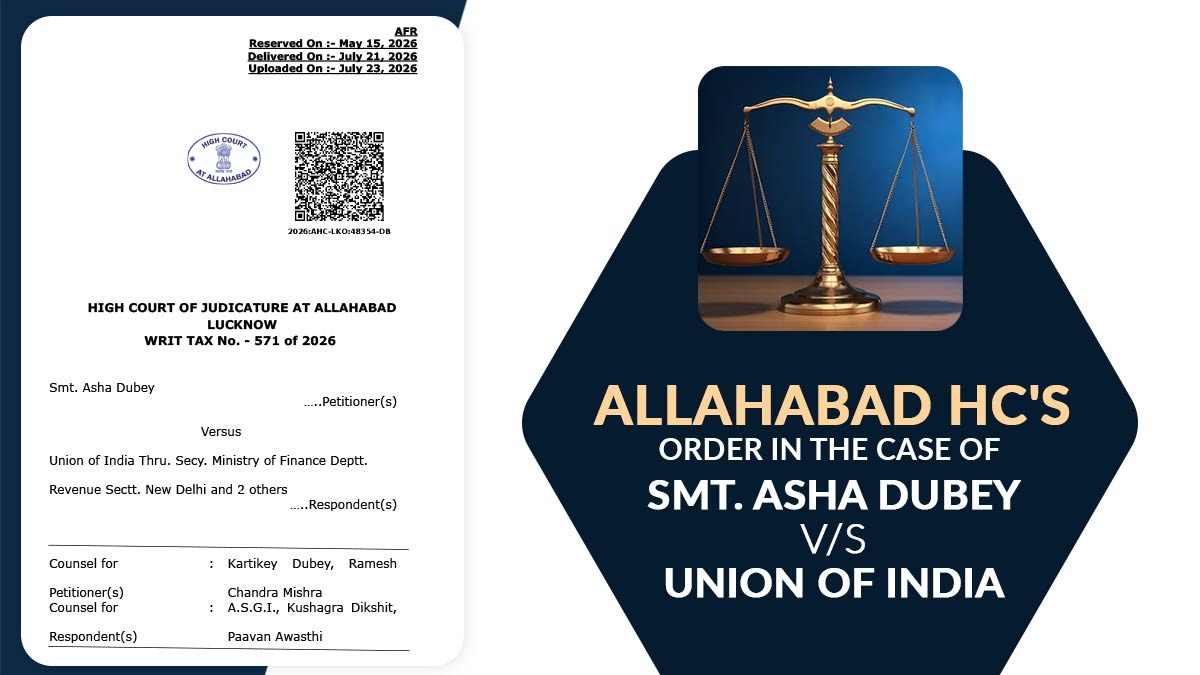
A Bench including Justices Shekhar B Saraf and Abdhesh Kumar Chaudhary provided the ruling in Smt Asha Dubey v. Union of India and Others, observing that “to tax the dead is a contradiction in terms” and tax laws are for applying to living persons.
Asha Dubey had submitted the case post issuance of a reassessment notice by the income tax department under section 148 in the name of her husband, Sanjay Dubey, who had died on January 7, 2024. On March 28, 2025, the notice was issued based on a search performed against the Omaxe Group in 2021.
The department alleged that Sanjay Dubey had paid an unaccounted ₹27.44 lakh in cash while purchasing a residential flat in Lucknow. After that, additional income of ₹69.06 lakh was computed, and a tax demand of Rs 39.67 lakh was raised against his wife as the legal representative.
After knowing about the death, the department replaced the deceased assessee’s name with his wife’s name. Asha Dubey had contested the action and approached the High Court.
The department claimed that it was clueless about the death of the taxpayer when the notice was issued and also stated that the applicant had submitted an ITR in the name of her husband after his death using Aadhaar OTP verification.
The Court said that submitting a return in the deceased person’s name was wrong and can lead to consequences under Sections 140 and 277 of the Income Tax Act. This conduct could not provide jurisdiction to the department where none existed.
The Bench stated that Section 159 permits continuation of reassessment proceedings against legal representatives only when proceedings were begun during the lifetime of the taxpayer. If proceedings are started after death, a fresh notice should be issued to the legal heir within the mentioned limitation period.
The Court said that issuing a notice to a deceased person is a jurisdictional error and cannot be cured under section 292B. Participation of the legal heir in these proceedings cannot check an invalid notice, and Section 292BB does not apply in these cases.
Recommended: Legal Solution for Assessment & Reassessment Notice U/S 148
The Court, while considering that these legal gaps can impact revenue recovery, asked that a copy of the judgment be sent to the Union Finance Ministry for consideration of possible changes in tax statutes.
The Court specified that reassessment notices should be issued in the name of the correct person, and proceedings against deceased taxpayers cannot continue unless initiated during their lifetime under the statutory provisions.
| Case Title | Smt. Asha Dubey Vs Union of India |
| Case No. | Writ Tax No. – 571 of 2026 |
| Counsel For Appellant | Kartikey Dubey, Ramesh Chandra Mishra |
| Counsel For Respondent | A.S.G.I., Kushagra Dikshit, Paavan Awasthi |
| Allahabad High Court | Read Order |