

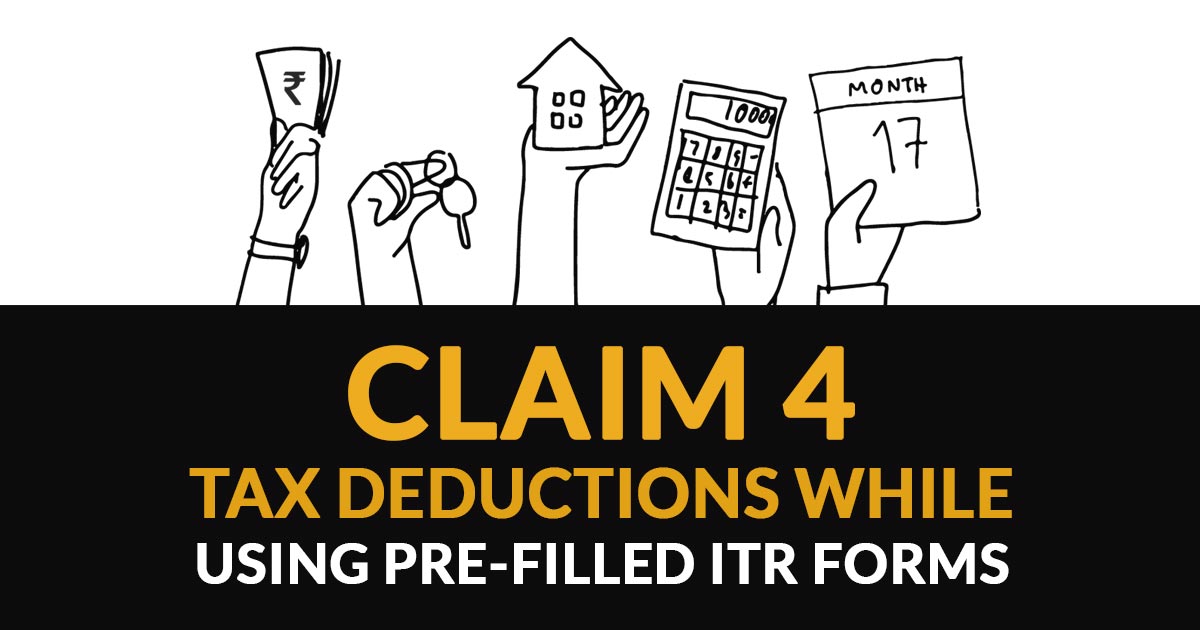
When you file your ITR for the current year through pre-filled forms, you can not claim specific tax deductions that don’t appear on your Form 168 (Earlier 26AS) or the new I-T Annual Information Statement and therefore aren’t auto-populated in the income tax return forms.
You do not need to think about filing the income tax return under the latest tax regime, which has executed nearly 70 tax deductions and exemptions. But when one is filing the income tax return under the former regime, then one is required to deeply investigate the expenses for the former fiscal year to take advantage of the tax available to you.
Mentioned are the 4 tax deductions that you might ignore to claim when pre-filled ITR forms are filed by you
House Rent Excluding HRA Exemptions
A salaried person who resides in rented accommodation can utilise the element of House Rent Allowance (HRA) in their salary package to reduce the tax payment. But if the HRA does not come in your salary structure, then under section 134 (Earlier 80GG) of the Income Tax Act, 2025, you have the choice to claim the deduction on the furnished house rent. Here is the impact of the deduction, which is the minimum of the following:
- Actual rent paid minus 10% of the taxpayer’s total income
- Rs 5,000 per month
- 25% of the total income
Under section 133 (Earlier 80G), the assessee is required to meet some additional conditions to claim the deduction. It points out that the assessee must not own a house in the same city in which he is residing on rent; also, there should be no house in the name of his spouse, minor child, or HUF, towards which he is a member, in the city where his/her office is situated, or business is conducted
Savings Account Interest Deduction
Under section 153 (Earlier 80TTA), an assessee can avail of the deduction of Rs 10,000 on interest obtained from the savings bank account. If the interest earned from the savings account is lower than Rs 10,000, then the complete amount is free from tax.
Worth specifying that here so that the deduction available under section 153 (Earlier 80TTA) does not apply to interest obtained via fixed deposits, recurring deposits, or time deposits.
Medical Bills of Uninsured Parents Deduction
If your parents are over 60 years old, do not have any medical insurance scheme, but used medical treatment in the previous fiscal year, then you are able to avail of the deduction on their medical bills.
Under Section 126 (Earlier 80D), one can avail Rs 50,000 as a deduction on the amount filed for the medical treatment of dependent parents whose age is 60 years or more. Money can be claimed as a deduction for purchasing medicines for the senior parents.
The majority of the assessees forget to claim the deduction even if they spend more than Rs 50,000 on their senior citizen parents’ medicines and the regular checkups for each year. However, the assessee does not intend to file the bills or receipts at the time of furnishing the income tax return; they should maintain the assisting transaction documents updated through them.
Donations Deduction
If you make any donations to any approved fund or towards any charitable institution that is accredited by the government in the former fiscal year, then indeed you can avail of the deduction on the same amount under section 133 (Earlier 80G). Still, the deduction would make a difference when the final amount is decided.
For instance, the donations furnished to the Union Government-accredited institutions are subject to a 100% deduction. There will be only 50% of the total amount, which shall be subject towards the deduction if the institution is private. But kind donations made shall not count as deductions.
Moreover, when you make the donation in cash, then the deduction available is only Rs 2000, provided the donor has receipts to back the transactions. Indeed, to claim the deduction, the assessee needs the PAN of the donee.