

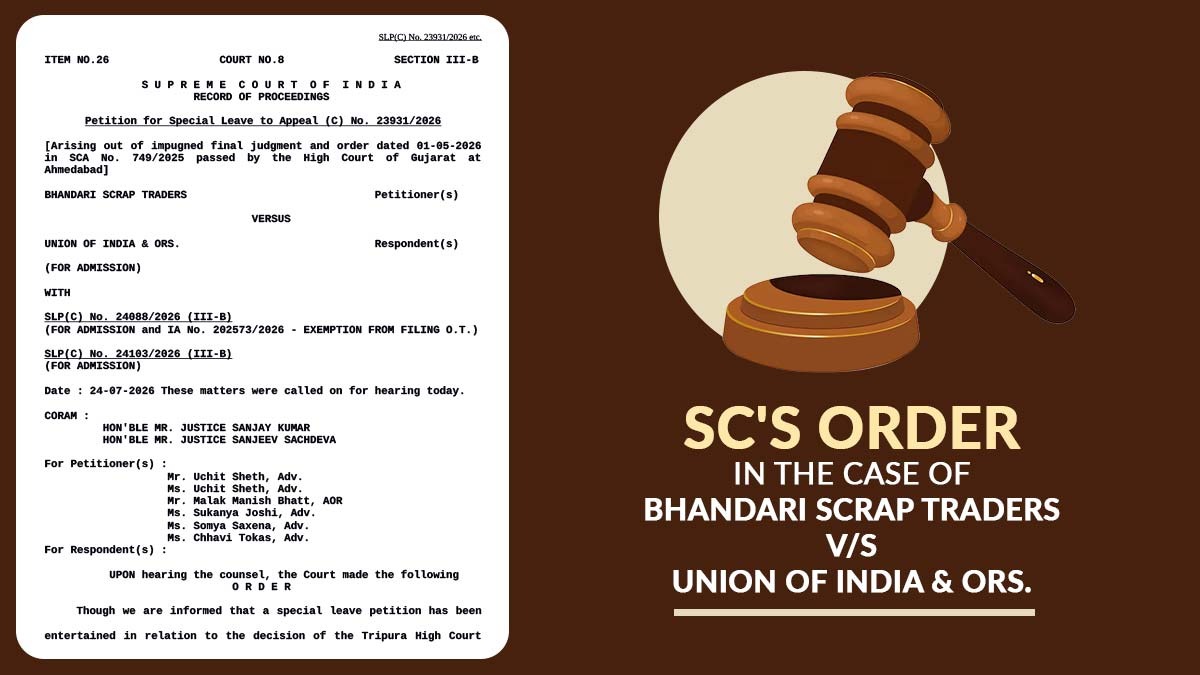
The Supreme Court states the judgment of the Gujarat High Court, which mentioned that the Input tax credit can be taken only when the supplier has actually paid the tax to the government.
A bench of Justice Sanjay Kumar and Justice Sanjeev Sachdeva quashed a batch of petitions submitted against the Gujarat High Court’s judgment, which had upheld the constitutional validity of Section 16(2)(c) of the Central Goods and Services Tax Act, 2017, which mandates that a buyer cannot claim Input tax credit unless the seller has actually paid the collected tax to the government.
“…the High Court was fully justified in holding that no grounds were made out to declare Section 16(2) (c) of the CGST Act as unconstitutional or read down the provisions thereof. We find ourselves in complete and respectful agreement with the views expressed by the High Court of Gujarat and affirm and uphold the impugned judgment.”, the Court stated.
The petitioners have approached the Gujarat High Court contesting the provision of Section 16(2)(c) of the CGST Act as arbitrary, ultra vires, and violative of Articles 14, 19(1)(g), 265, and 300A of the Constitution of India. They mentioned that the provision places a burden on bona fide purchasers who do not have any control over whether the supplier deposits the tax with the government, and that they cannot be denied Input Tax Credit only on the grounds that the supplier did not deposit the tax.
They had alternatively requested that the provision in question be interpreted to apply only to transactions that are fraudulent, collusive, or involve collusion between the purchasing dealer and the supplier. This interpretation would exclude purchasers who have acted in good faith.
The High Court dismissed their appeals, refusing to read down the provision and declaring it constitutional. The court reasoned that Section 16(2)(c), when read in conjunction with Sections 41 and 53 of the CGST Act, adequately safeguards the interests of purchasing dealers regarding their claims for denial of Input Tax Credit (ITC).
Read Also: How to Maintain Input Tax Credit Ledger By Gen GST Software
“It is well settled that ITC is not a constitutional or vested right, but a statutory concession, subject to the conditions and restrictions prescribed under the Act. Where the statute provides for reversal and re-availment of credit, the same cannot be characterised as double taxation so as to invalidate the provision.”, the High Court stated.
HC observed that the mere recovery procedure under the CGST Act against the supplier cannot be a ground to declare the provision to be unconstitutional, as the purchasing dealer “may pursue appropriate remedies against the supplier, while the Government retains the authority to recover the unpaid tax from the defaulting supplier.”
The High Court also stated that “The mere absence of a specific statutory mechanism enabling recovery by the purchasing dealer from the supplier cannot, by itself, render Section 16(2) (c) of the CGST Act ultra vires.” The HC prompted the government to re-evaluate the situation and execute a technology-driven tracking procedure for real-time verification of tax payments, take recovery measures against defaulting sellers, and bring legislative amendments or clarifications to safeguard genuine buyers.
The High Court said that, There is a pressing need for legislative amendments or clarifications to be issued within the GST framework to alleviate the disproportionate financial and administrative burdens currently placed upon purchasers who have an honest claim of ITC. Beyond mere policy changes, the Government should implement a robust, technology-driven tracking mechanism enabling verification of payments made by suppliers against specific invoices in real time, thereby insulating bona fide recipients from the defaults of their vendors.
Simultaneously, the Government has to take prompt and immediate steps for recovery of tax from the erring suppliers, instead of compelling the purchasers to avail themselves of alternate, cumbersome remedies.
In the absence of stringent oversight, unscrupulous sellers could potentially enrich themselves at the expense of both the public exchequer and honest buyers.”
| Case Title | Bhandari Scrap Traders v. Union of India & Ors. |
| Case No. | Appeal (C) No. 23931/2026 |
| For Petitioner | Mr. Uchit Sheth, Adv. Ms. Uchit Sheth, Adv. Mr. Malak Manish Bhatt, AOR Ms. Sukanya Joshi, Adv. Ms. Somya Saxena, Adv. Ms. Chhavi Tokas, |
| Supreme Court | Read Order |