

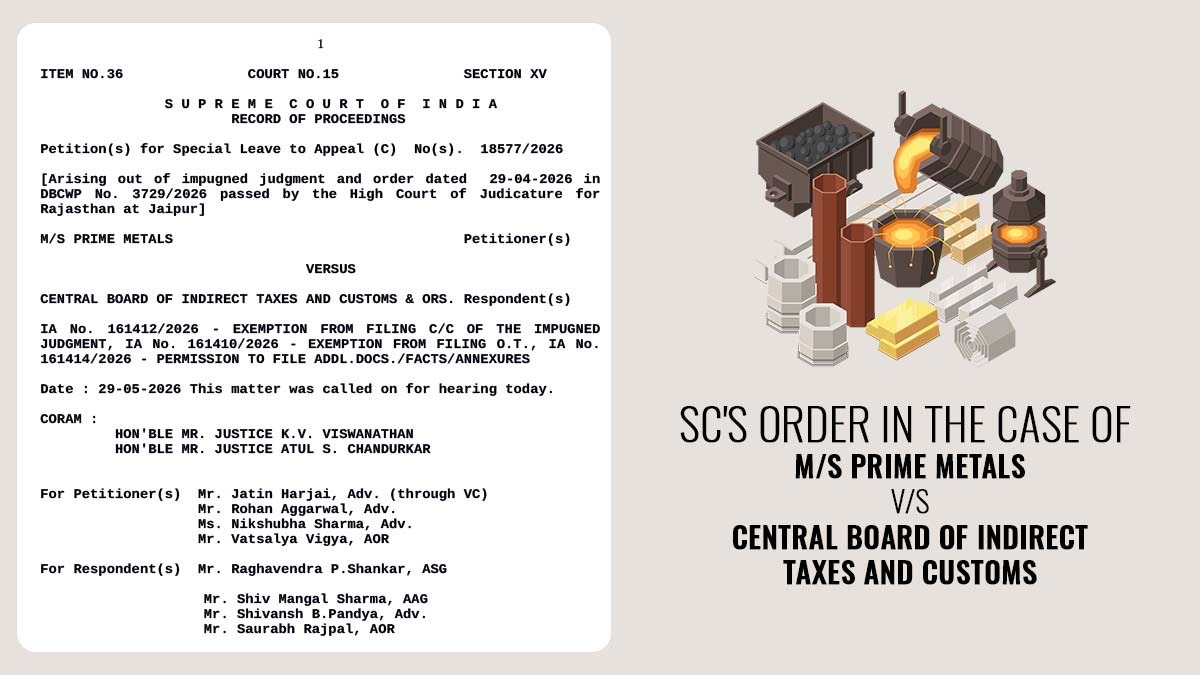
In a significant development regarding the ongoing controversy over Section 16(2)(c) of the Central Goods and Services Tax Act, 2017, the Supreme Court, through an order dated May 29, 2026, in the case of M/s Prime Metals v. Central Board of Indirect Taxes and Customs & Ors. (SLP (C) No. 18577/2026), refused to interfere with the decision of the Rajasthan High Court to dismiss the writ petition because there was an alternate statutory remedy available.
The Court stated that all statutory remedies available to the applicant remain open, including issues for the validity of Section 16(2) of the CGST Act. The dispute stemmed from the refusal of Input Tax Credit (ITC), allegedly due to non-compliance with the conditions set out in Section 16(2)(c), which requires that the tax levied for a supply must have actually been paid to the Government.
This provision has been the subject of extensive litigation across the country, specifically in cases where bona fide recipients are denied ITC due to defaults by suppliers over whom they have no control.
The Supreme Court stated on the aspects of the case that it did not intend to interfere with the impugned ruling. Also, at that time, it allotted liberty to the applicant to submit a statutory appeal within 8 weeks, along with the requisite pre-deposit.
The Court asked not to dismiss such an appeal based on limitation. The Court documented that issues for the validity of Section 16(2) of the CGST Act would remain open for consideration before the appropriate forum.
The order is significant because the Supreme Court had previously issued a notice regarding the case on May 22, 2026, prompting many stakeholders to anticipate an authoritative decision on the constitutional validity and practical application of Section 16(2)(c).
However, the Court decided not to address the constitutional challenge at this stage and instead directed the applicant to pursue the statutory appellate process.
Thereafter, the question concerning trouble for GST jurisprudence stayed unresolved: whether a legitimate purchaser who has obtained goods or services, paid consideration and tax to the supplier, and followed all regulatory provisions can nevertheless be denied ITC only because the supplier, or even suppliers further up the supply chain, failed to release tax obligation.
Taxpayers currently lack a statutory method to verify actual tax payments made by suppliers, relying only on the information available through the GST portal. This provision has faced criticism for placing an unreasonable burden on legitimate recipients.
While the order of the Supreme Court does not provide any judgment on the validity of Section 16(2)(c), it also does not support the position of the Revenue. Thus, the constitutional challenge is not resolved and may need authoritative determination by the Supreme Court in an appropriate case.
Until then, uncertainty regarding the denial of ITC for supplier defaults is likely to persist, leaving taxpayers and tax administrators reliant on the developing jurisprudence of the High Court and specific fact-based adjudications.
| Case Title | M/s Prime Metals Vs. Central Board of Indirect Taxes and Customs |
| Case Number | Special Leave to Appeal (C) No(s). 18577/2026 |
| For the Petitioner | Mr Jatin Harjai, Mr Rohan Aggarwal, Ms Nikshubha Sharma, Mr Vatsalya Vigya |
| For the Respondents | Mr Raghavendra P.Shankar, Mr Shiv Mangal Sharma, Mr Shivansh B.Pandya, Mr Saurabh Rajpal |
| Supreme Court | Read Order |