

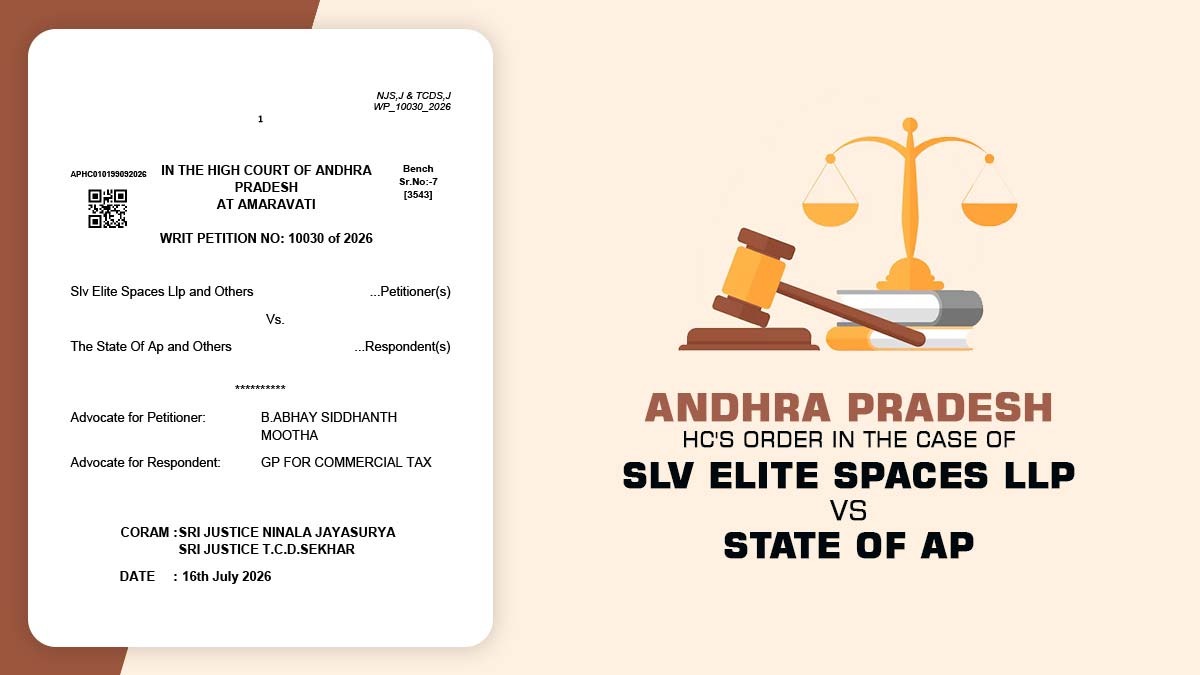
On 16 July, the Andhra Pradesh High Court said that GST authorities cannot invoke detention proceedings only because an e-way bill had lapsed when the delay in the delivery of goods was caused by a vehicle breakdown and no proof of tax evasion was there.
A Division Bench comprising Justices Ninala Jayasurya and T.C.D. Sekhar allowed the writ petition filed by SLV Elite Spaces LLP and directed the GST authorities to drop the proceedings initiated under Section 129 of the GST Act, which deals with the detention, seizure, and release of goods and vehicles in specified circumstances. The judges said that:
“On over all consideration of the case on hand, it is apparent that there is no evasion of tax on the part of the petitioner. In such circumstances, continuation of proceedings against the petitioner may not be proper, especially when this Court has already directed the 4th respondent to release the vehicle and the goods”.
In this matter, SLV Elite Spaces LLP contested a detention order Form GST MOV-06 issued on April 14, 2026. Intercepted during transit, the vehicle carrying TMT bars was detained by GST authorities on the sole ground that the accompanying e-way bill had lapsed at 11:59 PM on April 13, 2026.
The consignment was being transported from Vizianagaram to Suryaraopet, Vijayawada, along with all the required documents. Although the vehicle reached Vijayawada within the validity period of the e-way bill, it suffered a mechanical breakdown during inspection at a weighbridge. As a result, the vehicle was parked at Bhavanipuram while arrangements were made to generate a fresh e-way bill.
The authorities, during this period, analysed and detained the vehicle, citing the lapse of the e-way bill. The applicant claimed that there was no intention to evade tax and that the delay took place merely because of the mechanical issue.
A counter affidavit has been submitted by the State. In the hearing, the Government Pleader notified the court that the vehicle and goods had earlier been released as per the interim order passed by the High Court.
The Court said that the detention order was directed merely at the lapse of the GST E-way bill and did not specify any other breach. It said that no material was there that shows any attempt to evade tax.
The Bench said that the vehicle had arrived in Vijayawada on 13 April 2026 itself and could not move to the destination due to the breakdown.
It observed that the distance between Bhavanipuram and Suryaraopet was less than 8 kilometres and both the locations come within Vijayawada. It said that-
“…the subject vehicle reached Vijayawada on 13.04.2026 itself, but could not reach the destination as it was broke down. Further, the distance between Bhavanipuram and Suryaraopet is less than 8 km., and keeping in mind that both Bhavanipuram and Suryaraopet are located in Vijayawada, the action of the 4th respondent in invoking Section 129 of the GST Act may not be proper”.
Read Also: What is GST E Way Bill & How To Generate Via Online or SMS in Your State?
Subsequently, the HC permitted the writ petition and asked the fourth respondent to drop all further proceedings initiated against SLV Elite Spaces LLP.
| Case Title | SLV Elite Spaces LLP Vs State of AP |
| Case No. | WP NO: 10030 of 2026 |
| For the Petitioner By | B.Abhay Siddhanth Mootha |
| For Respondent | Government Pleader for Commercial Taxes |
| Andhra Pradesh High Court | Read Order |