

The Rajasthan High Court denied anticipatory bail to a company director accused of large-scale GST evasion exceeding ₹20.63 crore, holding that economic offences require strict scrutiny and that custodial interrogation may be necessary for an effective investigation.
However, the Court granted pre-arrest bail to a co-accused whose role was found to be limited and ancillary.
The bench of Justice Anil Kumar Upman outlined that economic breaches relied on a different foundation in bail jurisprudence as they often engage deep-rooted conspiracies, large-scale loss to the public exchequer, and significant societal impact.
It was mentioned that these violations should be taken seriously and that anticipatory bail should be granted sparingly, especially when an investigation is ongoing and custodial interrogation may be necessary to trace the modus operandi and money trail.
The matter originated from a pre-arrest bail application submitted by Premchand Jain and his son, Dhyata Jain, who were apprehended in relation to a criminal investigation initiated by the Directorate General of GST Intelligence (DGGI) under the provisions of the Central Goods and Services Tax Act, 2017.
The prosecution alleges that the defendants, who served as directors of two companies in the steel industry, were involved in unauthorised clearances of substantial amounts of TMT bars and scrap metal. This activity reportedly took place without proper invoicing, resulting in an estimated Goods and Services Tax (GST) evasion of approximately ₹20,63,97,337.
The defence claimed that the applicants had been implicated based on the statements of third parties and no independent material directly linked them with the alleged transactions. More than 10.38 crore had already been deposited with the department, and the petitioners were inclined to cooperate with the investigation.
The court post analysed the record marked that material collected at the time of investigation, along with the statements, shows that Premchand Jain had considered responsibility for the operation and decision making of the companies and had considered clandestine clearances leading to GST liability.
Depending on the norms specified by the Apex Court in various precedents related to economic breaches, the Court said that anticipatory bail is an extraordinary remedy aimed at safeguarding innocent individuals from motivated arrest, not a routine relief in serious financial crimes.
The Court, acknowledging the allegations, refused anticipatory bail to Premchand Jain, stating that the nature of the accusations and the phase of investigation did not explain the need to grant the same protection.
Read Also: Fraudsters’ Mind vs Govt Intelligence for Fake GST Invoices
The Court has another opinion for Dhyata Jain. It was discovered that his role was limited to field-level assistance under the norms of the principal accused and was thus confined in nature.
Based on that, anticipatory bail was provided to him as per the conditions, along with cooperation with the investigation, non-interference with witnesses, and restrictions on leaving India without court permission.
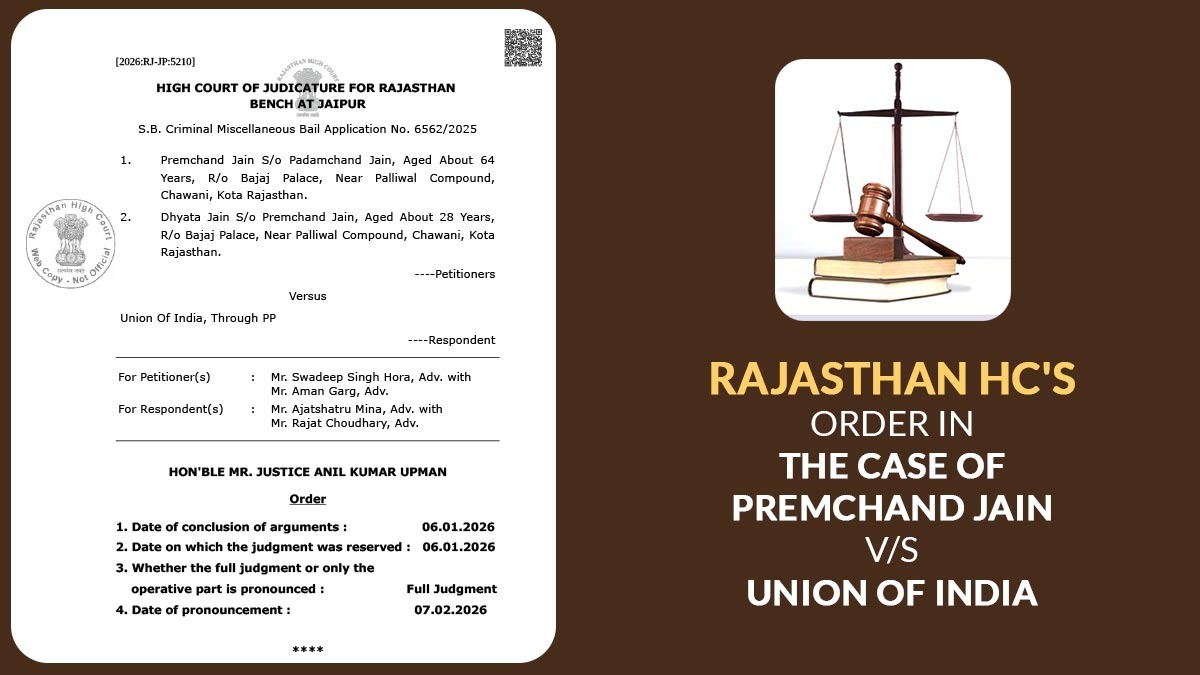
| Case Title | Premchand Jain vs. Union Of India |
| Case No. | Application No. 6562/2025 |
| Counsel for the Petitioner | Mr Swadeep Singh Hora and Mr Aman Garg |
| Counsel for the Respondent | Mr Ajatshatru Mina and Mr Rajat Choudhary |
| Rajasthan High Court | Read Order |