

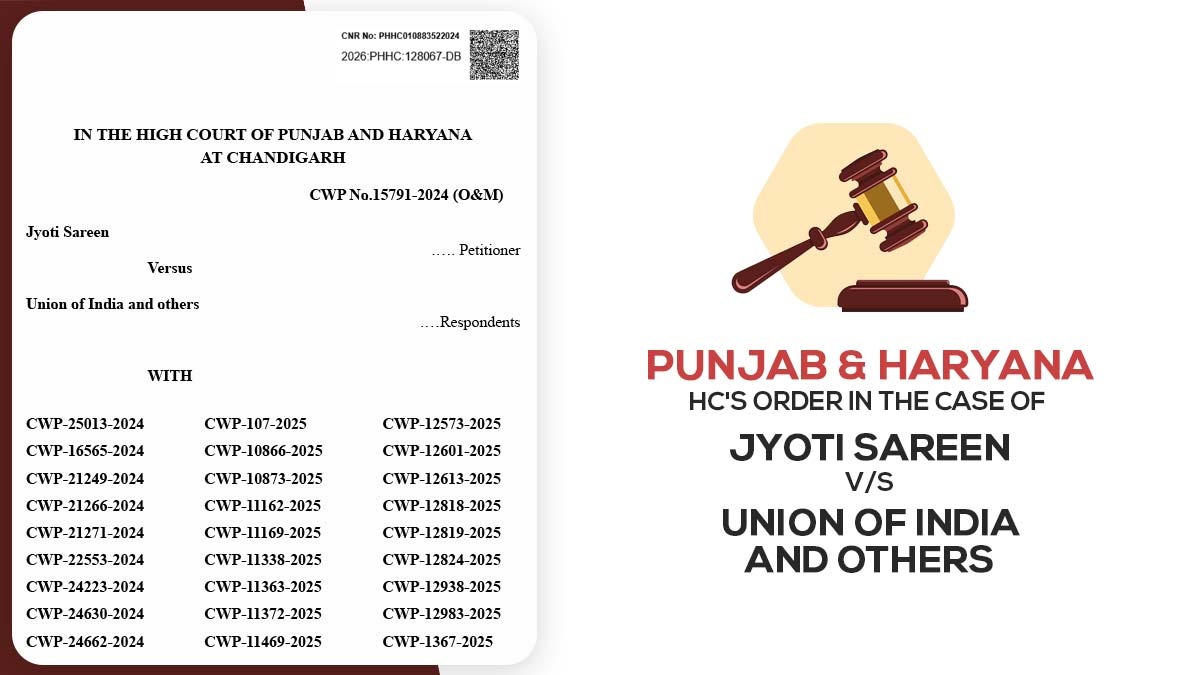
The Punjab and Haryana High Court set aside the newly inserted Section 147A of the Income Tax Act, 1961, as unconstitutional. The provision mentioned the role of the Jurisdictional Assessing Officer (JAO) in income tax reassessment proceedings.
The ruling has been delivered by the Bench of Justice Deepak Sibal and Justice Rupinderjit Chahal. The detailed order is yet to be issued.
Ruling of the Court
W.e.f. April 1, 2021, Section 147A was rolled out. As per that, for the purposes of Sections 148 and 148A, the term “Assessing Officer” is defined as an assessing officer other than the National Faceless Assessment Centre.
From a long-running dispute, the provision was rolled out over whether reassessment notices in the faceless assessment system could be furnished via Jurisdictional Assessing Officers or needed to be issued via the National Faceless Assessment Centre.
Reason for dispute over JAOs
Taxpayers have contested reassessment proceedings initiated by JAOs after the implementation of the post-2021 faceless assessment system.
Several high courts, including the Punjab and Haryana High Court in Income Tax Officer, Ward 2(1), Chandigarh & Ors. vs Tej Partap Singh, had held against the Revenue in these cases. The Courts set aside the orders passed under section 148A(d), and the following notices issued u/s 148, holding that the proceedings must have been managed via the mentioned faceless procedure.
However, some other High Courts took a different view and upheld the JAO’s authority to initiate such re-assessment proceedings.
Functionality of Retrospective Amendment
The Revenue contested the adverse HC rulings before the Apex Court. When such appeals were pending, Parliament inserted Section 147A with retrospective effect.
The amendment aimed to clarify that JAOs, in addition to the National Faceless Assessment Centre, could serve as the Assessing Officer for proceedings under Sections 148 and 148A. This change was perceived as an effort to provide legal support for reassessment notices issued by JAOs and to address High Court rulings that had previously invalidated such proceedings.
Thereafter, the Apex Court returned the batch of JAO-FAP cases to the respective High Courts for fresh consideration concerning the retrospective insertion of Section 147A.
The top court asked the applicants to contest the validity of the retrospective legislative amendment before the respective High Courts.
Section 147A of the Income Tax Act, 1961
W.e.f. 1st April 2021, Section 147A was inserted into the Income Tax Act, 1961. It aimed to specify who could serve as an assessing officer for reassessment proceedings under Sections 148 and 148A.
This provision states that in these sections, the term “Assessing Officer” refers to an Assessing Officer other than the ‘National Faceless Assessment Centre’.
Section 147A clarifies that reassessment proceedings could be managed via the taxpayer’s Jurisdictional Assessing Officer and are not confined to the National Faceless Assessment Centre.
The provision became crucial because several court rulings had asked whether JAOs had the power to issue reassessment notices under the faceless assessment structure rolled out from April 1, 2021.
By giving this provision retrospective effect, Parliament intended to bring proceedings initiated from April 1, 2021, within its ambit. However, the Punjab and Haryana High Court recently struck down this provision.
| Case Title | Jyoti Sareen V/S Union of India and others |
| Case No. | CWP No.15791-2024 |
| Counsel For Appellant | Advocates Ankit Kanodia, Megha Agarwal and Jitesh Sah |
| Counsel For Respondent | Advocate K. K. Maiti |
| Punjab and Haryana High Court | Read Order |