

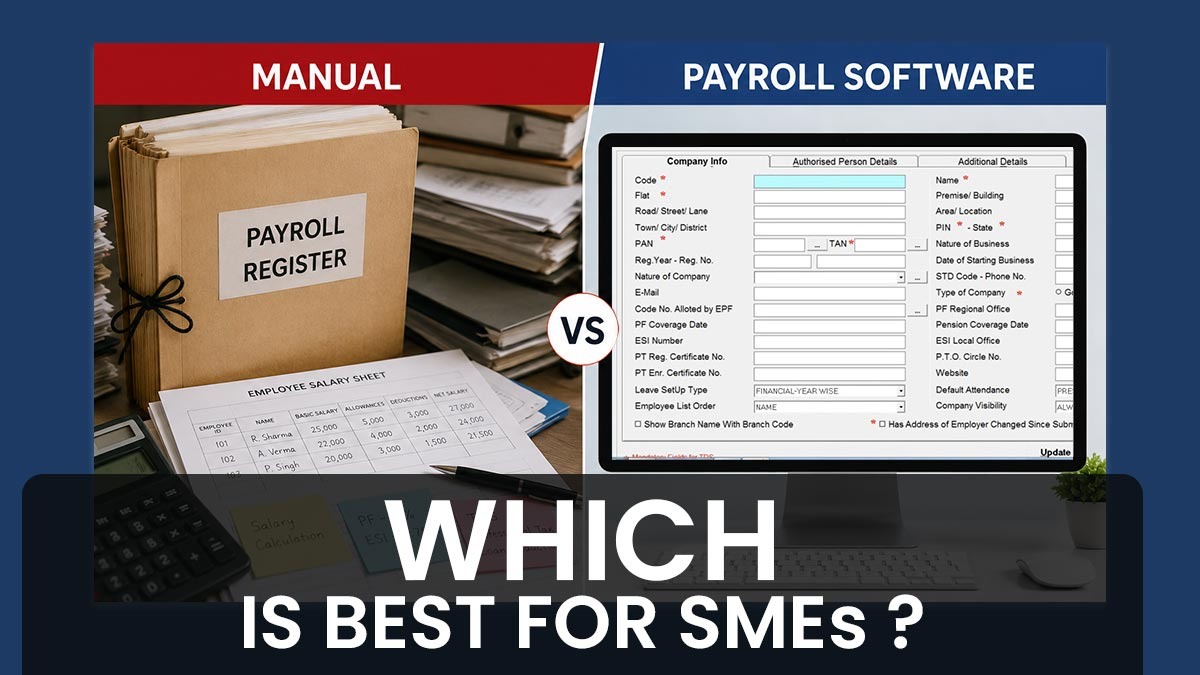
Payroll management is an important task for small and medium-sized businesses (SMEs). Employees expect to receive their salaries on time, and employers must comply with various government tax laws and labour regulations. As small businesses grow, managing payroll manually can become increasingly complex and time-consuming.
Therefore, businesses must make a crucial decision: should they continue using manual payroll methods or invest in payroll software that automates the process?
Let’s examine both options more closely.
Manual Payroll
Manual Payroll directs the computation of employee salaries, taxes, bonuses, and deductions manually with the use of spreadsheets or paper records. HR or accounting teams own this responsibility, keeping track of everything themselves.
Tasks in Manual Payroll:
- Tracking Attendance
- Calculating Salaries
- Making Necessary Deductions for Retirement Funds and Health Insurance
- Preparing Payslips
- Generating Payroll Reports
- Keeping Compliance Records
Read Also: Why HR Prefers Payroll Software for Salary Preparation?
The manual system can prove to be effective for small businesses, but when the number of employees grows, it becomes difficult.
What is Payroll Software
Payroll software is a digital tool that automates the calculations for salaries, deductions, and taxes. It takes a few minutes to create payslips and generate reports. Modern systems can connect with attendance tracking tools and accounting software, which makes the entire payroll procedure streamlined and faster.
Practical Example of a Small Manufacturing Unit
For instance, a small manufacturing company has 15 employees. The accountant calculates everyone’s salaries using Excel spreadsheets, which consume nearly 2–3 hours initially. However, as the number of attendance corrections, overtime, and other factors rises, it takes a full day to finish payroll.
An error in a spreadsheet once caused some employees not to receive the correct overtime pay. This mistake was only discovered after paychecks had been issued, leading to a loss of trust among employees and requiring extra time to resolve.
Although the company saved money by not using payroll software, it ultimately lost valuable time and employee confidence due to these errors.
Practical example of a Growing IT Startup
Consider a tech startup that started with 8 employees and grew to 60 in just two years. Initially, they managed payroll manually, but as their workforce expanded, this method became ineffective. Their HR team spent nearly 2 days each month processing payroll, juggling various calculations such as bonuses, reimbursements, and different leave policies.
When they started using the payroll software, their processing time was reduced from two days to hours. Automatic payslip generation occurs, and the questions from employees regarding payroll decrease gradually.
Case Study: Benefits of Payroll Automation for an SME
Let’s look at a fictional company, ABC Tech Solutions, which has 75 employees. They often encountered issues with their payroll, such as calculation errors and delays in issuing payslips. They give 20 to 25 hours every month to manage payroll
When they worked using payroll software that functioned alongside their attendance and leave management systems, they discovered that HR could focus more on hiring and employee engagement instead of being stuck with payroll tasks. Management can access real-time payroll reports.
Manual Payroll Benefits
- Lower Initial Costs: With the use of free spreadsheets, businesses can save money rather than buying software.
- Works for small Businesses: Manual payroll can be easily managed by small companies.
- Personal Oversight: Business owners can verify each payroll calculation.
Manual Payroll Challenges
- Increased Risk of Mistakes: A small error can cause wrong payments.
- Compliance Problems: Adhering to tax and labour law amendments consumes much time.
- Time-Intensive: Valuable time and resources are consumed in manual payroll.
- Difficulties in Scaling: As the workforce grows, spreadsheet record-keeping becomes challenging.
Payroll Software Advantages
- Speed: It takes a few minutes to process payroll.
- Accuracy: Automated systems reduce human mistakes.
- Facilitated Compliance: Software updates assist businesses in staying updated with revised statutes.
- Employee Access: Employee can view their payslips and salary information online.
- Quick Reporting: Management can generate payroll reports for decision-making.
In summary, as businesses expand, the advantages of automated payroll software often surpass the challenges of sticking to manual methods. It can save time, minimise errors, and enhance overall efficiency.
When Should SMEs Use Payroll Software?
Small and Medium Enterprises (SMEs) need to acknowledge payroll software if:
- Their employee strength is between 20 and 25
- Payroll processing takes much time each month
- They sometimes need to make corrections to the payroll
- Complying with laws becomes difficult
- HR teams spend a lot of time on payroll chores instead of focusing on crucial strategic work
Closure: For startups and small businesses, managing payroll manually may be sufficient initially. However, as a company expands, payroll management can become more intricate and time-consuming, which causes mistakes and inefficiencies.
The examples illustrated in this blog depicted payroll software’s assistance to SMEs in saving time, reducing errors, ensuring compliance with regulations, and supporting overall business growth. Although investing in payroll software has its costs, the long-term benefits, such as improved efficiency, better compliance, and happier employees, make it a valuable investment.
Choosing automated payroll software for a small business is a convenient option and is a practical tool that helps run the business more smoothly.