

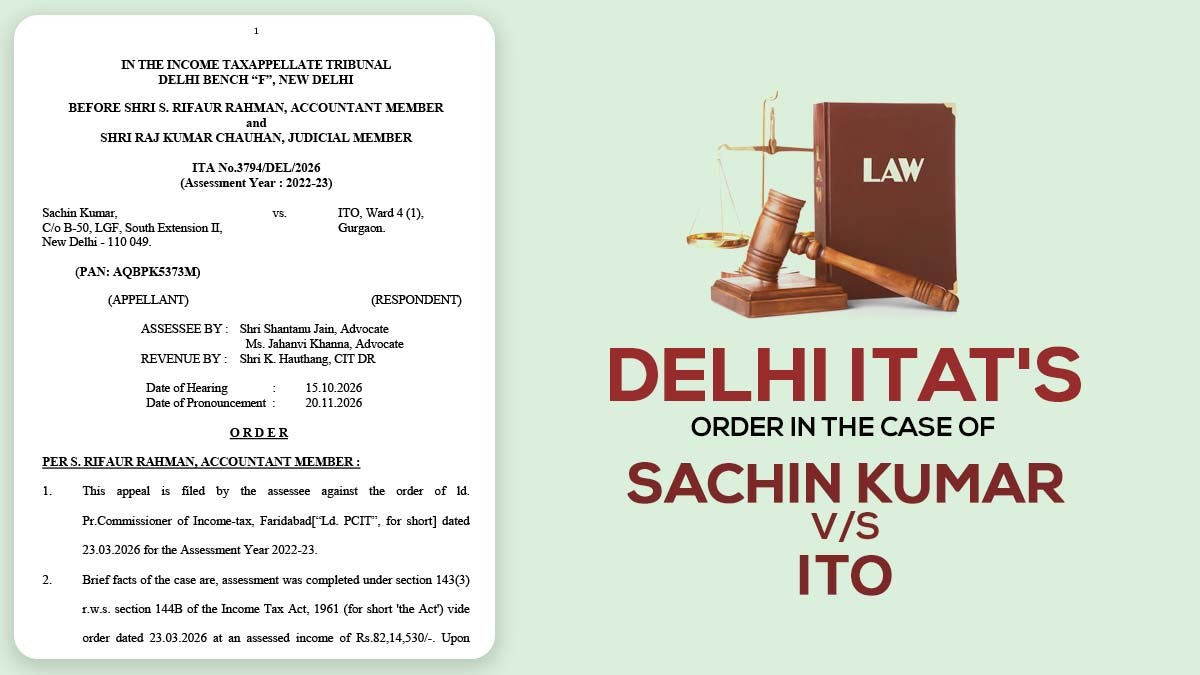
The taxpayer, Sachin Kumar’s appeal for the AY 2022-23 arose against the order dated 23.03.2026 passed by the Principal Commissioner of Income-tax (PCIT), Faridabad, u/s 263 of the Income-tax Act, 1961, which quashed the assessment made u/s 143(3) read with Section 144B at the returned income of Rs. 82,14,530.
The taxpayer sold their ancestral agricultural land for Rs 25.80 crore, purchased agricultural land at nine locations for Rs 24.05 crore, and claimed an exemption under Section 54B; additionally, they spent Rs 41.50 lakh on the construction of a house and claimed an exemption under Section 54F.
However, the Assessing Officer had referred the matter to the Physical Verification Unit for an inspection of the agricultural land; no report was received by the time the assessment was concluded. Consequently, due to the lack of verification, the PCIT deemed the order erroneous and prejudicial to the recovery of tax.
The question before the Tribunal was whether the PCIT had correctly exercised its revision powers under section 263, given that the ‘faceless assessment’ had been completed without any report from a ‘physical verification unit’ or any additional independent inquiry.
The taxpayer stated that the PCIT recorded contradictory facts, disregarded the principles of a fair hearing, and failed to explain, in the context of the ‘Malabar Industrial Co. Ltd. vs. CIT’ case, how the assessment was erroneous and resulted in a loss to the revenue, even though full information had been submitted and examined during the assessment proceedings.
While the tax department stated that the Assessing Officer had considered the claims of the taxpayer without obtaining a report from the verification unit or conducting any independent inquiry, they thus upheld the order of the PCIT.
An order was issued by the Income Tax Appellate Tribunal (ITAT), Delhi Bench “F”, on 20.11.2026 in ITA No. 3794/DEL/2026, considering the taxpayer’s appeal and cancelling the Section 263 order.
In the context of faceless assessment u/s 144B, the Delhi Bench stated that the assessment unit must adhere to strict timelines, regardless of whether or not other internal units submit their reports on time. The Delhi Bench held that a missing report from an internal unit does not render the entire assessment invalid.
Furthermore, under the ‘faceless system,’ if the PCIT fails to substantiate any error, the taxpayer cannot be compelled to undergo fresh proceedings. Consequently, the Bench set aside the revision order, deeming it invalid in law.
| Case Title | Sachin Kumar Vs ITO |
| Case No. | ITA No.3794/DEL/2026 |
| For Petitioner | Shri Shantanu Jain, Ms Jahanvi Khanna |
| For Respondent | Shri K. Hauthang |
| Delhi ITAT | Read Order |