

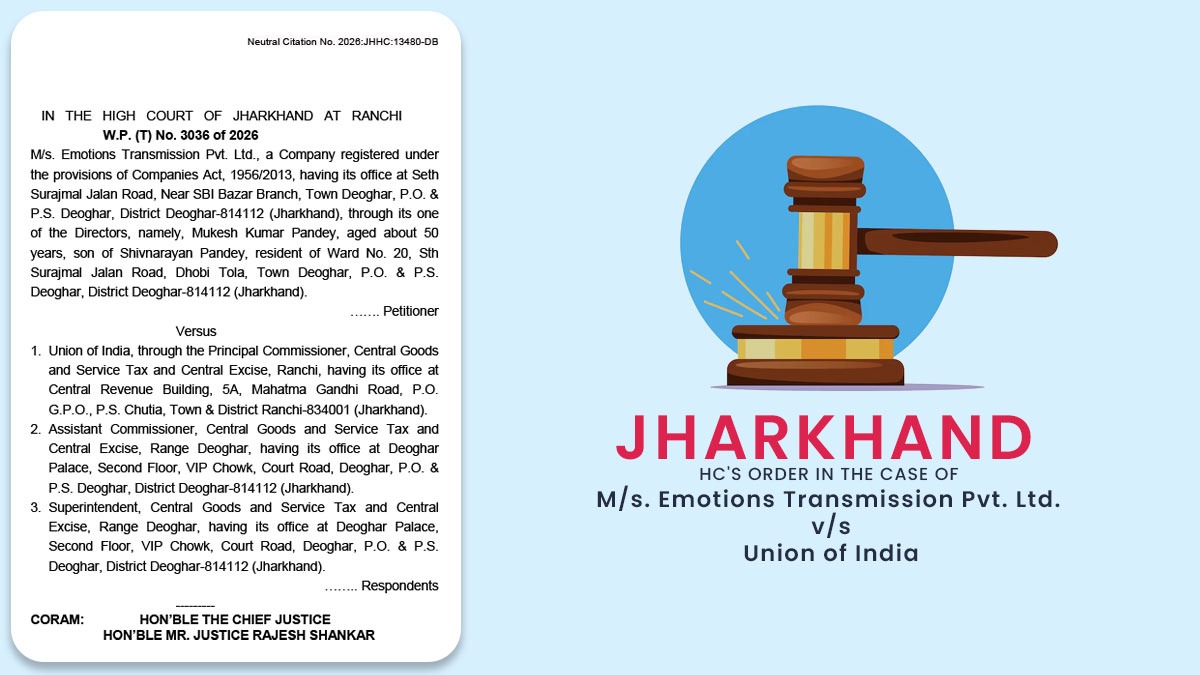
The Jharkhand High Court has struck down an Order-in-Original that denied Input Tax Credit (ITC) amounting to Rs. 8.48 lakh based on the delayed submission of GSTR-3B returns. In its ruling, the Court has directed the Assessing Authority to re-evaluate the case, taking into account the retrospective amendments made to Section 16(5) of the CGST Act, as updated through the Finance (No. 2) Act, 2024.
Chief Justice M. S. Sonak and Justice Rajesh Shankar’s bench noted that while the petitioner might normally be directed to pursue the available GST appeal, recent legislative changes necessitated judicial intervention. The insertion of Section 16(5) in the CGST Act, which specifies that even after Section 16(4), registered persons shall be qualified to claim ITC concerning FYs 2017-18 to 2020-21 in any return filed up to November 30, 2021.
The Order-in-Original had been contested by the applicant company on July 26, 2023, whereby the department rejected ITC of Rs 8,48,496 for FY 2018-19 u/s 73(9) of the CGST Act only on the ground that GSTR-3B returns for the period July 2018 to March 2019 were filed after the specified deadline u/s 16(4) of the CGST Act. Consequential interest u/s 50 and penalty u/s 122(2)(a) were levied.
Thereafter, the applicant asked for a declaration that the input tax credit (ITC) had been validly taken as per the newly inserted Section 16(5) of the CGST Act, which retrospectively extended the time duration for claiming the ITC for FYs 2017-18 to 2020-21 till November 30, 2021.
The company claimed that as its GSTR-3B returns had been submitted within the extended timeline, the refusal of ITC was no longer sustainable in law.
The appeal contested the garnishee proceedings initiated via Form GST DRC-13 dated December 18, 2025, by which the department asked the applicant’s banker, Canara Bank, to recover the alleged interest and penalty of ₹8,44,801 from the company’s account.
The Bench took note of CBIC Circular No. 237/31/2024-GST dated October 15, 2024, which specified the implementation of Sections 16(5) and 16(6) of the CGST Act.
The Court put reliance on its earlier rulings in Vinod Udaipuri v. Union of India and Manoj Kumar Singh v. Principal Commissioner, CGST & Central Excise, where similar GST adjudication orders had been set aside post acknowledging the retrospective amendment and related CBIC clarification.
After the identical approach, the HC quashed the impugned Order-in-Original dated July 26, 2023. The Court held that once the adjudication order itself was set aside, the garnishee proceedings initiated via Form GST DRC-13 shall automatically fail, and subsequently quashed the recovery proceedings.
Read Also: Jharkhand HC Dismisses Tata Steel’s Writ Petition in Alleged Wrongful GST ITC Claim Case
Now the case has been remanded to the assessing authority for fresh adjudication, post acknowledging the impact of the retrospective amendment and CBIC explanation.
The Court ordered the authority to restart and finish the proceedings within four months of the parties’ appearance. The parties have been asked to appear before the assessing officer on May 18, 2026, at 11:00 AM.
Important: Portal vs GST Software: Which is Better for GSTR-3B Filing?
The HC specified that although the Order-in-Original was being set aside, no refund direction was being issued at this phase, and all rights and contentions of the parties were left open for reconsideration via the Assessing Authority.
| Case Title | M/s. Emotions Transmission Pvt. Ltd. vs. Union of India |
| Case No. | W.P. (T) No. 3036 of 2026 |
| Counsel For Petitioner | Mr Sumeet Gadodia, Mr Ranjeet Kushwaha, and Ms Sanya Kumari |
| Counsel For Respondent | Mr P.A.S. Pati |
| Jharkhand High Court | Read Order |