

The GST e-invoicing framework will include two additional categories of transactions from January 1, 2027. It mandates taxpayers to generate Invoice Reference Numbers (IRNs) for recipient-generated self-invoices under the Reverse Charge Mechanism (RCM).
The two categories included under the upcoming changes are domestic supplies received from unregistered persons (RCMDOM) and import of services (RCMIMP). The extension has been announced via Notification No. 04/2026-Central Tax, dated October 26, 2026, along with related amendments to the CGST Rules and the e-Invoice schema as specified in Notification No. 05/2026-Central Tax, also dated October 26, 2026.
In a new advisory issued following the earlier communication from October 16, 2026, the GST system has provided details on the implementation timeline, sandbox testing arrangements, and the steps that taxpayers and technology partners must complete before the mandatory rollout.
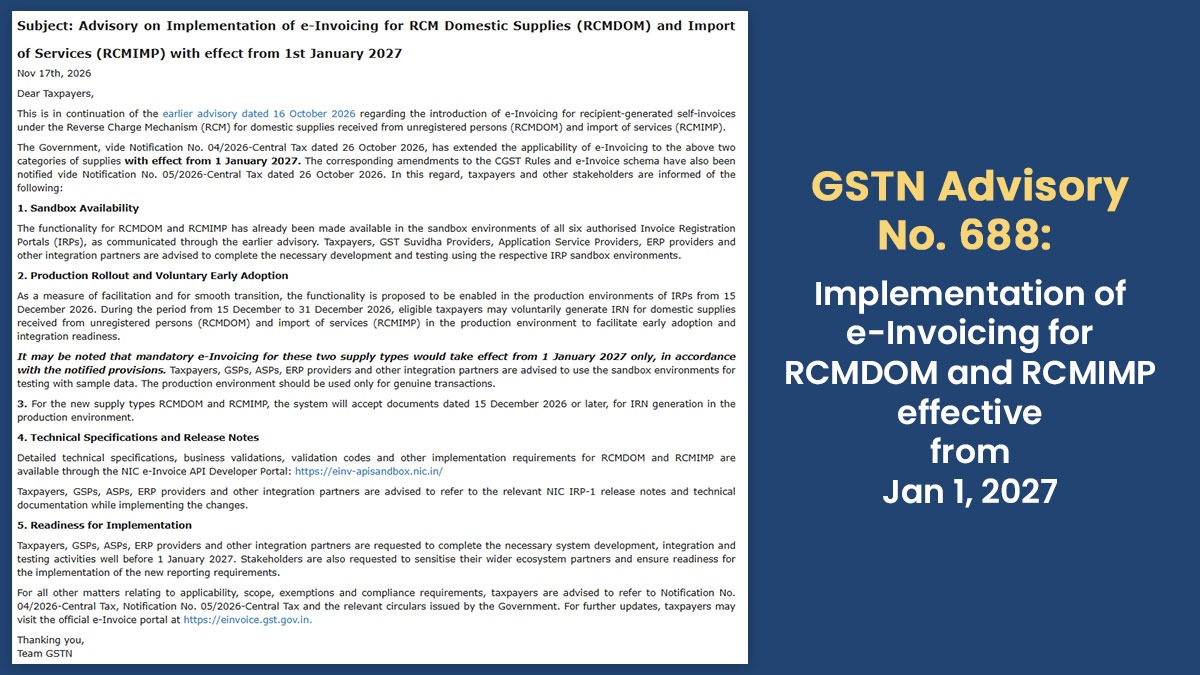
The Advisory is mentioned as:
Following the advisory dated 16 October 2026, the Government has mandated e-Invoicing for recipient-generated Reverse Charge Mechanism (RCM) self-invoices covering domestic supplies from unregistered persons (RCMDOM) and import of services (RCMIMP) w.e.f. 1 January 2027 (Notification No. 04/2026-Central Tax).
Corresponding updates to the CGST Rules and e-Invoice schema have also been notified (Notification No. 05/2026-Central Tax, dated 26 October 2026). Concerning this, the taxpayers and other stakeholders are notified about-
Sandbox Access Availability
RCMDOM and RCMIMP functionalities are now available in all six authorized IRP sandbox environments. Taxpayers, GST Suvidha Providers, Application Service Providers, and ERP providers should complete development and testing promptly.
Production Launch and Voluntary Adoption
To ensure a smooth transition, RCMDOM (domestic supplies from unregistered persons) and RCMIMP (import of services) functionalities will be enabled on IRP production environments starting 15 December 2026. Between 15 December and 31 December 2026, eligible taxpayers can voluntarily generate IRNs for these transactions to support early adoption and integration readiness.
Mandatory e-Invoicing for these two supply types takes effect on 1 January 2027. Taxpayers, GSPs, ASPs, ERP providers, and integration partners must use sandbox environments for sample data testing and reserve the production environment strictly for genuine transactions.
For the new supply types RCMDOM and RCMIMP, the system will accept documents dated December 15, 2026, or later for the purpose of generating an IRN in the production environment.
Technical Features and Release Details
Detailed technical specifications, business validations, validation codes, and other implementation requirements for RCMDOM and RCMIMP are available on the NIC e-Invoice API developer portal: https://einv-apisandbox.nic.in/.
Taxpayers, GSPs, ASPs, ERP providers, and other integration partners should refer to the pertinent NIC IRP-1 release notes and technical documentation when implementing these changes.
Readiness for Rollout
Taxpayers, GSPs, ASPs, ERP providers, and integration partners must complete system development, integration, and testing before 1 January 2027, and sensitise their ecosystem partners to ensure readiness for the new reporting requirements.
For details on applicability, scope, exemptions, and compliance, refer to Notification No. 04/2026-Central Tax, Notification No. 05/2026-Central Tax, and relevant government circulars, or visit einvoice.gst.gov.in for updates.
Read GSTN Advisory No. 688: https://www.gst.gov.in/newsandupdates/read/688