

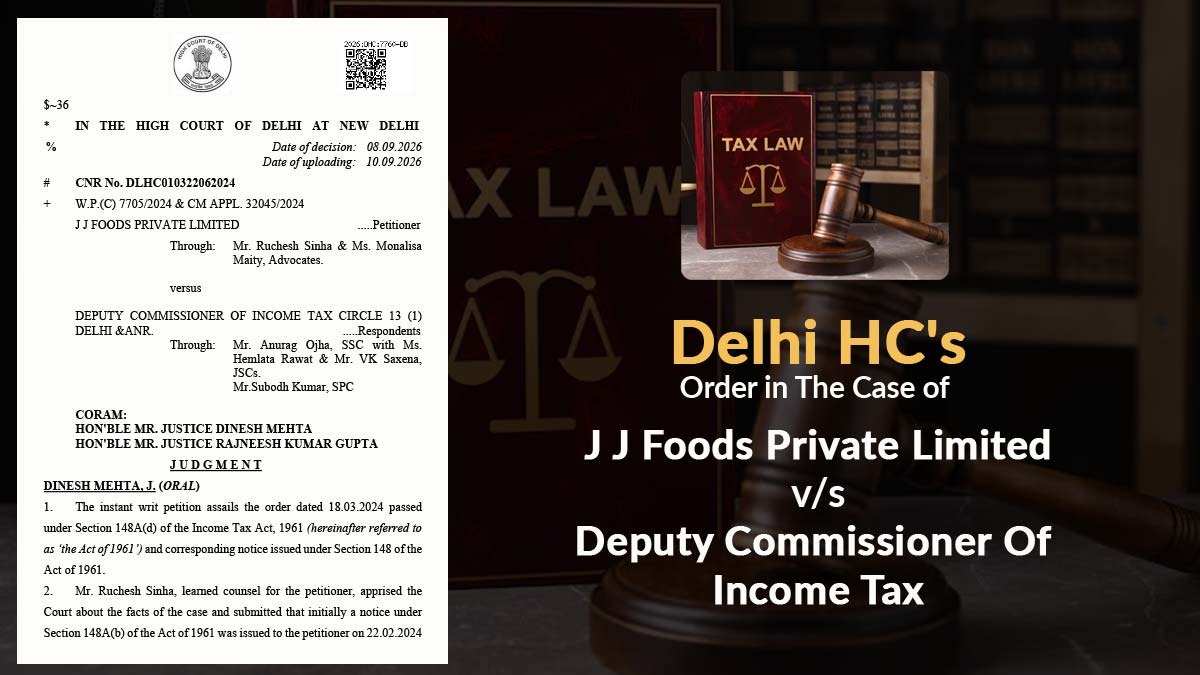
The Delhi High Court has quashed an order issued under Section 148A(d) of the Income Tax Act, 1961. The Court held that the Assessing Officer (AO) violated natural justice principles by arbitrarily shortening the assessee’s statutory timeline to respond and passing the order without evaluating the reply already submitted.
The Division Bench of Justices Dinesh Mehta and Rajneesh Kumar Gupta stated that the taxpayer was entitled to 30 days to submit its response; the AO had practically reduced the time available to it to nearly 15 days.
The court was hearing a writ petition contesting the Section 148A(d) order dated March 18, 2024, and the consequential notice issued to the applicant u/s 148 of the Income Tax Act.
As per the record, the taxpayer was initially issued a notice u/s 148A(b) on February 22, 2024, requiring it to answer by March 3. On that date, the taxpayer asked for an adjournment, after which the AO fixed the case for March 8.
On March 8, the taxpayer asked for 2 weeks to submit its reply. However, the AO provided only 2 days, requiring the response to be submitted by March 10.
The taxpayer mentioned that its accountant was not in the city and thus it failed to respond within the shortened duration. It therefore asked for 15 days by email but did not succeed.
Despite the submission of a reply, the AO passed an order under Section 148A(d) on March 18 without considering the reply.
Defending its action, the Income Tax Department stated that two opportunities had already been granted, yet the taxpayer failed to file a response by the deadline of March 10.
It was argued that since the law prescribes a time limit, the taxpayer was equally bound to adhere to the timeframe stipulated by the AO.
But the HC observed that the taxpayer was given 30 days to submit its reply under the statutory structure.
The Court said, “such being the position,” the AO does not have adequate time to consider the taxpayer’s reply, “at least up to 22.03.2024.”
The Court said that there was “no pressing hurry to eschew petitioner’s right to file reply or to confine its right to file reply by 10.03.2024.”
Important: Bombay HC: Delay in Filing ITR Due to CAs Advice Does Not Constitute Assessee’s Negligence
It was stated that the taxpayer had emailed the AO on March 9-one day before the deadline expired-requesting a two-week extension. Under these circumstances, the AO should have given some additional time “in the interest of justice.”
The Court said that the response of the taxpayer had been uploaded by the time the reassessment order was passed on March 18.
The AO, hence, the Court expressed, “could very well see and consider the reply so filed before passing an order, but he has chosen not to do so.”
Read Also: Delhi HC Sets Aside Reassessment Notice for Breaching Section 148A Norms
The court, holding that the AO’s approach had “seriously prejudiced the petitioner’s right”, quashed the impugned action and asked the AO to pass a fresh order after considering the response of the taxpayer.
| Case Title | J J Foods Private Limited vs. Deputy Commissioner Of Income Tax |
| Case No. | W.P.(C) 7705/2024 & CM APPL. 32045/2024 |
| Counsel For Appellant | Mr Ruchesh Sinha & Ms Monalisa Maity |
| Counsel For Respondent | Mr Anurag Ojha, Ms Hemlata Rawat and Mr V. VK Saxena, Mr Subodh Kumar |
| Delhi High Court | Read Order |