

The Delhi High Court has mentioned that a penalty levied under section 271(1)(c) of the Income Tax Act, 1961, cannot be sustained if the notice issued to the taxpayer did not mention the specific limb under which the penalty proceedings are proposed.
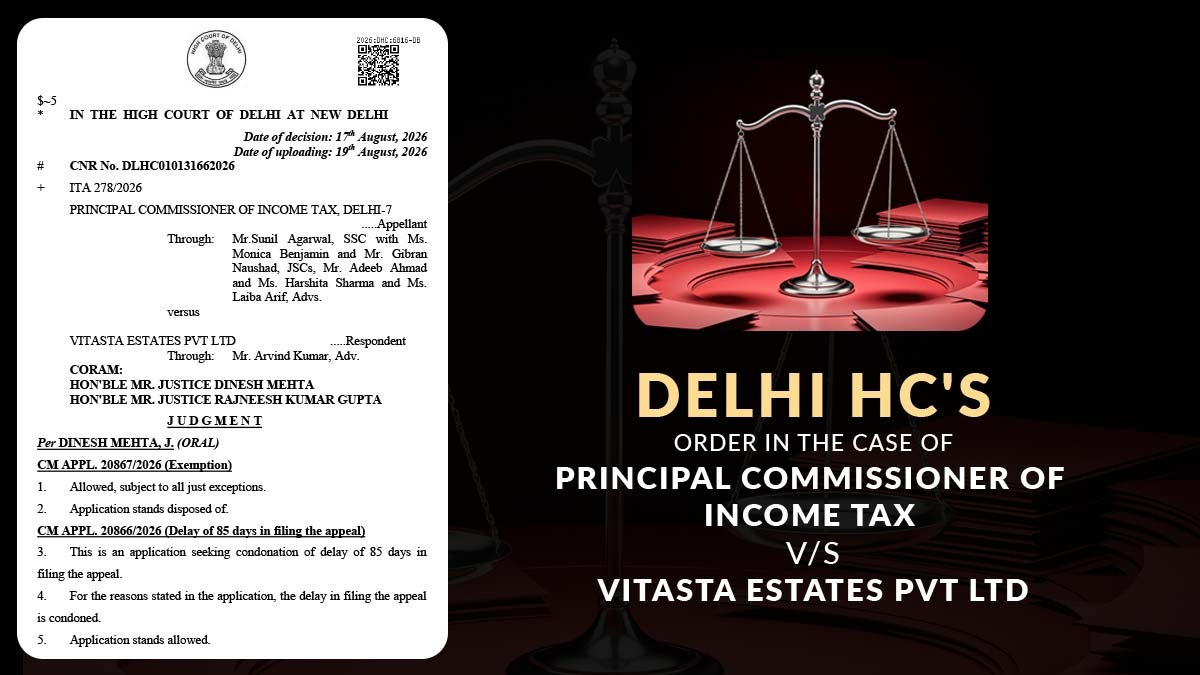
The division bench of Justices Dinesh Mehta and Rajneesh Kumar Gupta did not accept the Revenue’s appeal against an ITAT order quashing the penalty levied on Vitasta Estates.
The Section 271(1)(c) considers two different grounds for charging penalty: concealment of particulars of income or giving wrong particulars of income.
As the legislature has used the word “or”, the two contingencies are independent alternatives; the court mentioned that-
“Unless the AO puts the assessee to notice as to which part of Clause (c) he seeks to invoke against the assessee, the assessee cannot be expected to defend his cause,” it observed.
The court outlined that the issuance of notice cannot be regarded as an empty formality and though the two limbs can be directed to the same outcomes, they comprise distinct means and may need distinct explanations from the taxpayer.
The case is related to the penalty proceedings started against the respondent-taxpayer for AY 2008-09.
The Assessing Officer (AO) in the scrutiny assessment discovered that the taxpayer had incorrectly claimed a loss emerging from the sale of land as a revenue loss. However, the taxpayer submitted a revised return asserting that the loss was specified as capital; the revised return was not considered.
The assessing officer recorded that the taxpayer had given wrong particulars, thereby hiding the income particulars.
The taxpayer received notice from the AO to show cause why proceedings must not be initiated for having “concealed the particulars of your income or furnished inaccurate particulars of such income”.
Revenue claimed that the intent of the AO could be seen from the assessment order and that failure to remove one of the options in the notice was only a procedural irregularity.
Also Read: Delhi ITAT Deletes Tax Penalty on Salaried Person for Failing to File ITR Even With ₹30 Lakh Income
The HC denied the claim and said that although the assessing officer had recorded satisfaction for initiation of the penalty proceedings, he was unclear about which limb of Section 271(1)(c) was drawn or the accurate violation for which the taxpayer was asked to be penalised.
The Court observed that the previous decision of the Delhi High Court on the issue, along with PCIT v. Unitech Reliable Projects (P) Ltd., had been confirmed by the Supreme Court.
Therefore, the Court cancelled the appeal of the revenue and upheld the decision of the ITAT quashing the penalty.
| Case Title | Principal Commissioner of Income Tax Vs Vitasta Estates Pvt Ltd |
| Case No. | ITA 278/2026 |
| Counsel for Petitioner | Mr Sunil Agarwal, Ms Monica Benjamin, Mr Gibran Naushad, Mr Adeeb Ahmad, Ms Harshita Sharma, Laiba Arif |
| Counsel for Respondent | Mr Arvind Kumar |
| Delhi High Court | Read Order |