

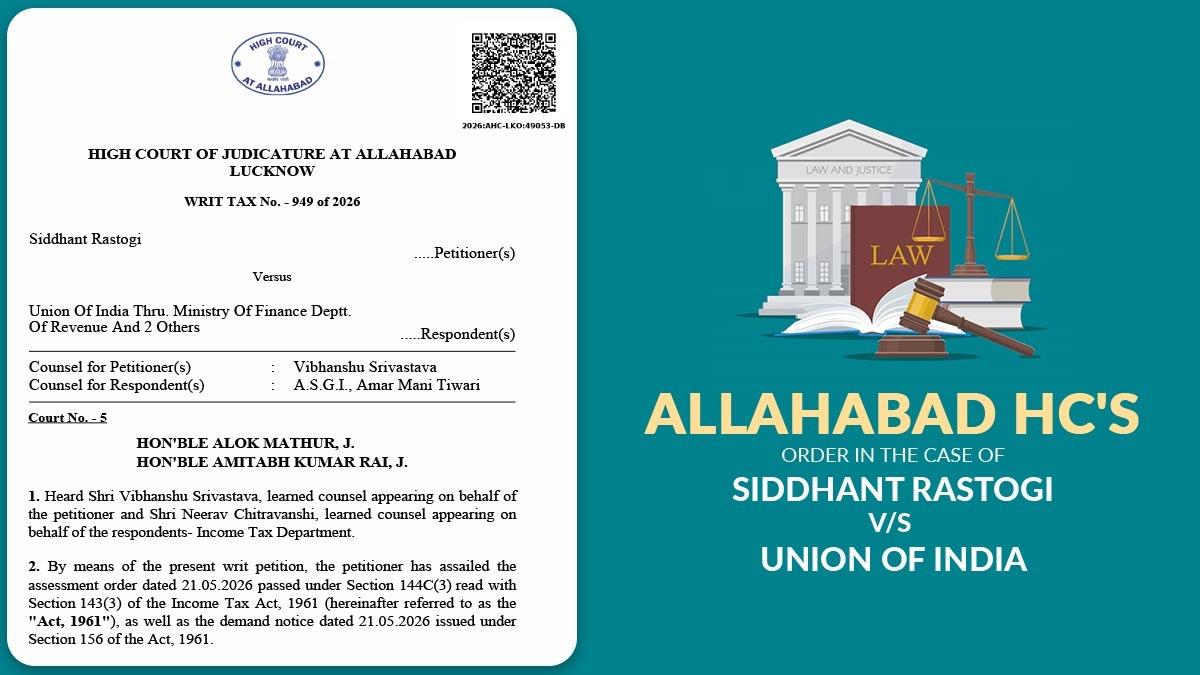
The Allahabad High Court at Lucknow has said that objections to a draft assessment order u/s 144C of the Income Tax Act, 1961, should be submitted before the Dispute Resolution Panel along with the Assessing Officer and that filing them before the Assessing Officer alone will be ineffective.
The Court said that if no objections are submitted before the Dispute Resolution Panel, the Assessing Officer may conclude the assessment based on the draft order itself.
Section 144C of the Income Tax Act, 1961 specified a procedure that applies once a draft assessment is issued. Section 144C(2)(b) provides for objections to the draft and Section 144C(3) permits the assessment to be finished based on the draft where no objections are submitted.
The bench of Justice Alok Mathur and Justice Amitabh Kumar Rai said that
“Section 144C(2)(b) specifically requires that objections against the draft assessment order be filed before both the Dispute Resolution Panel and the Assessing Officer. The use of the word “and” clearly indicates that compliance with both requirements is mandatory.”
“However, where no objections are filed before the Dispute Resolution Panel, Section 144C(3) enables the Assessing Officer to complete the assessment based on the draft assessment order.”
The applicant, a professional seafarer employed outside India during the assessment period, was asserted to be a non-resident under the Act. For AY 2024-25, he submitted a return claiming exemption on the remuneration earned abroad.
A notice u/s 143(2) was issued on June 24, 2025, initiating a faceless assessment u/s 144B. This was followed by additional notices u/s 142(1) on October 3, 2025, December 2, 2025, and February 9, 2026.
The petitioner stated that none of these notices reached him due to an inadvertent error: an incorrect email address had been entered on the Income Tax portal.
He only became aware of the proceedings upon receiving the draft assessment order dated March 14, 2026, which proposed to evaluate his total income at ₹79,63,350.
On the e-filing portal, the applicant submitted objections dated 27.03.2026 and received an acknowledgement. The assessment order arrived on 21.05.2026.
Before the HC, he said that the assessing officer did not deal with any of the grounds raised, that the order incorrectly recorded that no response to the draft order had been submitted, and that he was not heard at any phase.
Concerning the Income Tax Department, it was furnished that the objections had gone merely to the Assessing Officer instead of the Dispute Resolution Panel, and in their absence the Assessing Officer could complete the assessment u/s 144C(3) without a reference to the Panel.
The court observed that the applicant confessed that the section 142(1) notices could not reach him because of the e-mail address he had given and no objections had been placed before the Dispute Resolution Panel.
It stated that when objections arrived before the Dispute Resolution Panel, the panel is obliged to analyse them and issue directions, which bind the assessing officer.
“Apart from the above, it is also noticed that under the Income Tax (Dispute Resolution Panel) Rules, 2009 (hereinafter referred to as “Rules, 2009″), a statutory appellate remedy has been provided. Where the assessment order is passed pursuant to the directions of the Dispute Resolution Panel, an appeal lies before the Income Tax Appellate Tribunal. In cases where Section 144C is not attracted or where the statutory conditions thereunder are not fulfilled, the remedy of appeal under Section 246A of the Act, 1961 is available before the Commissioner of Income Tax (Appeals).”
The Court did not discover any procedural infirmity prima facie in the assessment order and placed reliance on Commissioner of Income Tax and others v. Chhabil Dass Agarwal, in which the Apex Court said that where the taxing law furnishes a statutory procedure, the taxpayer must be relegated to that remedy instead of being allowed to invoke Article 226.
The court did not consider the petition for an alternative remedy and dismissed it; it stated that it had not gone into the merits and allowed the applicant to raise the grounds before the appellate authority.
| Case Title | Siddhant Rastogi vs. Union Of India |
| Case No. | WRIT TAX No. – 949 of 2026 |
| Counsel for Petitioner | Vibhanshu Srivastava |
| Counsel for Respondent | A.S.G.I., Amar Mani Tiwari |
| Allahabad High Court | Read Order |