

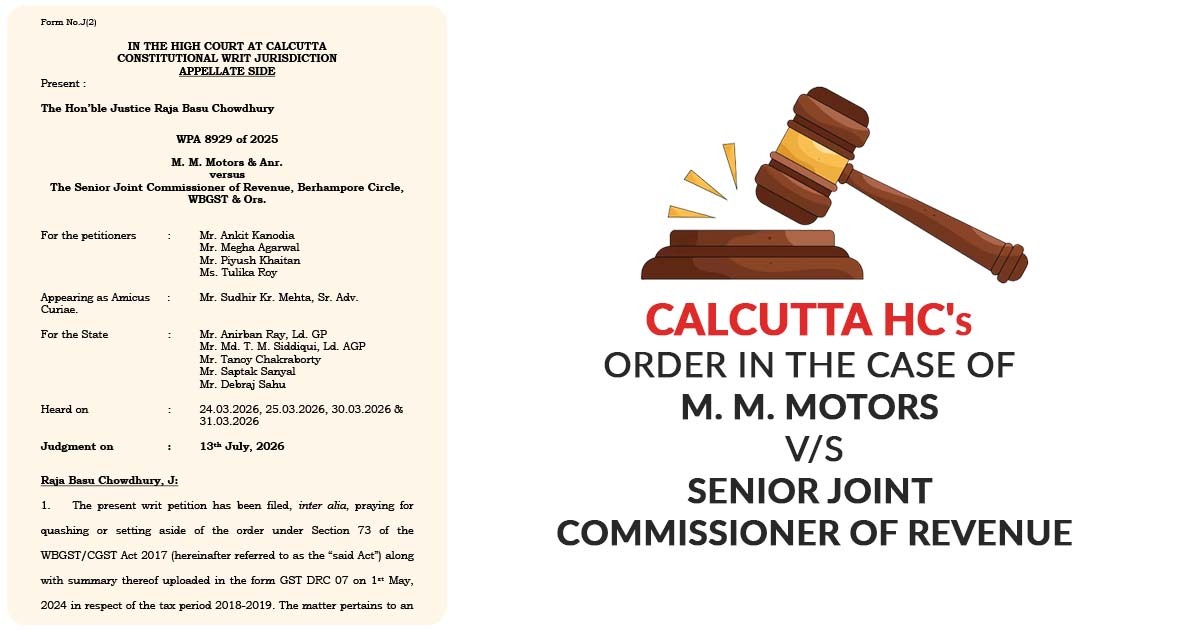
The Calcutta High Court has held that an order under Section 73 of the Central Goods and Services Tax (CGST/WBGST) Act, 2017 is validly issued within the prescribed limitation period if it is digitally signed by the proper officer on or before the statutory deadline, even if it is uploaded to the common portal on the following day. Accordingly, the Court dismissed the writ petition challenging the GST demand order.
M. M. Motors and another petitioner contested the final order issued u/s 73(9) of the GST Act, 2017, for the year 2018-2019. The order’s deadline was extended to April 30, 2024. The summary in Form GST DRC-07 was submitted on the portal on May 1, 2024; however, the order was digitally signed by the proper official on April 30, 2024, at 21:15 hrs.
The petitioners argued that the ruling was unlawful and barred by the statute of limitations. They referenced precedents from the Income Tax Act and contended that the terms “issue” and “service” are interchangeable. They pointed out that, under Rule 142(5), the order must be uploaded to the website and that it should be considered “issued” only once it has been successfully uploaded. Additionally, they claimed that the order, in its current state, is incomplete without proper service.
The Counsel of the State Advocate General, Mr Anirban Ray, and Senior Advocate Mr Md. T. M. Siddiqui said that the GST Act distinguishes between the adjudicatory and the communication functions. The order was legally passed on 30.4, as soon as it was digitally signed, within the limitation period, and uploading it afterwards was only a means of service as provided in Section 169 of the Act.
The Single Judge Bench Justice Raja Basu Chowdhury, with the assistance of Senior Advocate Mr Sudhir Kr. Mehta, appearing as amicus curiae, studied the statutory structure of the GST Act in detail. The court specified that the order u/s 73 comprises three different steps, namely, (1) making of the order, (2) issuing of the order, and (3) transmission (service) of the order.
The bench said that the legislature had intentionally departed from earlier acts like the Finance Act, 1994, and the Central Excise Act, 1944, which had clearly linked the limitation period with the “service” of a notice. Section 73(10) of the GST Act uses the word “issue” and not “serve” and the form of “service” is completely isolated and dealt with u/s 169.
The Court placed reliance on the e Supreme Court judgement in R.K. Upadhyay v. Shanabhai P. Patel and Safari Retreats Private Limited and repeated that foreign interpretations like the import of dictionary meanings or precedents from the Income Tax Act concerning section 148 notices could not be imported while interpreting a taxing law where the legislature has deliberately utilised distinct terminology.
The Court said that the limitation period is restricted to the issue of the order (digital signing) and the Act does not require the order to be provided within the limitation period. The order can merely be executed after service, but a delay in service or uploading does not quash the order ab initio or take away the jurisdiction already assumed by the officer.
Therefore, the court set aside the writ petition, citing that the order was statutorily passed within the expanded limitation period.
| Case Title | M. M. Motors Vs Senior Joint Commissioner of Revenue |
| Case No. | WPA 8929 of 2025 |
| For Petitioner | Mr Ankit Kanodia, Mr Megha Agarwal, Mr Piyush Khaitan, Ms Tulika Roy |
| For Respondent | Mr Anirban Ray, Mr Md. T. M. Siddiqui, Mr Tanoy Chakraborty, Mr Saptak Sanyal, Mr Debraj Sahu |
| Calcutta High Court | Read Order |