

The Bombay High Court said that the TDS credit should not be refused to a taxpayer only because the person who deducted the tax did not deposit it with the Central Government, once the actual deduction of tax from the income or payment is specified.
A Division Bench of Justices B.P. Colabawalla and Firdosh P. Pooniwalla said that the mistake of the deductor cannot harm the deductee and directed the income tax department to check claims and provide TDS credit where actual deduction is established. The judges said that-
“where tax has in fact been deducted at source from the income or payment of an assessee, the Department cannot deny the deductee the credit thereof merely because the deductor failed to deposit the amount to the credit of the Central Government.”
The applicants are salaried employees and other taxpayers whose payments were liable for TDS. In their cases, the deductors had not submitted the tax or had not accurately filed the TDS statements.
Therefore, the amounts were not shown in the taxpayers’ records, after which the Income Tax Department rejected the TDS credit and raised demands against them.
The question before the court was whether TDS credit could be given u/s 199 of the Income-tax Act, 1961, when tax had been deducted but not deposited by the deductor, or whether Section 205 only safeguards the taxpayers from recovery of the related demand. The court regarded what proofs could specify deduction where Form 16 or Form 16A was unavailable.
The Court said that Sections 199 and 205 must be read harmoniously. Section 199 deals with credit for tax deducted at source, while Section 205 safeguards a taxpayer from tax recovery to the extent that tax has earlier been deducted from the income.
Section 205 is a substantial protection that comes into effect once tax has been deducted from the taxpayer’s income. The protection is not dependent on the deductor depositing the amount with the Government afterwards.
Also, the Bench mentioned that a stringent interpretation of Section 199 shall override the protection given u/s 205 and appropriately make the taxpayer bear the consequences of the deductor’s statutory default.
It considered the order of the Apex Court in Income-tax Assessing Officer, Baroda v. Shobhan Shantilal Doshi, which recorded the submission of the revenue that where TDS had actually been deducted, the taxpayer shall obtain credit even when the deductor had not deposited the amount with the department, subject to factual verification.
The court concluded that the position taken supported a harmonious interpretation of Sections 199 and 205. It rejected the argument that the absence of Form 16 or Form 16A alone would invalidate a claim for TDS credit.
The court noted that, under the current electronic system, these certificates are typically generated only after the deductor has deposited TDS and filed the necessary statement. Therefore, requiring such certificates when the deductor has defaulted would make it nearly impossible for the deductee to substantiate the deduction.
Furthermore, the court maintained that a taxpayer can demonstrate the actual deduction using other credible evidence. This evidence may include salary slips, bank statements, payment advisories, ledgers, invoices, rent records, correspondence, insolvency claims, and other relevant documentation. Thus, the absence of Form 16 or Form 16A is not detrimental to a claim for TDS credit.
The bench issued guidelines for handling such claims. It stated that if a taxpayer provides prima facie evidence indicating that TDS was deducted but is not reflected in Form 26AS due to the deductor’s default, the jurisdictional Assessing Officer must register the application, hold the corresponding demand in abeyance, and ensure that no coercive recovery or adjustment of refunds occurs while the claim is under verification.
The court directed the Assessing Officers to issue reasoned orders, preferably within six months.
Consequently, the High Court quashed the disputed orders and notices to the extent that they raised demands for TDS that had been deducted but not deposited with the government.
The court remanded the matters back to the respective Assessing Officers for verification and instructed them to grant TDS credit, including any applicable consequential refunds, and to make the necessary rectifications, corrections, or deletions of demands following verification.
Read Also: ITAT Bangalore Allows TDS Credit Despite Non-Claim in Original ITR
The ruling concerns domestic transactions and does not extend to international transactions.
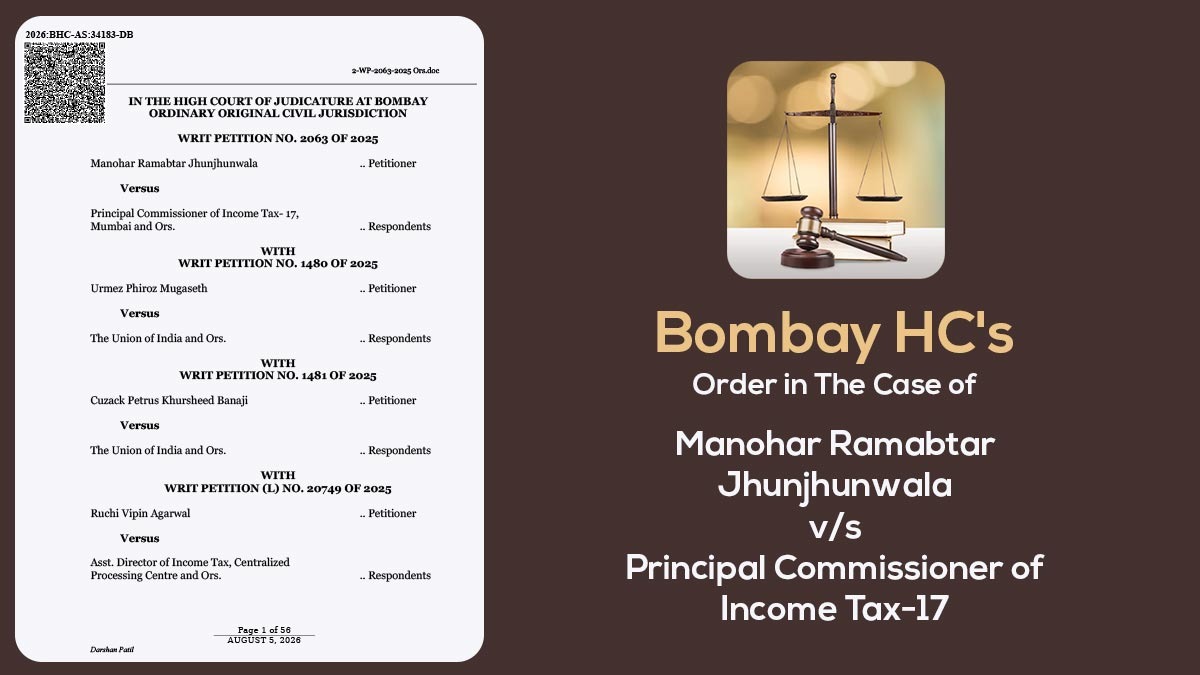
| Case Title | Manohar Ramabtar Jhunjhunwala vs. Principal Commissioner of Income Tax-17 |
| Case No. | No. 2063 OF 2025 |
| For the Petitioner | Mr Dharan V. Gandhi |
| For the Respondents | Mr. Ravi Rattesar |
| Bombay High Court | Read Order |