

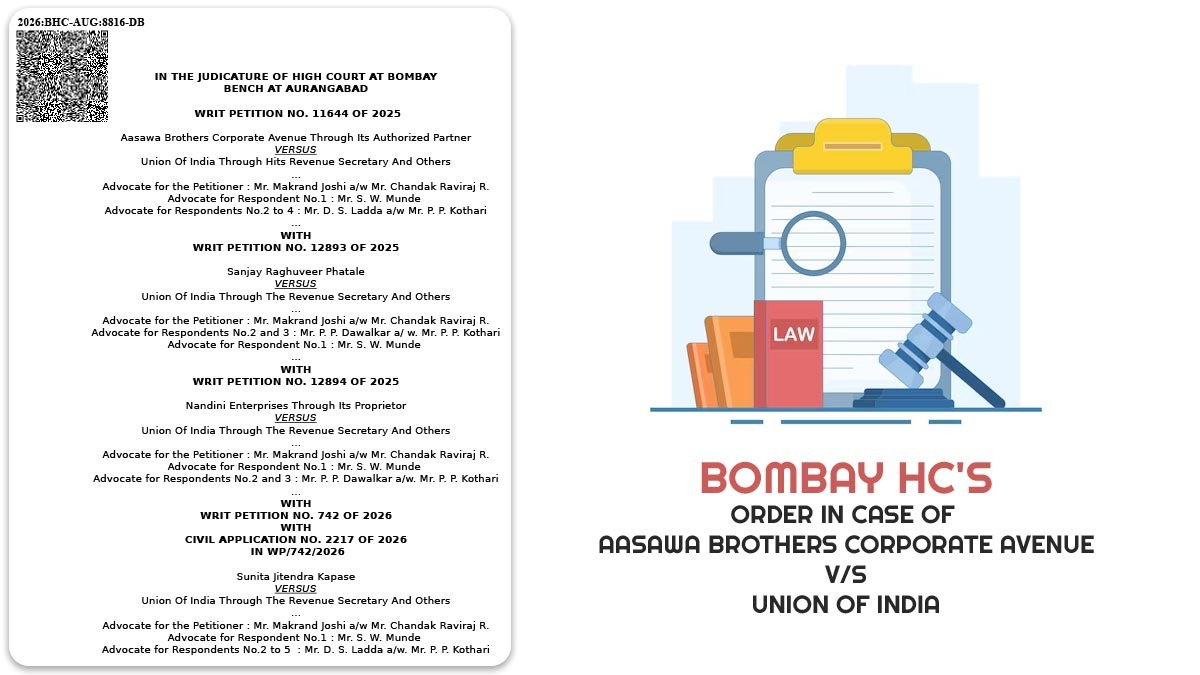
The Aurangabad Bench of the Bombay High Court has refused several GST SCN issued by the DGGI because these notices improperly connected numerous financial years into a single notice.
The Bench of Justices Arun R. Pedneker and Vaishali Patil-Jadhav has noted that the provisions under the CGST Act establish that the timeframe for determining tax is linked to the due date for submitting the annual return for each specific financial year related to the demand. Consequently, the limitation applies independently for each financial year.
Combining multiple financial years into a single SCN leads to the aggregation of different tax periods, each regulated by its own limitation timelines. This practice can undermine the taxpayer’s ability to present year-specific defences.
The applicants had contested a show cause-cum-demand notices on June 25, 26, and 27, 2025, issued via the Additional Director, DGGI u/s 74 of the CGST Act. The notices include multiple financial years in a single consolidated proceeding.
In two of the petitions, the adjudication process had already been completed, and final orders were issued based on the contested notices. Additionally, the petitioners have amended their petitions to challenge those adjudication orders on the grounds of jurisdiction.
Petitioners specified that the statutory scheme u/s 74 reflects year-wise determination of tax liability. As a limitation is related to the due date of filing the annual return for each fiscal year, independent notices should be issued for each year. It was claimed that the consolidation of multiple fiscal years in a single notice conquers the limitation framework and prejudicially impacts the rights of taxpayers.
The Court mentioned that the consolidation of multiple financial years in a single SCN under section 74 is not allowable unless exceptional possibilities exist.
The petitions were countered by the Union of India, claiming that the writ jurisdiction must not be invoked against the SCN and that an efficacious alternate remedy of appeal was present for the matters where adjudication had been completed earlier. The respondents put reliance on the decisions of the Delhi High Court, including Ambika Traders vs. Additional Commissioner, DGGSTI, to claim that consolidated notices might be allowable for the matters that comprise fake ITC of various years.
The Bombay High Court said that in Ambika Traders, the Delhi High Court had allowed the consolidated notices for the matters that comprise fake GST ITC transactions of multiple years, where the fraud cannot be formed without examining interlinked transactions in fiscal durations.
But, the Division Bench mentioned that in the current batch of matters, the impugned notices did not allege a composite or indivisible fake procedure for multiple years. No sign was there related to a continuous, interlinked design necessitating consolidation.
As per the Court under Sections 73 and 74 of the CGST Act, the limitation for tax determination is connected to the respective fiscal year and the deadline for filing the annual return. Hence, for each fiscal year, the limitation operates independently
The Court ruled that issuing a single SCN that combines multiple financial years effectively aggregates distinct tax periods, each governed by separate limitation timelines. This practice could unfairly prejudice a taxpayer’s ability to raise defences specific to each year.
Reiterating its previous stance from the case of Milroc Good Earth Developers, the Bench clarified that a single consolidated SCN covering multiple financial years is not legally sustainable unless there are exceptional circumstances, such as demonstrable composite fraud spanning multiple years.
Also Read: How GST Software Simplifies the Challan Facility for Taxpayers
As a result, the Court quashed the show cause and demand notices issued u/s 74. It also set aside the corresponding adjudication orders from two of the writ petitions and granted the respondents the right to issue new notices for the respective financial years, provided such actions are legally permissible.
| Case Title | Aasawa Brothers Corporate Avenue vs. Union Of India |
| Case No | Writ Petition No. 11644 of 2025 |
| For Petitioner | Mr Makrand Joshi, Mr Chandak Raviraj R. |
| For Respondent | Mr P. P. Dawalkar, Mr P. P. Kothari, Mr S. W. Munde |
| Bombay High Court | Read Order |