

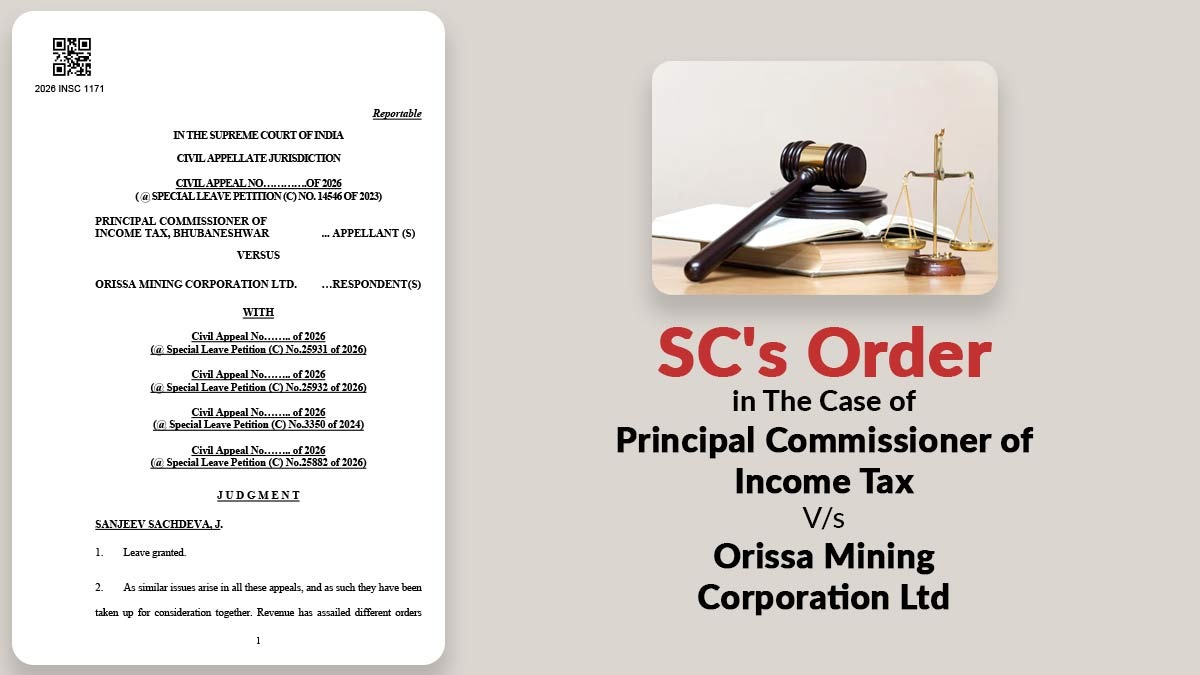
The Supreme Court has ruled that the Income Tax Department cannot legally conclude reassessment proceedings without first serving a mandatory notice under Section 143(2) of the IT Act, 1961.
The court ruled that a taxpayer’s participation in the proceedings cannot compensate for failing to issue the mandatory notice.
A bench of Justice Sanjay Kumar and Justice Sanjeev Sachdeva said that Section 292BB of the Act can safeguard the department against specific objections related to the service of a notice. However, if a notice was never issued in the first place, this defect cannot be cured.
“The Assessing Officer cannot undertake the proceedings of reassessment under Section 143(3), read with Section 147 of the Act, unless a notice under Section 143(2) of the Act has been issued to the Assessee. Mere participation of the Assessee in the assessment proceedings, in the absence of a notice under Section 143(2) of the Act, does not confer jurisdiction on the Assessing Officer to frame an assessment under Section 143 (3) of the Act,” the court stated.
This judgment concerns income tax reassessment cases involving Odisha Mining Corporation Limited and another taxpayer, relating to different assessment years. The department had already completed the original assessments for these cases before initiating the reassessment proceedings.
Subsequently, the Income Tax Department has reopened the assessments u/s 147 and issued notices u/s 148, but did not issue the important notices u/s 143(2).
The taxpayers contested the reassessment orders, but the Commissioner of Income Tax (Appeals) rejected their objections, noting that they had participated in the proceedings. The Income Tax Appellate Tribunal quashed these reassessment orders, and the High Court carried this decision.
The department, before the Supreme Court, has claimed that section 292BB could cure the defect. The provision safeguards the department against specific objections to the service of notices when the taxpayer participates in the proceedings. This is not applicable if the notice has not been issued, the Court stated.
Read Also: ITAT Kolkata Sets Aside Fake LTCG Assessment for Non-Service of Notice U/S 143(2)
The Court stated that a taxpayer may inform the department that the return originally filed u/s 139 should be treated as the return filed in response to a ‘reopening notice’ received u/s 148. However, this does not eliminate the requirement to issue a notice u/s 143(2).
It also mentioned that a letter u/s 142(1) cannot supersede the crucial notice. The Supreme Court dismissed the appeals of the department.
| Case Title | Principal Commissioner of Income Tax, Bhubaneshwar vs. Orissa Mining Corporation Ltd |
| Case No. | Special leave petition(C) No. 14546 OF 2026 |
| For Appellant | N. Venkataraman, Nisha Bagchi, Madhulika Upadhyay, Sudarshan Lamba, Venkataraman Chandrashekhara Bharathi and Raj Bahadur Yadav |
| For Respondents | Ashok Panigrahi, Shubhranshu Padhi, Subhas Chandra Das, Jay Nirupam, D. Girish Kumar, Pranav Giri |
| Supreme Court | Read Order |