

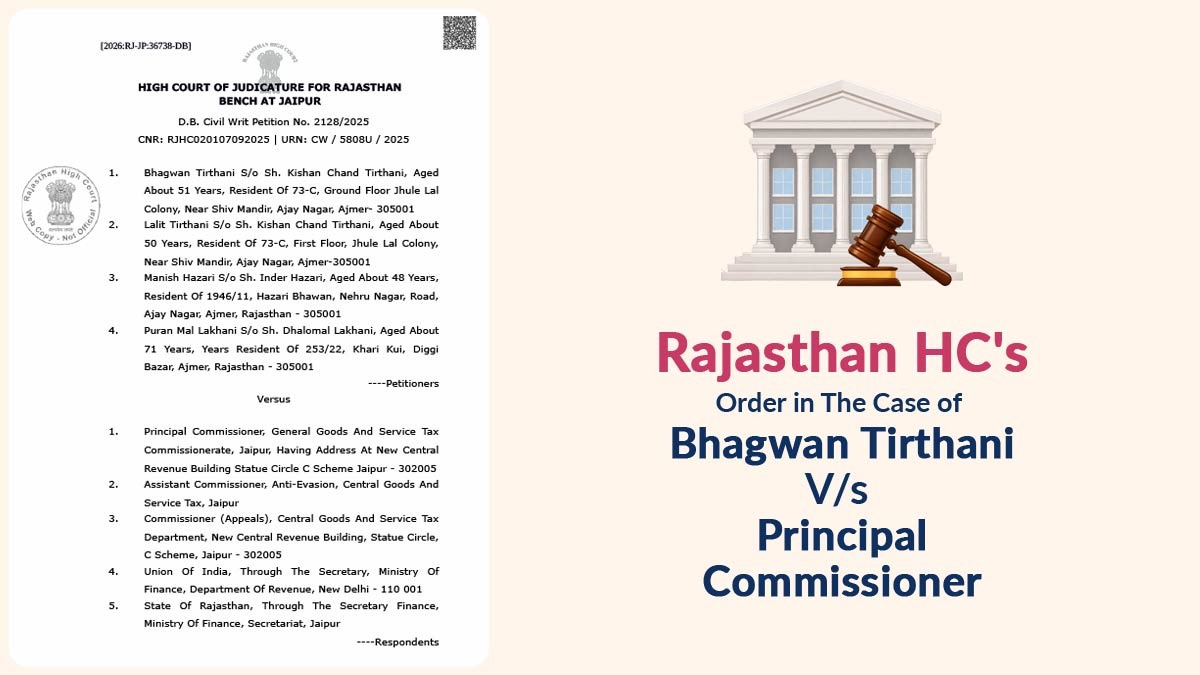
The Rajasthan High Court has asked the GST department to release the seized amount of Rs 47.45 lakh during a search of residential premises, including applicable interest.
A Division Bench comprising Justices Arun Monga and Ashutosh Kumar stated that Section 67(2) of the Central Goods and Services Tax (CGST) Act does not provide the authority for the seizure of cash only on suspicion that it represents proceeds from unaccounted sales. It stated:
“the jurisdictional condition of ‘reasons to believe’ under Section 67(2) is not an empty formality. The expression requires a bona fide belief based on objective material having a rational nexus with the action proposed. It is not synonymous with a mere suspicion”
The matter arose from search-and-seizure operations conducted by GST authorities across the petitioner’s commercial and residential premises. During the search, tax officials confiscated ₹47.45 lakh in currency and 2,33,300 cigarettes valued at approximately ₹18.67 lakh.
Applicants claimed that different individuals and family members have ownership of the cash. However, the assistant commissioner considered the cash and cigarettes as accountable to seizure, alleging that the unaccounted cigarette sales directed money.
To support the cash seizure, the GST department cited the recovery of untaxed stock, investigative statements, and WhatsApp chat records, alleging the funds represented proceeds from unaccounted commercial transactions.
The Court analysed Section 67(2) of the CGST Act, which allows tax authorities to seize goods, documents, books or things at the time of search if they have reasons to assume that these can be effective or pertinent to the proceedings under the Act.
It is stated that, under Section 2(52) of the Act, money and securities are explicitly excluded from the definition of ‘goods’. Furthermore, it is noted that the term ‘things’ cannot be interpreted so broadly as to encompass the seizure of cash. It was said that:
“Section 67(2) of the CGST Act does not use any expression comparable to ‘money’, ‘currency’, ‘cash’, ‘sale proceeds’, or ‘valuable article’. To hold that ‘things’ includes currency notwithstanding this deliberate legislative arrangement would, in effect, add words to the statute. Such an interpretation is impermissible, particularly when the power asserted is a coercive power authorising deprivation of possession of money.”
Furthermore, the bench stated that the term ‘things’ in Section 67(2) should be interpreted in the context of the other items mentioned therein.
This refers to items that could serve as material or evidence in an investigation; it does not imply that every movable article discovered during a search can be seized.
Read Also: Rajasthan HC Upholds GST Provision Under Section 16(2)(c) Requiring Supplier Tax Payment for ITC
It observed that the Income-tax Act and the Customs Act provide for the seizure of money or currency in certain circumstances. It stated that the absence of a corresponding provision in the CGST Act was substantial. It expressed:
“Other enactments, including the Income-tax Act and Customs Act, specifically provide for seizure of money or currency. The omission of a corresponding power in the CGST Act cannot be judicially supplied.”
Furthermore, the judges observed that the department failed to establish a direct link between the seized cash and the supply of any specific goods on which taxes had not been paid.
Although one of the petitioners acknowledged that Rs 37.45 lakh belonged to them, this merely establishes ownership; it does not prove that the money was derived from unaccounted sales.
They refused to comply with the decision of the Madhya Pradesh High Court in Smt. Kanishka Matta v. Union of India. Instead, the Bench placed reliance on the approach adopted by the Delhi High Court in Deepak Khandelwal v. Commissioner of CGST, Delhi West and the Bombay High Court in Smurti Waghdhare v. Joint Director, Directorate General of GST Intelligence (DGGI).
Accordingly, the High Court directed the GST department to release the seized amount of Rs 47.45 lakh, along with applicable interest as per the law, within 6 weeks from the date of the order being uploaded.
| Case Title | Bhagwan Tirthani vs. Principal Commissioner |
| Case No. | 2128/2025 |
| For Petitioner | Mr Rahul Lakhwani, Mr Mihir Jhanwar, and Mr Prateek Kedawat |
| For Respondent | Mr C.S. Sinha, Mr Dev Yadav, Ms Chelsi Agarwal, Mr Kuldeep Singh Rathore, and Ms Mahi Yadav |
| Rajasthan High Court | Read Order |