

The Delhi High Court has said that the absence of a stipulated duration for determining applications seeking cancellation of duplicate Permanent Account Numbers (PANs) can cause issues for taxpayer, especially those concerned with ITR filing and claiming services associated with PAN.
The Division Bench of Chief Justice Devendra Kumar Upadhyaya and Justice Tejas Karia was dealing with a PIL which sought directions to the authorities to specify a timeframe for determining applications for cancellation of duplicate PANs.
The case of the applicant was that Section 139A(7) of the Income Tax Act, 1961 provides that a person can be provided only one PAN and cannot apply for, receive, or possess another PAN. The additional PAN is needed to be surrendered if a person is allotted more than one PAN.
The petitioner cited the CBDT’s Circular No. 7 of 2022 regarding the linking of PAN with Aadhaar, stating that if an individual holds more than one PAN, the additional PAN(s) must be surrendered before the retained PAN can be linked to Aadhaar.
Read Also: Solved! Name Mismatch Problem (Aadhaar & PAN Card) for ITR?
Furthermore, it was noted that neither the Income Tax Act nor any CBDT circular prescribes a specific timeframe within which the Assessing Officer must decide on an application to cancel or surrender a duplicate PAN.
The applicant received information from the CBDT under the Right to Information Act, 2005, but the response did not cite any timeframe for deciding such applications.
The Revenue stated that the relief sought in the PIL, specifically, the demand to fix a definite timeframe, was essentially in the nature to seeking a change or amendment to existing rules and the administrative framework.
Reacommended: Avoid Errors in Aadhaar/PAN for Income Tax Return Filing
It was concerned that applications for cancellation or surrender of duplicate PANs must not remain pending for an unduly prolonged period and should be analyzed and determined by the competent authority.
The Court said that, “The absence of such a timeframe may cause hardship to taxpayers during the pendency of their applications, particularly in relation to the filing of Income-tax Returns and the availing of services linked to the PAN.”
It is observed that the applicant did not give any representation to the CBDT before approaching the Court.
The Court allowed the applicant to provide a representation to the CBDT within 2 weeks, specifying issues arising from the absence of a stipulated timeframe.
CBDT sought to entertain the representation and choose the correct decision within 8 weeks.
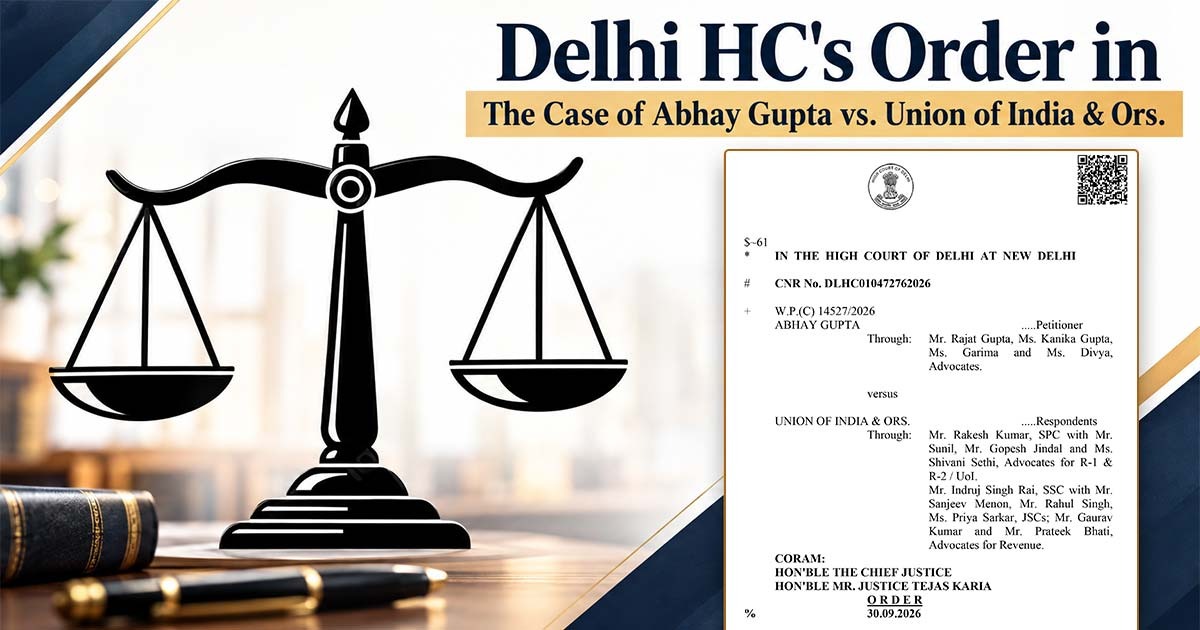
| Case Title | Abhay Gupta vs. Union of India & Ors. |
| Case No. | W.P.(C) 14527/2026 |
| For Petitioner | Mr. Rajat Gupta |
| For Respondent | Mr. Rakesh Kumar, SPC |
| Delhi High Court | Read Order |