

The Gujarat High Court has said that tax authorities cannot refuse ITC on a transaction on which tax was not levied initially.
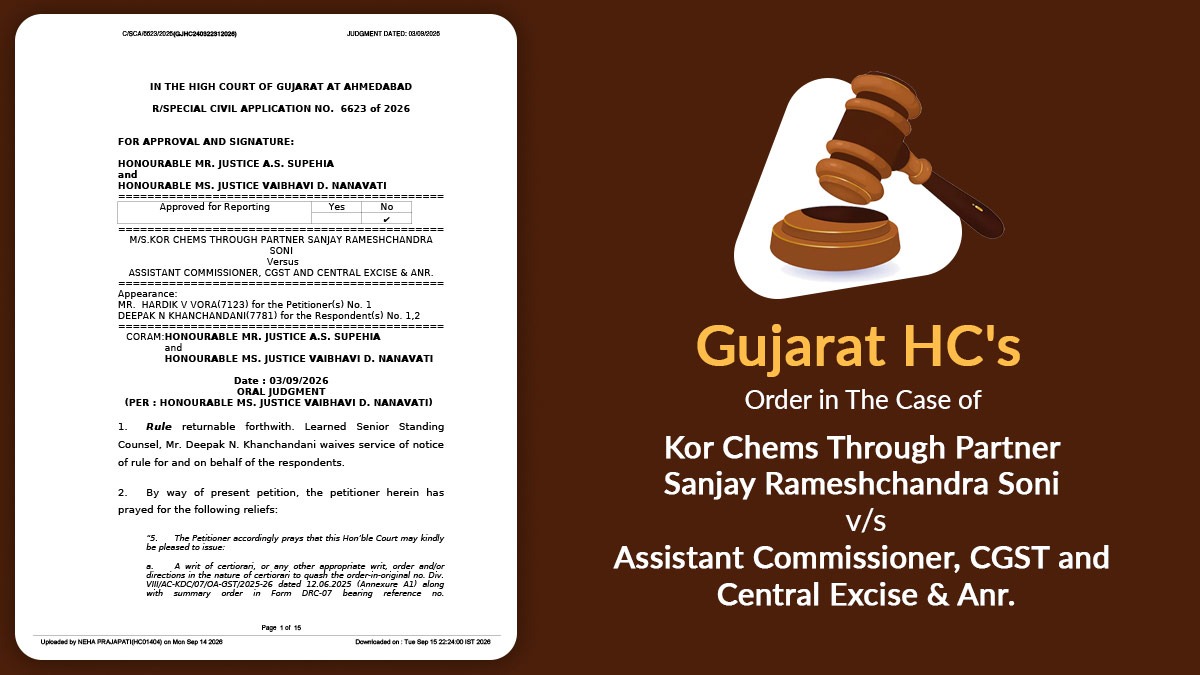
A bench of Justice A.S. Supehia and Justice Vaibhavi D. Nanavati has given the ruling while setting aside a GST demand against Kor Chems over credit claimed on the acquisition of leasehold rights in a GIDC industrial plot.
After determining that GST was not chargeable on the transfer of the leasehold rights, the Court mentioned that the ITC reversal and interest could not exist.
“Section 17(5)(d) of the CGST Act, presupposes the existence of a taxable inward supply, on which tax is lawfully leviable and paid,” the bench said. “When there is no taxable supply, the question of applying the blocking provision under section 17(5) of the CGST Act does not arise at all.”
The dispute is related to Rs 29.25 lakh in ITC claimed by Kor Chems on GST levied for the assignment of leasehold rights in an industrial plot at Ankleshwar. The firm acquired the rights in February 2022 and claimed the GST paid on the transaction as ITC.
In a departmental inspection, a firm’s partner said that the ITC had been claimed under a bona fide assumption that it was considerable. The firm therefore reversed the Rs 29.25 lakh via DRC-03 and paid Rs 4.44 lakh as interest.
Thereafter, the tax department considered the credit as blocked u/s 17(5)(d) of the CGST Act and invoked Section 74(1) to recover the amount with interest and penalty. Kor Chems stated that details of the transaction had been disclosed in their GST returns and books of account, and there was no element of fraud, suppression of facts, or willful misrepresentation involved.
The adjudicating authority validated the ITC demand of Rs 29.25 lakh, interest of ₹4.44 lakh, and an equivalent penalty. Thereafter, the appellate authority upheld the demand.
HC placed reliance on its earlier ruling for assignment of leasehold rights in GIDC plots. It said that assignment or transfer of these rights is directed to the transfer of advantages emerging from immovable property and is not included in the related provisions specifying a taxable supply. Hence, GST was not chargeable on these transactions.
The bench stated that this finding was the main reason for the ITC dispute. Due to not charging of the GST on the underlying transaction, the ITC and interest reversal could not survive, which were founded on the assumption that GST was liable to be paid.
The Court placed reliance on an earlier ruling in which it had analysed the scope of Section 17(5)(d). It said that the restriction is related to the goods or services obtained for the construction of an immovable property and observed that the provision did not apply where the taxpayer had not performed construction activity.
The court in the case of Kor Chems has observed that there was no activity of the construction taken place. Thus, the allegation of blocked credit u/s 17(5)(d) was misguided, and the resulting demand was unsustainable.
The court did not discover any fraud, wilful misstatement, or suppression of facts by Kor Chems. It therefore stated that Section 74(1), which applies to an incorrect claim or use of ITC on the grounds of such conduct, could not be invoked.
The bench set aside the orders confirming the demand and asked the authorities to refund Rs 29.25 lakh paid via DRC-03 as tax and Rs 4.44 lakh paid as interest. The refund was ordered to be made within 3 weeks from the receipt of the judgment.
| Case Title | Kor Chems Through Partner Sanjay Rameshchandra Soni v. Assistant Commissioner, CGST and Central Excise & Anr. |
| Case No. | Civil Application No. 6623 of 2026 |
| For Petitioner | MR. Hardik V Vora |
| For Respondent | Deepak N Khanchandani |
| Gujarat High Court | Read Order |