

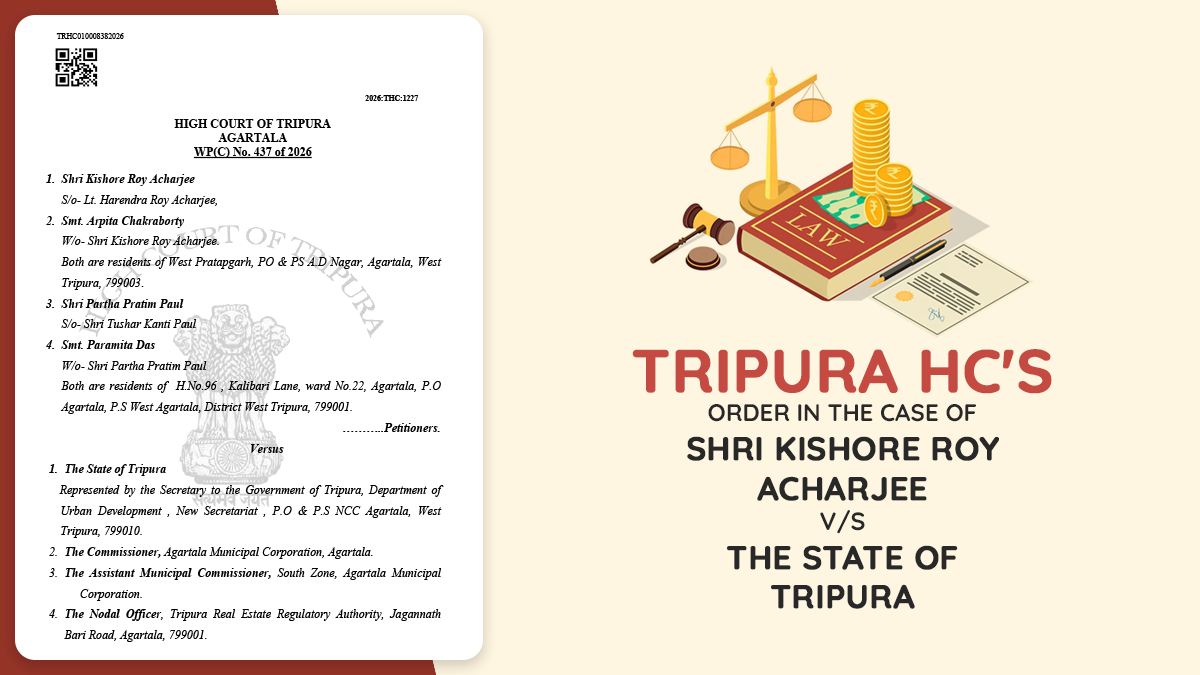
The Tripura High Court dismissed a writ petition seeking the conversion of a residential property for commercial use. The Court imposed a fine of ₹40,000, citing the concealment of information regarding parallel proceedings pending before the Real Estate Regulatory Authority (RERA).
In 2020, the petitioners acquired ground floor commercial units in “The Royal Peace Apartment,” Agartala, developed by respondent No. 5.
The petitioners alleged that the developer erected an unauthorised latrine, toilet, and brick-walled tin-shed guard room in violation of the sanctioned Municipal Building Plan. These illegal structures obstructed access and severely restricted the operation of the planned pathology laboratory and eye clinic.
In response to the applicants’ complaints, an inspection has been conducted by the municipal authorities, and asked for the demolition of the unauthorised constructions. However, the developer did not comply with the stipulated orders.
Read Also: Tripura High Court Rules GST ITC Can’t Be Denied for Bona Fide GSTIN Reporting Error
The applicants were not satisfied with this and thus approached the HC seeking directions for demolition of the unauthorised constructions, initiation of appropriate proceedings for breaching the Building Rules and approved plan, compensation, and costs.
Tapas Kumar Deb, counsel for the petitioners, submitted that the developer erected latrines and toilets over open drains on both the northern and southern sides of the apartment complex.
These structures were allegedly built in direct violation of the sanctioned building plan dated February 1, 2020. The petitioners contended that these unauthorised constructions created severe unhygienic conditions and significantly disrupted their commercial operations.
Despite repeated requests, the developer failed to demolish the illegal structures, prompting the petitioners to approach municipal authorities.
Although the competent authorities issued formal removal orders for the unauthorised constructions, these directions remained unexecuted. Consequently, counsel petitioned the court for explicit directives to enforce and execute the outstanding administrative orders.
The developer’s counsel, Sankar Lodh, had claimed that the writ petition was not upheld under Article 226, as the dispute was civil in nature and did not involve any breach of the applicants’ fundamental or statutory rights.
The applicants had converted the residential flats for commercial use in breach of the norms, and the toilets formed part of the common areas.
Arijit Bhaumik, the counsel for the Municipal Corporation, has said that the applicants had pursued remedies before the Municipal Corporation and T-RERA for the same cause of action and obtained orders from both forums.
Relying on M/s. Kabra and Associates & Ors. v. Rekha Rajkumar Hemdev & Ors., it was claimed that parallel proceedings for the same cause were not allowed.
Furthermore, it was submitted that the petitioners had concealed the fact that they had initiated execution proceedings before T-RERA, thereby rendering the writ petition not maintainable.
Important: SC: GST Exempt for Residential Premises Leased as Hostels for Students and Professionals
Justice Dr. T. Amarnath Goud said that “This Court is of the opinion that the petitioners herein converted residential building into commercial purpose which is in contravention to the building construction and permission and as well contrary to deed of conveyance. This Court is also of the view that the petitioners have initiated parallel proceedings before TRERA and Agartala Municipal Corporation and obtained orders . It is also brought to the notice of this Court that they have also filed an execution proceeding before the TRERA prior to filing of this petition and this fact is also suppressed by them. It transpires that they have not approached this Court with clean hands.”
The Court observed that since the petitioners themselves initiated this litigation, the case is not maintainable in the eyes of the law. Consequently, the Court ordered the petitioners to pay costs of ₹10,000 per person (totalling ₹40,000) to the High Court Bar Association within one month from the date of the judgment.
| Case Title | Shri Kishore Roy Acharjee vs. The State of Tripura |
| Case No. | WP(C) No. 437 of 2026 |
| For the Petitioner | Mr Tapas Kumar Deb |
| For the Respondent | Mr Sankar Lodh, Mr Dipankar Sarma, Mr Arijit Bhaumik, and Mr K. Roy |
| Tripura High Court | Read Order |