

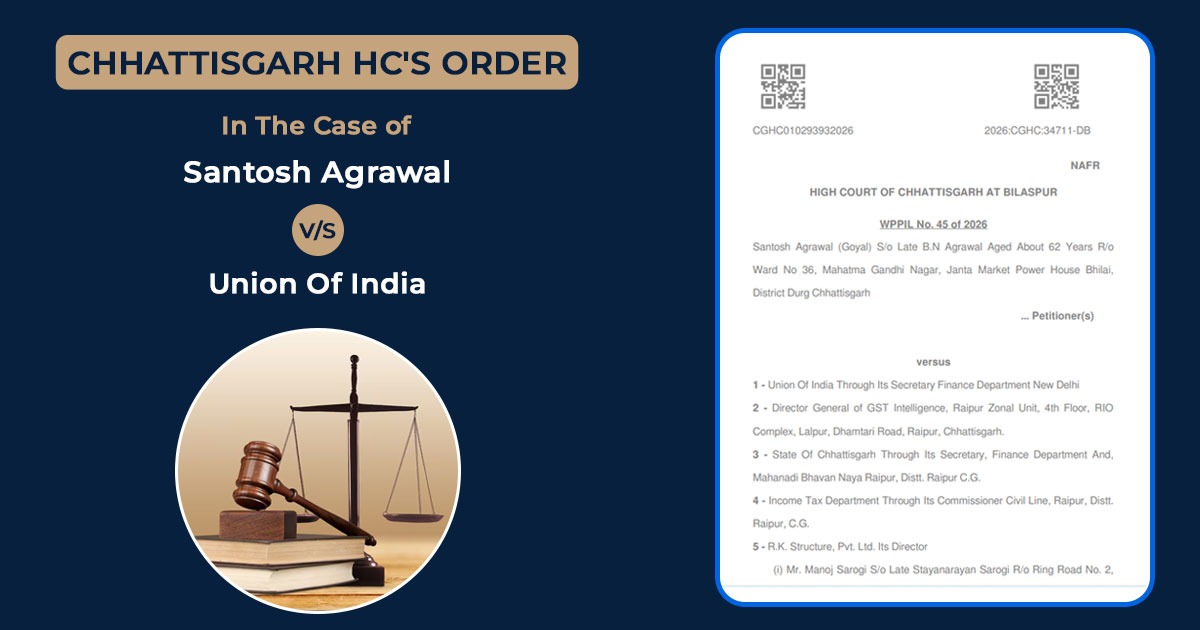
In a ruling, the Chhattisgarh High Court determined that a Public Interest Litigation (PIL) cannot be utilised to request court supervision over investigations related to Goods and Services Tax (GST) and Income Tax against specific private parties, unless there is evidence indicating a failure to fulfil statutory duties or the presence of malintent.
A PIL had been submitted by the applicant Santosh Agrawal asking for directions to GST and Income Tax authorities to perform an impartial, independent, and time-bound investigation into alleged large-scale tax evasion by R.K. Structure Pvt. Ltd., R.K. Ispat Trading Company and R.K. Ispat Udyog.
The petitioner requested the analysis of their business transactions, GST returns, books, invoices, e-way bills, and other records, as well as the recovery of any statutory dues found payable.
The applicant complained to the GST officers in November 2022 and supplied documents concerning alleged unrevealed scrap transactions. He stated that the material exhibited GST evasion of over Rs 11 crore and estimated income tax evasion of surpassing Rs 18 crore. The pleadings recorded that GST authorities had started investigations and issued summons to several people.
The counsel of the applicant stated that the petition was submitted merely in public interest to assure a impartial and time-bound investigation. They said that the petitioner had earlier submitted the writ petition and had been dismissed for the absence of locus standi without determining the tax-evasion allegations on merits.
The counsel of the revenue said that the PIL was not kept because the applicant does not have any personal or legal interest in the transactions. They said that the tax obligation and commercial records need to be analysed by regulatory authorities. As per revenue, the applicant had no enforceable right to track the investigation or receive confidential investigation material.
Also Read: SC Declines PIL Challenging TDS Deduction Obligation on Private Employers
The Division Bench Chief Justice Ramesh Sinha and Justice Ravindra Kumar Agrawal said that only explaining a petition as a PIL does not make it a genuine public cause. The court said that tax liability and the quantum of any evasion should be decided by the authorities under the GST and Income Tax laws.
The court stated that “Public Interest Litigation is an extraordinary jurisdiction evolved to protect the rights of the poor, disadvantaged and marginalised sections of society and to remedy genuine public wrongs. It cannot be permitted to become an instrument for settling private disputes or for supervising statutory investigations merely because allegations of irregularities have been made.”
No material has been discovered by the Court which shows failure of statutory powers or mala fides. It quashed the PIL at the threshold and ordered confiscation of the security amount deposited by the applicant.
| Case Title | Santosh Agrawal Vs Union Of India |
| Case No | WPPIL No. 45 of 2026 |
| Counsel For Petitioner | Sammith S., Advocate |
| Counsel For Respondent | Mr R.K.Mishra, Mr Maneesh Sharma, Mr P.K.Bhaduri, Ms Ankita Gourha, Mr Amit Choudhari |
| Chhattisgarh High Court | Read Order |