

The GST Composition Scheme was introduced to reduce the compliance burden on small taxpayers by providing an easier tax filing procedure and lower tax rates. Under the Composition Scheme, registered businesses are required to file CMP-08 quarterly for tax payments and GSTR-4 annually, while maintaining accurate records and ensuring timely tax payments.
Despite the seamless framework, many small businesses face issues in computing tax liability, preparing returns manually, tracking due dates, and avoiding filing errors.
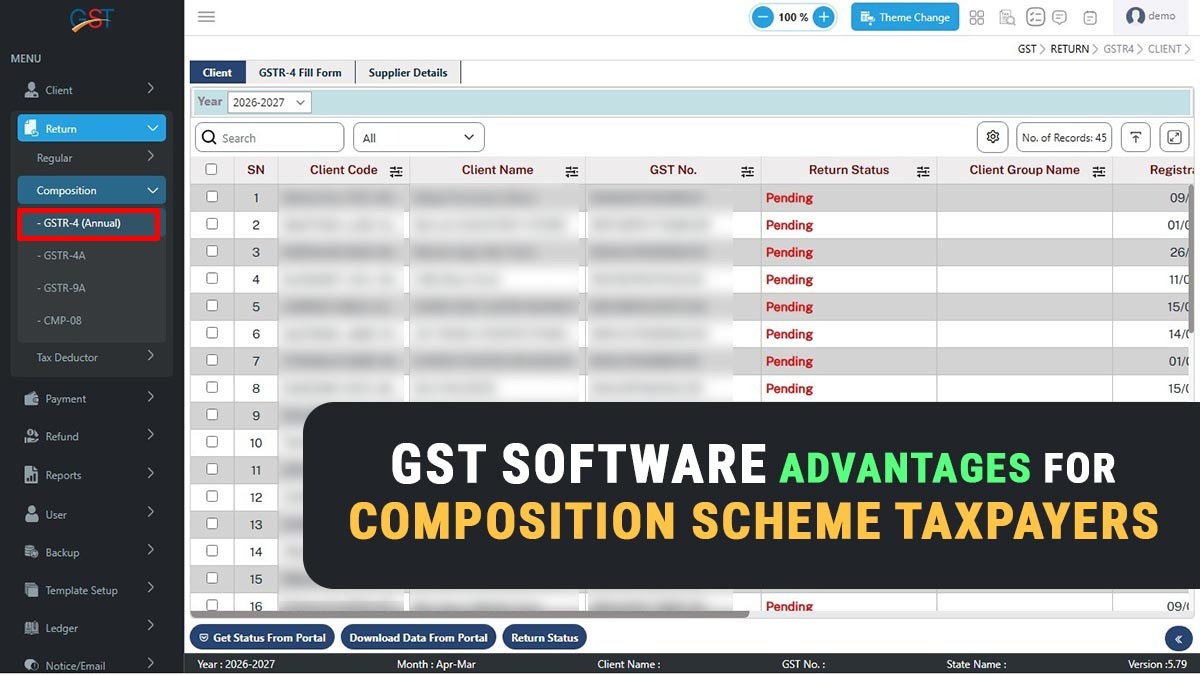
GST software is a useful tool for composition dealers; it automates calculations, eases return preparation, and supports taxpayers in adhering to the GST norms.
The blog illustrates the benefits provided to taxpayers under the GST software within the composition scheme via a practical case study, and compares the manual filing procedure with the software-based filing for CMP-08 and GSTR-4.
What is the GST Composition Scheme?
The Composition Scheme is for small businesses that meet GST’s turnover thresholds. Under this program, businesses are subject to a fixed tax rate calculated on their sales. They have no obligation to keep detailed GST records like regular taxpayers.
Composition taxpayers required to file:
- CMP-08: Quarterly statement-cum-challan for tax payment
- GSTR-4: Annual return for composition taxpayers
Despite less stringent compliance demands, mistakes in filings or delays can still lead to fines and notices.
CMP-08 Filing for Composition Scheme Taxpayers: Manual V/S GST Software
Composition scheme taxpayers are required to file CMP-08 every quarter and GSTR-4 yearly. The adoption of GST software has simplified compliance by automating key tasks like calculations, return preparation, and error checking, a significant improvement over manual filing for numerous small businesses.
CMP-08 Filing Comparison: Manual vs. GST Software
CMP-08 is a quarterly statement-cum-challan that composition taxpayers use to declare their self-assessed tax liability and pay taxes.
Step 1: Collect Sales Data
Manual Filing Process: The taxpayer manually collects quarterly sales invoices and computes total turnover. For instance, if the turnover from April to June is ₹10,00,000.
GST Software Filing: The software imports invoices and sales records from billing entries, generating turnover without manual compilation.
Step 2: Compute Tax Liability
Manual Filing Process: The taxpayer manually computes the composition tax liability. For example, ₹10,00,000 × 1% results in a GST liability of ₹10,000. It needs manual verification.
GST Software Filing: The software computes the composition tax as per the applicable GST rates, reducing calculation errors.
Step 3: Log in to the GST Portal
Manual Filing Process: The taxpayer manually logs into the GST portal and opens CMP-08.
GST Software Filing: Various GST software solutions integrate with the GST portal, easing the login and filing procedure.
Step 4: Enter Details
Manual Filing Process: Manually, the taxpayer inserts turnover details, tax amounts, and interest values into the portal, which can cause incorrect entries or mismatches.
GST Software Filing: The software prepares CMP-08 in the required GST format, with values pre-filled.
Step 5: Error Checking
Manual Filing Process: Errors are determined only during or after filing, increasing the possibility of notices or penalties.
GST Software Filing: The software checks entries and shows missing values, incorrect tax amounts, duplicate records, and inconsistencies before filing.
Step 6: Generate Challan & Payment
Manual Filing Process: A challan is generated by the taxpayer manually and paid via net banking or other methods.
GST Software Filing: The software eases challan generation and supports direct payment integration with the GST portal.
Read Also: How GST Software Simplifies the Challan Facility for Taxpayers
Step 7: Submit Return
Manual Filing Process: The taxpayer validates and files CMP-08 via digital signature certificate (DSC) or one-time password (OTP) authentication.
GST Software Filing: The taxpayer reviews the prepared return and files it electronically through the integrated filing features.
Issues with Manual CMP-08 Filing
- Manual Tax Calculation Errors
- Incorrect Turnover Reporting
- Difficulty Tracking Due Dates
- Time-Consuming Data Entry
- Missed Interest Calculations
- Data Mismatch Issues
- Late Fees Due to Delayed Filing
- Lack of Automatic Record Backups
GSTR-4 Manual Filing vs. GST Software Filing
GSTR-4 is an annual return and is filed by composition taxpayers, who have consolidated business and tax information.
Step 1: Collect Annual Records
Manual Filing Process: The taxpayer manually compiles the details of annual turnover, purchase records, tax payments, and CMP-08. It may require several days.
GST Software Filing: The software collects all quarterly CMP-08 records, invoices, and annual transaction information from its database.
Step 2: Match Quarterly Data
Manual Filing Process: Manually, the taxpayer validates that the details of CMP-08 match the annual turnover figures, which may cause errors.
GST software filing: The software reconciles quarterly tax payments with annual turnover and fetches any discrepancies.
Step 3: Enter Data in GSTR-4
Manual Filing Process: All the information about the business, i.e., turnover, inward supplies, and tax payment, is entered manually into the GST portal.
GST Software Filing: Many GST software solutions auto-populate annual turnover, inward supplies, tax liability, and payment details directly into GSTR-4.
Step 4: Error Detection
Manual Filing Process: Through the manual procedure, errors like duplicate entries, incorrect turnover, and missing inward supply information might not get noticed.
GST Software Filing: The software automatically verifies records and fetches the missing transactions, duplicate entries, and filing inconsistencies.
Step 5: Return Preparation
Manual Filing Process: The annual return takes a lot of time and effort to prepare manually.
GST Software Filing: In a GST-compatible JSON format, GSTR-4 can be generated automatically.
Step 6: Final Verification and Filing
Manual Filing Process: After a manual check, the taxpayer submits the return electronically through the GST portal.
GST Software Filing: After validating the auto-prepared return, the taxpayer uploads it via the integrated GST filing features.
Advantages of Using GST Software for CMP-08 and GSTR-4 Filing
- Ease Quarterly and Annual GST Compliance.
- Reduces Manual Errors in Tax Calculations and Reporting.
- Saves Time in Preparing Returns.
- Delivers Automated Reminders for Due Dates.
- Improves Precision Via Automatic Validations.
- Maintains Secure Digital Records and Backups.
- Allows Faster Return Filing Via GST Portal Integration.
- Helps Avoid Penalties Due to Delayed or Incorrect Filings.
GST software streamlines the management of CMP-08 and GSTR-4 for composition taxpayers compared to manual processes.
Case Study: Sharma Kirana Store
Let’s consider the example of Sharma Kirana Store, a small grocery business located in Jaipur, Rajasthan. The business has an annual turnover of ₹45 lakhs and is registered under the GST Composition Scheme. As a result, it is required to file CMP-08 quarterly and Form GSTR-4 annually.
Initially, with the use of spreadsheets and the GST portal, the owner managed GST compliance manually. This manual process has various challenges, including incorrect tax calculations, challenges in matching turnover details, delayed return filings, and frequent data entry errors when preparing CMP-08 and GSTR-4 forms.
For example, at the time of filing CMP-08 manually, the owner is required to calculate the quarterly turnover and composition tax liability separately before entering the information into the GST portal. Likewise, compiling yearly records and reconciling quarterly tax payments for GSTR-4 filing was a time-consuming task.
Further, the business chose GST software, which eases the compliance process by computing tax liabilities, preparing returns, maintaining records, and sending filing reminders. The CMP-08 and GSTR-4 data were auto-populated, reducing manual work and filing errors.
Consequently, Sharma Kirana Store obtained precise GST return filings, saved time, avoided penalties, and managed GST compliance perfectly under the composition scheme.
Impact of GST Software
After choosing the GST software, the business experienced:
- A 70% reduction in compliance time.
- Improved filing accuracy.
- Timely submissions of CMP-08 and GSTR-4.
- Better management of business records.
- Reduced stress during GST return periods.
Now the owner does not need to keep multiple spreadsheets or worry about manual calculations.
Closure: Even though the GST Composition Scheme is straightforward, those opting for it are still obligated to file CMP-08 and GSTR-4 accurately and on schedule. With manual filing, issues may arise, such as calculation errors, delayed submissions, and poor record management.
GST software supports composition taxpayers in automating tax calculations, organising business records, generating GST returns, and filing forms effectively with minimal effort. The best GST software includes features such as automated validation, return preparation, reconciliation, and due date reminders, which help enhance compliance management for small businesses.
With the use of GST software, businesses can reduce their compliance burden, maintain precision, save time, and avoid penalties under GST norms.