

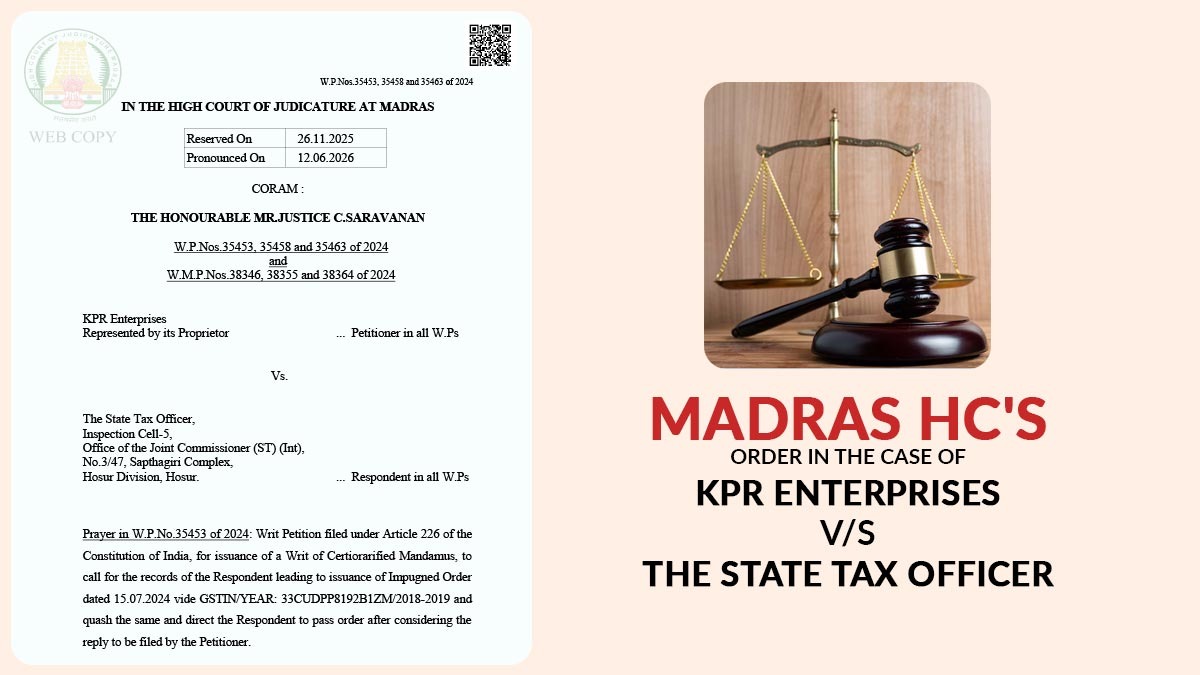
The Madras High Court has upheld GST proceedings initiated against a quarry operator, observing that a mismatch between the seigniorage fees paid for mineral extraction and the value of outward supplies disclosed in GST returns was sufficient to support the tax department’s prima facie view that turnover may have been underreported.
The Court held that such discrepancies provided a reasonable basis for further investigation and adjudication under the GST law.
Justice C. Saravanan dismissed writ petitions of KPR Enterprises for the 2018-19, 2019-20 and 2020-21 tax periods.
“Since the petitioner has paid a huge amount for the seigniorage fee, but has under-declared the value of the outward supply, it is evident that a prima facie case was made out for the invocation of the extended period of limitation under Section 74 of the respective GST enactments, as both under Section 73 and 74 of the respective GST enactments, the expression used is “Where it appears”, the court stated
In July 2024, KPR Enterprises contested the assessment orders. The proceedings arose after an inspection and the issuance of intimation notices and SCNs by GST authorities.
The firm claimed that another contractor, B.T. Nagaraj Reddy, extracted and sold the rock boulders. It claimed that GST had earlier been released. It stated that no incriminating material was discovered at the time of inspection and that it was refused a chance of a hearing.
The department put reliance on seigniorage fee records and estimated the quantity of boulders extracted. Those numbers were used to estimate the value of supplies that, as per the department, had been short-declared in GSTR-1.
The Court observed that the department evaluated the escaped turnover via the National Standard Method.
“It is evident that the respondent has estimated the escaped turnover based on the National Standard Method in order to arrive at the value of supply short declared by the petitioner in the Returns to invoke the machinery under Section 74 of the respective GST enactments,” the court stated.
The Court observed that the SCNs alleged suppression of the value of outward supplies. Those calculations on which the department trusted are also contained in that.
“Thus, there were sufficient materials / foundational facts available for the issuance of a notice under Section 74 to demand tax for the above tax period,” the court mentioned.
The court did not discover any procedural flaws in the manner in which the proceedings were performed. It then dismissed the petitions while granting liberty to pursue the statutory appellate remedy.
| Case Title | KPR Enterprises vs. The State Tax Officer |
| Case No. | W.P.Nos.35453, 35458 and 35463 of 2024 and W.M.P.Nos.38346, 38355 and 38364 of 2024 |
| For Petitioner | Dr.S.Sathyanarayanan |
| For Respondent | Mr V. Prashanth Kiran |
| Madras High Court | Read Order |