

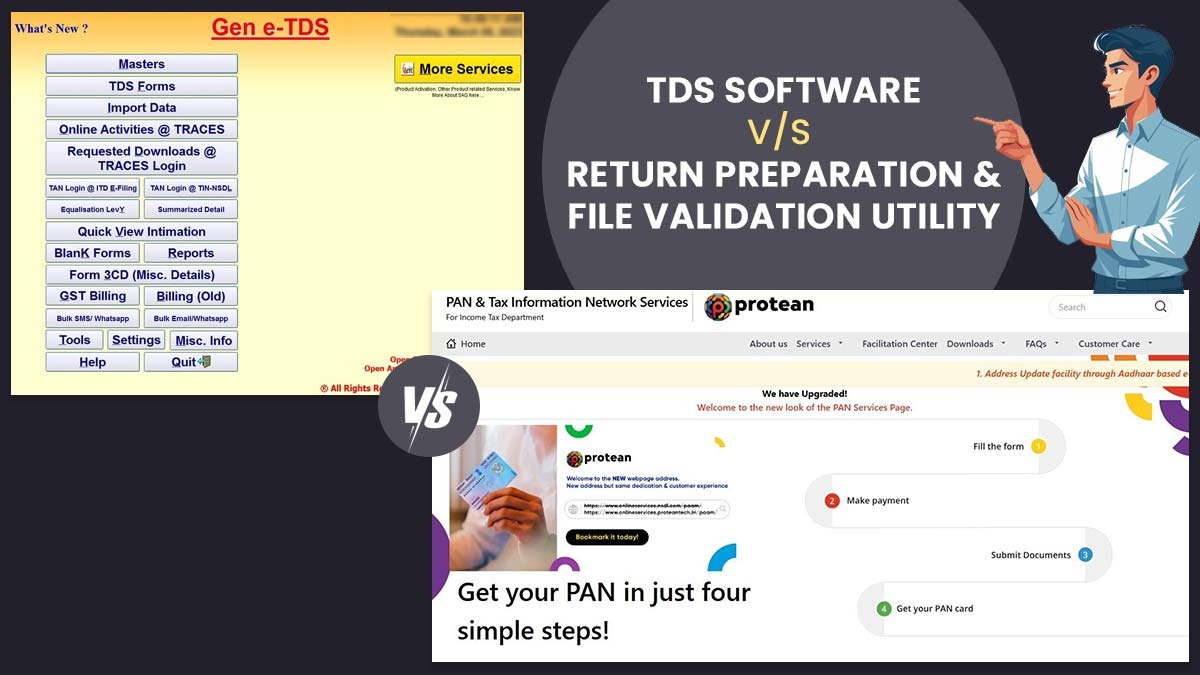
In tax compliance, using precise tools is essential when dealing with Tax Deducted at Source (TDS). Businesses, accountants, and tax professionals often rely on two commonly used solutions: the Return Preparation Utility (RPU) along with the File Validation Utility (FVU), and dedicated TDS software. Both are used for preparing and validating TDS returns, but they differ in functionality, usability, and overall efficiency.
The difference between such tools supports users in selecting the correct solutions as per their needs.
Return Preparation Utility (RPU)
Return Preparation Utility (RPU) is a tool furnished for preparing TDS return files in a specified format. It permits users to enter deductor information, deductee information, and challan data to generate return files. RPU is used to confirm that the return data is made perfectly under the statutory norms.
However, RPU itself does not validate the file. After preparing the return, users need to use another tool, known as the File Validation Utility (FVU), to validate the file before submission.
File Validation Utility (FVU)
The File Validation Utility (FVU) is a tool that supports ensuring that TDS return files, formed using specific software, are correct and ready for submission. It scans for mistakes, such as incorrect formats, missing information, or inconsistencies in the data.
It can be submitted once the file is validated and everything looks acceptable. However, if any errors occur, then the users need to return to the original software to fix the issues and then check the file again. This process of correcting and rechecking can take much time, especially when dealing with large amounts of data.
TDS Software
The TDS return filing software simplifies the handling of Tax Deducted at Source (TDS). It supports you in preparing tax returns as well as proposes features for validating accuracy, making corrections, generating reports, and ensuring you follow the regulations.
Important: How TDS Software Merges Duplicate Deductee Master Data
It is the opposite of the tools that separate these tasks; it integrates everything into one convenient platform. And thus its use will be simpler, particularly for businesses that deal with various transactions and different individuals from whom they deduct taxes.
Main Difference Between RPU/FVU and TDS Software
The major difference between RPU/FVU and TDS software, along with the features, usability, and efficiency, is given below-
Ease of Use
For beginner RPU and FVU can not be easy, as they need technical understanding and manual data handling. Users should comply with the formats and procedures that could be intricate.
The software is made with a user-friendly interface. It eases the procedure with guided workflows, facilitating it for non-technical users.
Functionality
RPU and FVU are basic utilities that have limited features. RPU is utilised for data entry and file creation, while FVU is utilised for validation. They function as separate tools and need manual coordination.
TDS software proposes an all-in-one solution. It permits the users to prepare, validate, and submit the returns within the same system, lessening the requirement for multiple tools.
Data Management
RPU does not provide advanced data management features. Users must maintain records separately, which raises the chance of data loss or duplication.
In contrast, the software offers centralised data storage, allowing for easier management of the deductor, deductee, and transaction records all in one place.
Time Efficiency
Various steps are included in utilising RPU and FVU, such as data entry, file generation, validation, error correction, and revalidation. The same takes much time, particularly when dealing with errors.
It eases the procedure via automating validation and prompting for errors.
Error Handling
Errors in RPU/FVU are identified only after the validation process is completed. Users should manually identify and fix these errors within the RPU.
TDS software delivers real-time error detection and recommendations for correction, making the procedure efficient and lessening the possibility of mistakes.
Other Features
Both RPU and FVU are limited to basic preparation and validation functions. They do not include advanced features such as reporting, tracking return statuses, or generating compliance reports.
On the other hand, the software includes a wide range of features like return tracking, report generation, bulk data import, and integration with other systems, significantly improving overall productivity.
When to Use RPU and FVU
For small businesses or individuals with limited transactions, RPU and FVU may be effective. They are valuable when the volume of data is less, and the user is familiar with the technical process.
They are effective for those who choose the government-provided utilities and do not need advanced features.
When to Use TDS Return Filing Software
TDS software is perfect for medium to large businesses, tax professionals, and organisations that manage high volumes of transactions. It is effective when efficiency, accuracy, and automation are priorities.
Through its advanced features and ease of use, it supports lessening the manual effort and confirms effective compliance.
Closure: For the filing of TDS returns, there are various tools available for recognition, including the Return Preparation Utility (RPU), the File Validation Utility (FVU), and specialised TDS return software. Each of these solutions serves the purpose of facilitating TDS return submissions; however, they differ in functionality, user-friendliness, and overall effectiveness.
The RPU and FVU provide a basic method for preparing and checking TDS returns. However, TDS software offers a complete solution for businesses seeking to simplify their TDS filing process, reduce errors, and save time
Ultimately, the best option for you will depend on the size of your business and your specific needs. By understanding the differences between these options, you can choose the right approach and ensure that your TDS filing process runs smoothly.